

· 23 min read
How to Do an SEO Audit of Any Website (2026 Guide)
Learn how to do an SEO audit of any website in 2026 — technical, on-page, off-page, and AI-search checks — then run a free audit to fix issues fast.
Our audit page fell from the top four to page two for "seo audit" after the March 2026 core update, then came back. Read our 6-step Google core update recovery.

Emre Elbeyoglu · Founder & CEO, SEOmator
16+ years in B2B SaaS SEO and growth
How we know this
Full method ↓ Written up by Emre Elbeyoglu
Google core update recovery means improving what the update judged: check the cause, cut off-topic pages, rebuild core pages, show who's behind the site, clear crawl debt, measure. When the March 2026 update hit seomator.com, it was a disaster; I gave us a 20% chance. We did it anyway: 91% of March's clicks, and "seo audit" back near #3.
"seo audit" shows the whole arc on one page. Ahrefs' checks of Google's US results had our audit page in the top four every time from July 2025 to March 2026. On April 13, 17 days after the March 2026 core update began and five days after it ended, Ahrefs recorded it 19th, and its checks in May, July and August put it between 12th and 15th. Worldwide, its clicks for the term went from 941 in 28 days in March to 148 at the low and 927 in the latest window. How we won back "seo audit" shows what we did to that page.
This Google core update recovery is our own site's, measured in Google Search Console, and no single step is proven to have caused the return. I run SEOmator, and I've worked in B2B SaaS SEO and growth for more than 16 years, at Flatart, Popupsmart, LiveChatAI and now SEOmator. The six steps organize work that overlapped between late June and the end of August, and each change below carries its date. Our case study of the recovery tells the same story from an earlier October window.
You need Search Console access, Google's Search Status Dashboard, a link index, a crawl of your site and a dated log of every change.
A core update is a broad change Google makes to its search systems several times a year, and Google's own guide to core updates says these changes "don't target specific sites or individual web pages." Referring domains are the separate websites that link to a page or site, the count a link index reports.
The main changes before clicks turned ran from late June to the end of August 2026, and clicks turned on August 31. You should be able to read a Performance report, compare two date ranges, and edit redirects or ask someone who can.
Match the drop to the update's official dates, compare equal periods in Search Console, and rule out a manual action before you change anything.
To tell if a core update hit your site, start with the Search Status Dashboard. Most of the nine results we read for this query tell you to confirm the update's dates and compare equal periods. None of them deals with a spam update and a core update landing three days apart, which is what happened in March 2026. Skip this step and you can spend months fixing the wrong thing.
Run the check in this order. Is the drop inside a core update's rollout? If not, look for other causes. If it is, check for a manual action and fix it if you have one. No manual action? Then rule out a migration, lost links and broken tracking. If none of them explains the drop, the evidence points to the core update. Timing alone still can't prove it.
The decline was clear by April 1, five days into the core rollout, not after the spam update. The March 2026 core update began on March 27 and took 12 days and 4 hours to roll out, according to the Search Status Dashboard. Three days earlier, on March 24, Google ran the March 2026 spam update, which took 19 hours and 30 minutes.
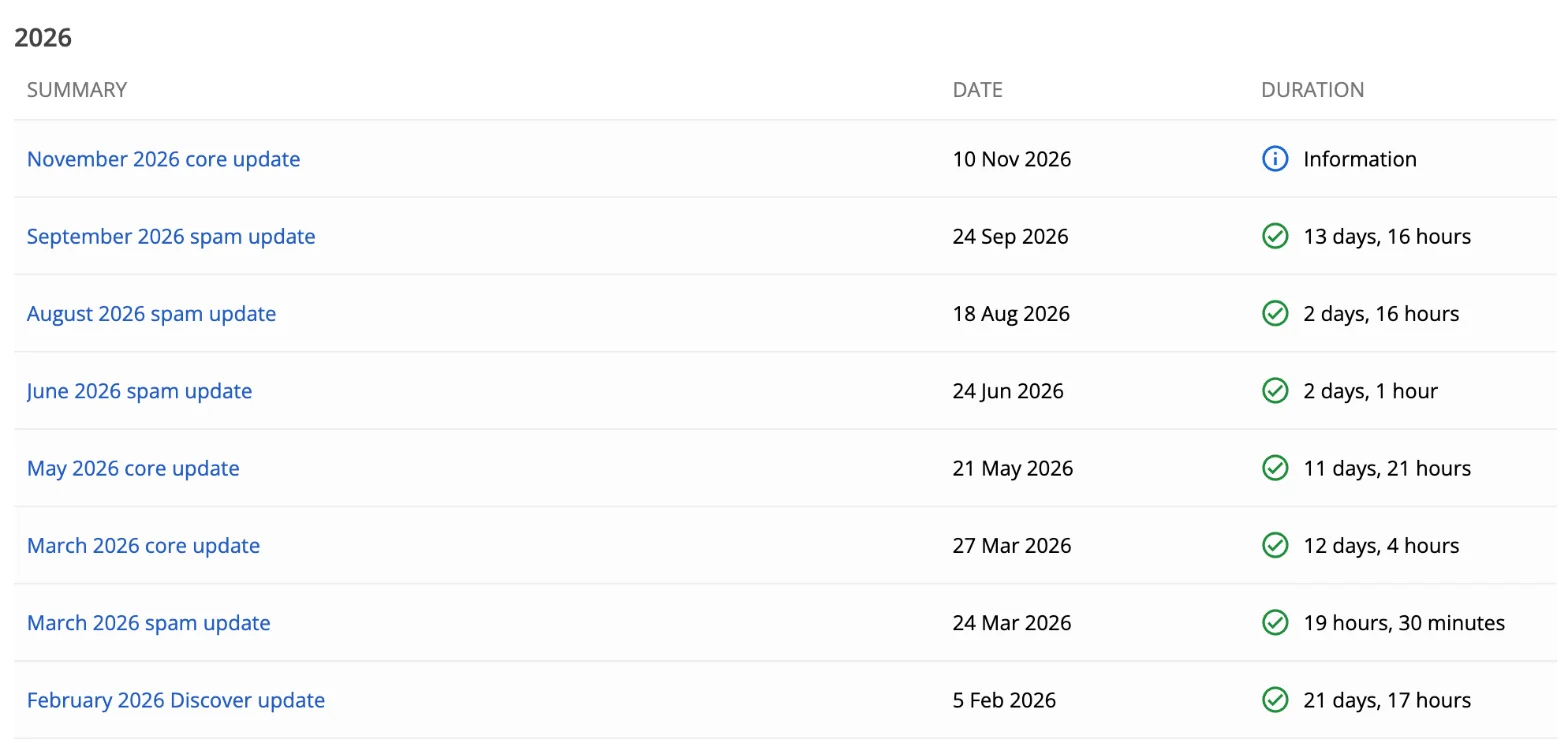
The dashboard lists the ranking updates Google reported in 2026, with a start date for each and a length once it ends, from the February 2026 Discover update (5 February, 21 days 17 hours) to the November 2026 core update, still marked Information on November 13. Google also makes smaller updates it doesn't announce, so a drop outside every listed rollout can still be Google's.
These are seomator.com's Google clicks on the weekdays around both updates.
| Day (2026) | Google clicks |
|---|---|
| Tue 24 March (spam update) | 1,520 |
| Wed 25 March | 1,455 |
| Thu 26 March | 1,490 |
| Mon 30 March | 1,447 |
| Wed 1 April | 1,066 |
| Fri 3 April | 638 |
| Mon 6 April | 750 |
Search Console, sc-domain:seomator.com, web, all countries.
Clicks on 24–26 and 30 March stayed above 1,400, and by April 1 the fall was clear. They kept falling after the May 2026 core update began on May 21: 16,194 clicks in May, 11,925 in June.
Rule out a site migration, a link loss, broken tracking and a manual action before you settle on the update. We moved seomator.com from Webflow to a new build in July, between July 3 and July 22, three months after the fall began, so the migration couldn't have started it.
Ahrefs counted 2,004 referring domains to seomator.com on March 1 and 2,638 on August 1, so the net count grew while clicks fell. A rising total doesn't rule out losing particular links, so read your lost-links report too.
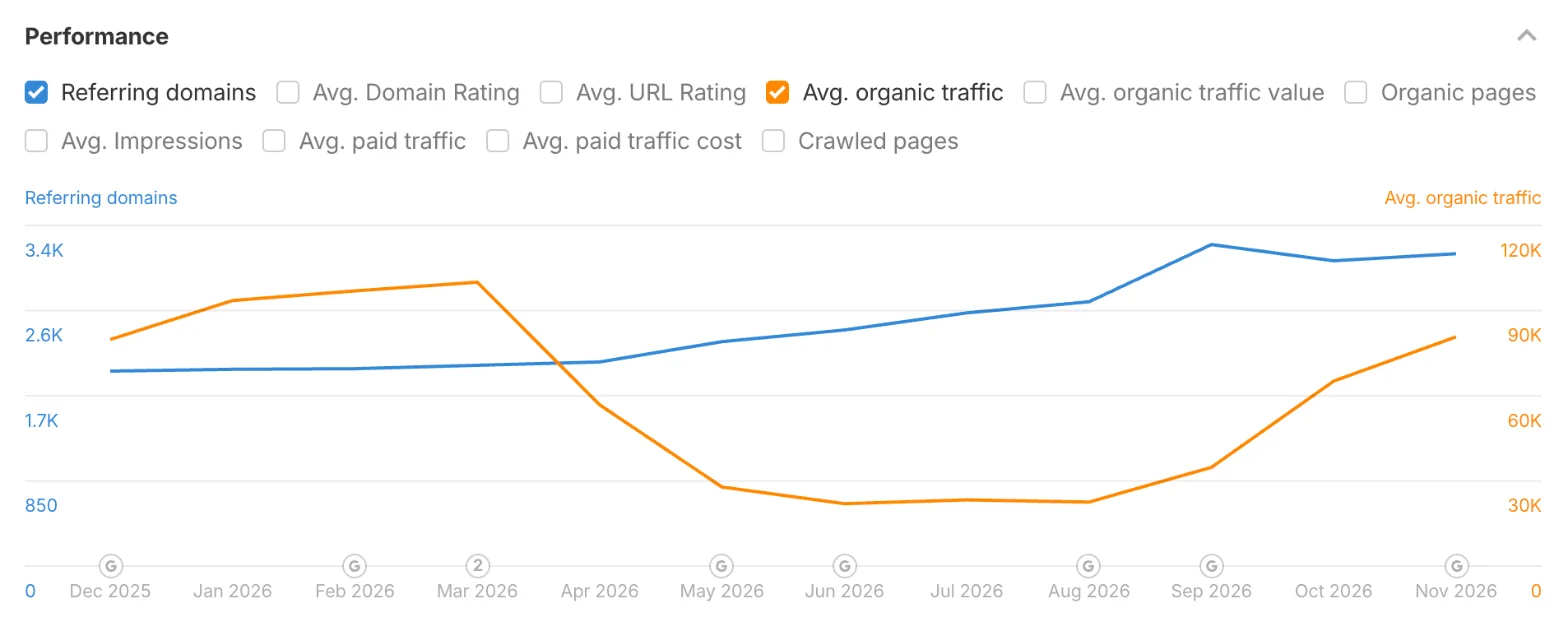
The chart shows 2,004 referring domains in March and 2,638 in August, while Ahrefs' traffic estimate fell from 100,007 to 22,540 a month over the same months. Tracking wasn't the cause either: Search Console counts clicks on Google's side, without our analytics tag.
A manual action is a penalty a person at Google applies to a site, and it shows in Search Console. Google's Manual actions report help says "Google issues a manual action against a site when a human reviewer at Google has determined that pages on the site are not compliant with Google's spam policies." We had none. A core update drop comes with no such notice.
Compare 28-day windows, so each holds four of every weekday and the weekday-weekend swing cancels out. Search Engine Land's guide to core updates advises: "Wait at least a week after the update finishes rolling out before comparing metrics."
We compared three windows: a March baseline (1–28 March, which ends two days into the rollout, before the decline was clear on April 1), the low (20 July–16 August) and now (12 October–8 November). Compare clicks only across April 2026. Google's data anomalies page says "A logging error prevented Search Console from accurately reporting impressions from May 13, 2025 until April 27, 2026", and that CTR and average position were affected while clicks were not. If you doubt the numbers themselves, read how accurate Search Console is.
You can move on once the drop lines up with a rollout and nothing else you checked explains it.
Start with the pages that lost the most clicks, then ask of each one whether it serves a search you sell to.
Most of the nine results we read say to segment the loss by page, country, device or search type. Only three treat off-topic content as a cause. For us, that turned into the biggest part of the work. You come out of this step with a list of what to keep, rebuild or remove, and Steps 3 and 4 work through it.
Open the Performance report, compare two date ranges, and sort the Pages tab by the click difference. Google's Performance report help says the default view shows "the past three months", so set your own ranges. In 1–28 March our third-largest page by Google clicks was a reverse email lookup, with 2,748 of the site's 34,748.
SEOmator audits websites for SEO and AI search. A reverse email lookup has nothing to do with that, and neither did a QR code reader or a post on reverse video search (503 clicks in March). Our llms.txt generator (582) sat closer to the topic, and we folded it into our GEO audit tool.
Google's guide to creating helpful content asks: "Are you producing lots of content on many different topics in hopes that some of it might perform well in search results?" For seomator.com the honest answer was yes. I put it this way in our case study:
We had published blog posts on topics outside our core areas of expertise, and even developed free tools—such as a "reverse email finder"—that were not aligned with our primary focus.
Topical authority is how well a site's pages, taken together, cover one subject with real expertise. I read our drop as a topical authority problem, so we judged seomator.com by site-wide quality signals, such as how much of it served our own topic, rather than page by page.
On July 14, 2026, Ahrefs found that 131 of our 196 English posts, 67%, had no keyword footprint at all. A topical map shows which pages sit on your core topic and which stray from it.
Step 2 is done when every URL on the site carries one label: keep, rebuild or remove.
Improve or merge a weak page first, remove it only when it doesn't belong on the site, and redirect it only when it earned links or was merged, and a relevant page can take it.
Content pruning is removing or merging pages that don't serve a site's readers. Six of the nine results we read cover deleting, merging or improving pages, and Google's core update guide says "Deleting content is a last resort", to be considered only when content can't be salvaged. None of them says how many URLs it removed or what happened to each one, so we give both below. The aim is a smaller site that's clearly about one thing, without throwing away the links it earned.
The whole decision fits in three questions. Is the page on your topic? Rebuild it. If not, has it earned links or been merged into another page? If it has, and a page on the same topic can take it, redirect it there permanently. Otherwise, let it return 410 or 404.
I set the rule in July: a removed page gets a redirect only when it earned links or was merged into another post. Merged content goes to the post it was merged into; a linked page goes to the closest page on its topic, and if there is none, it gets no redirect. The rule took effect with the July 14 removals. Google's redirects guide recommends "a permanent server-side redirect whenever possible" when a page's URL changes.
Let a removed page with no successor and no links return 410 (gone) or 404. Google's HTTP status codes guide says "All 4xx errors, except 429, are treated the same: Google crawlers inform the next processing system that the content doesn't exist." We used 404 in July and August; on August 29 we marked 168 missing paths as gone, and 162 of them answer 410 (Step 6).
For the three off-topic tools removed on August 20, I chose deletion over noindex, and no redirect at all. Sending people who wanted an email lookup to an SEO page they never asked for would have kept the problem alive. One result we read suggests redirecting such pages to the blog index; we didn't.
These were the largest removals, by date, and how we handled each one.
| Date (2026) | Removed | How |
|---|---|---|
| 14 July | 35 posts | 23 merged into surviving posts with a permanent redirect, 12 left to 404; the commit records 0 referring domains lost |
| 20 July | 28 English and 28 German posts | 19 URLs with referring domains redirected, the other 37 left to 404 |
| 3 August | 5 tools and 5 posts | Link extractor, cache-date checker, UTM generator, email extractor, QR code reader |
| 20 August | 3 tools | Email verification, reverse email lookup, website hosting checker: 404, no redirect |
| 24 August | 1 tool | Website technology checker: 404, no redirect |
| 29 August | llms.txt generator | Redirected into our GEO audit tool |
Source: seomator.com's git history. Counting these and smaller removals, English posts went from 196 before July 14 to 99 by August 31.
The llms.txt generator now points at our GEO audit tool, which checks the same thing among others. Google's AI Overview for this query advised on November 12 not to mass-delete pages unless they are "truly unsalvageable". We read off-topic pages as exactly that: no rewrite makes a reverse email lookup about SEO audits. Glenn Gabe's core update case study describes another site that "dropped by 41% in the fall of 2023" and then removed "38% of their editorial content in one fell swoop".
Before you move on, check every removed URL. It should answer with a redirect to a same-topic page, a 410 or a 404, and no internal link should point at it.
Rebuild the pages that carry your core topic until they serve the search better than what outranks them. A new date on an old page isn't a rebuild.
All nine results we read say to improve the content itself, and six say to match search intent. Both are right, and neither tells you what to change first. So I'll show you one page we rebuilt, before and after.
Search your page's main query and read the pages above you. In August, the results above our free SEO audit tool had moved to audits that cover both SEO and AI search visibility, while our page said nothing about AI search. Its 13,348 words were mostly a generic essay about audits, not the tool.
We rebuilt the free SEO audit tool on August 10, 2026. Before and after:
| Part of the page | Before (until 10 August 2026) | After (10 August 2026) |
|---|---|---|
| Title | Free SEO Audit Tool: Website SEO Analysis 2026 (NEW v2 SEO Audit) | Free SEO Audit Tool — 172 Checks + AI Visibility - SEOmator |
| The audit form | Inside an iframe of a separate app marked noindex | In the page's own served HTML |
| Length | 13,348 words | 4,667 words |
| Who stands behind it | No byline | A named reviewer |
| Number of checks | Not stated | 172, the number the free tool runs |
Source: seomator.com's git history and changelog.
The old page had no form or input in its own HTML: the audit lived in an embedded app marked noindex. Google's JavaScript SEO basics notes that server-side or pre-rendering "makes your website faster for users and crawlers, and not all bots can run JavaScript." The new page puts a working form in the HTML Google receives.
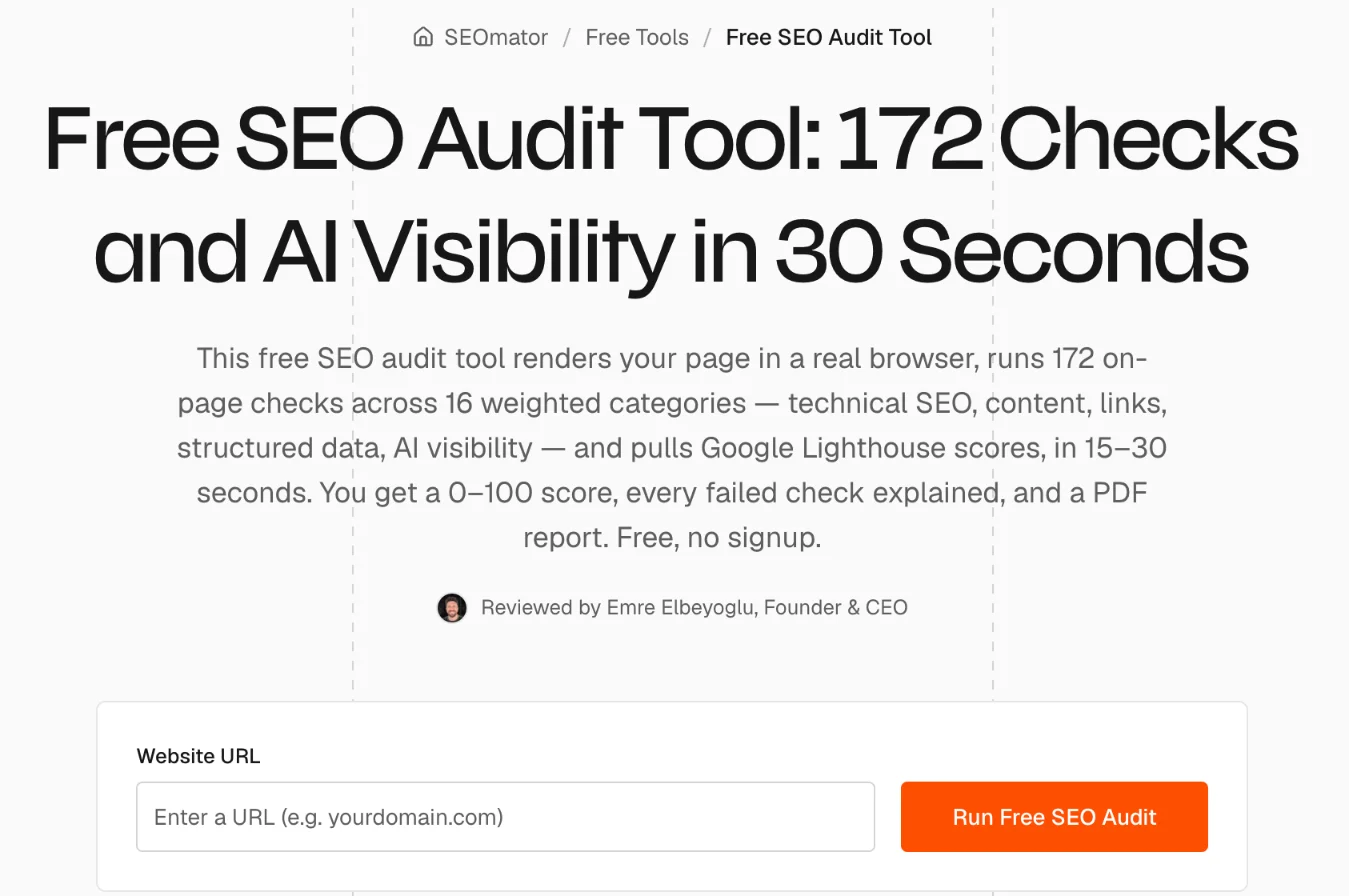
The page now opens with what the tool does: 172 checks across 16 weighted categories, in 15–30 seconds by its own description, with a 0–100 score, a named reviewer and the form itself.
The title changed too. Google's guide to title links asks site owners to write "descriptive and concise text" for their <title> elements. The old title named a year and a version; the new one names what the page does.
We rebuilt about 20 of our other free SEO tools to the same standard between July 22 and September 5, and rewrote blog posts around studies we ran ourselves instead of borrowed statistics.
A rebuilt page is finished when it answers its query in the opening and shows evidence no other result has.
Make it plain who writes, who reviews and which company stands behind the site, and remove every claim you can't prove.
E-E-A-T stands for experience, expertise, authoritativeness and trustworthiness, the qualities Google's quality raters look for. Six of the nine results we read cover it, and three name bylines, author bios or an About page. The part that's easy to skip is auditing your own site for claims that were never true, and we found several.
Google's post on E-E-A-T asks whether content "demonstrate[s] that it was produced with some degree of experience". Its helpful content guide adds: "Of these aspects, trust is most important." What we shipped, by date:
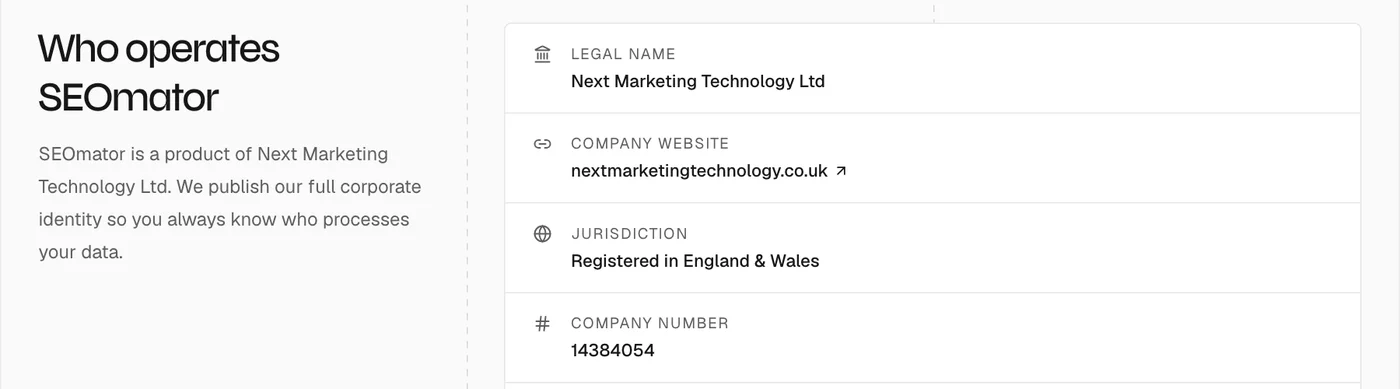

seomator.com/trust-center, "Who operates SEOmator", captured November 13, 2026.
Our E-E-A-T checklist covers the rest: bylines, author pages and sources.
The test for this step: could a stranger check every person, company and number on your site?
Fix the URLs Search Console can't find, then measure against your baseline in windows of the same length.
Most of the nine results we read end with advice to monitor, iterate and compare periods in Search Console or analytics. None of them mentions a 410 status or compares three 28-day windows. Broken URLs are noise, and noise hides whether Steps 2 to 5 moved anything.
Crawl debt is our shorthand for what a site leaves broken: links to pages that no longer exist, chains of redirects and canonicals that point at a redirect. Ours came in three parts:
Google's Page indexing report help treats "a 404 for a page that you've removed and have no replacement for" as a normal reason a URL isn't indexed. Choosing between 301 and 410 status codes came down to one question: does the page have a live equivalent? For canonicals, Google's guide to consolidating duplicate URLs says to keep "the information about the canonical URL" as clear as possible.
Google clicks came back to 91% of the March baseline. Three 28-day windows for the whole site:
| 28 days (2026) | Google clicks |
|---|---|
| 1–28 March (baseline) | 34,748 |
| 20 July–16 August (the low) | 10,887 |
| 12 October–8 November (now) | 31,609 |
Search Console, sc-domain:seomator.com, web, all countries.
Between the low and now, both after Google's logging fix, impressions fell from 6.76M to 5.39M while click-through rate (CTR) rose from 0.16% to 0.59%. The site showed for fewer searches and earned the click far more often.
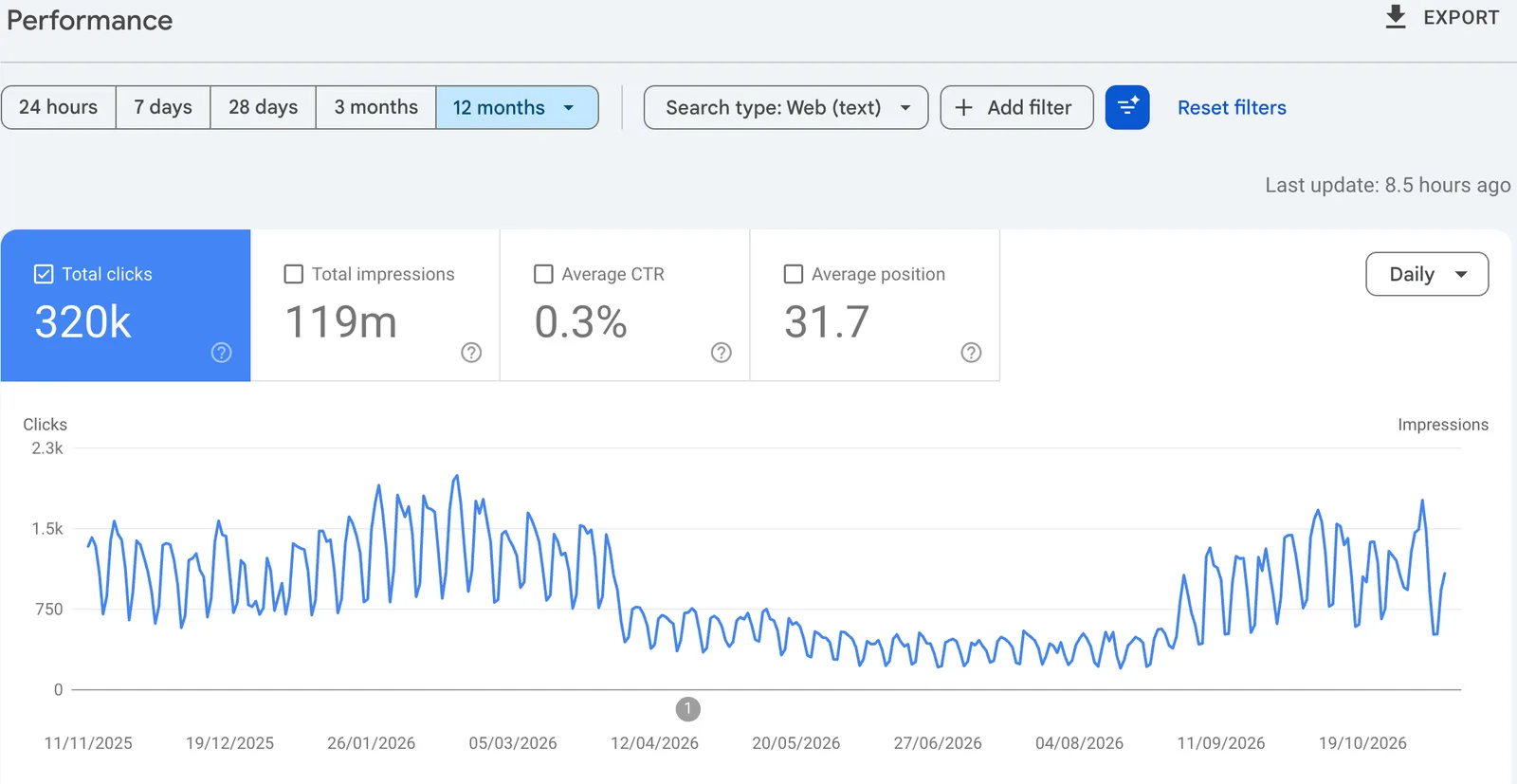
The report shows 320k clicks over the 12 months to November 2026. Its other totals, 119m impressions, 0.3% CTR and an average position of 31.7, include months inside Google's logging error, so we read only the click line. The turn came on Monday, August 31: 826 clicks against 472 the Monday before, then 1,069 on September 1 and 1,242 on September 7. The Search Status Dashboard lists no core update then, only spam updates from August 18 and September 24.
The sign to watch is the same 28-day window, read the same way, rising week after week. It shows that clicks moved, not which change moved them.
Our audit page won back "seo audit" after we rebuilt it around the tool, cut the off-topic pages around it and linked to it from our main pages. Worldwide, its clicks for the term are back to 99% of March.
"seo audit" is the head term for our free SEO audit tool, and Google's results for it are crowded with bigger sites. We read its record two ways: Ahrefs' checks of Google's results, and Search Console's clicks.
Ahrefs had the page in Google's US top ten in all ten of its checks from January 2024 to March 2026, and in the top four in all six checks from July 2025 to March 2026. Each Ahrefs figure is one check of the results, not an average.
| Ahrefs checks, US | Positions |
|---|---|
| January and July 2024 | 10, 7 |
| January and April 2025 | 2, 10 |
| July 2025 to March 2026 (6 checks) | 4, 3, 4, 2, 2, 3 |
| April to August 2026 (5 checks) | 19, 12, 1, 15, 14 |
| September to November 2026 (3 checks) | 6, 6, 4 |
Ahrefs Site Explorer, organic keywords for seomator.com, US, one check in each listed month. Check dates are under "How did we measure this?".
Clicks are the one measure Search Console reported correctly before and after its logging error, so the long view is in clicks.
The page earned 766 to 1,308 clicks a month for "seo audit" from August 2025 to March 2026. It fell to 354 in April and 120 in June 2026, then rose to 572 in September and 905 in October, 86% of March.
The same three 28-day windows as Step 6, narrowed to this page and this query:
| "seo audit", the audit page | 1–28 March | 20 July–16 August | 12 October–8 November |
|---|---|---|---|
| Clicks, all countries | 941 | 148 | 927 |
| Clicks, India | 454 | 53 | 517 |
| Clicks, US | 119 | 8 | 69 |
| Average position, US | Not comparable (logging error) | 12.5 | 5.5 |
Search Console, page-level rows for seomator.com/free-seo-audit-tool, query "seo audit".
Worldwide the page is back to 99% of its March clicks for the term, and India, its largest market, is above March. The US is at 58%. There the page's average position went from 12.5 at the low, outside the top ten, to 5.5, and held between 4.3 and 4.8 each day from October 28 to November 10.
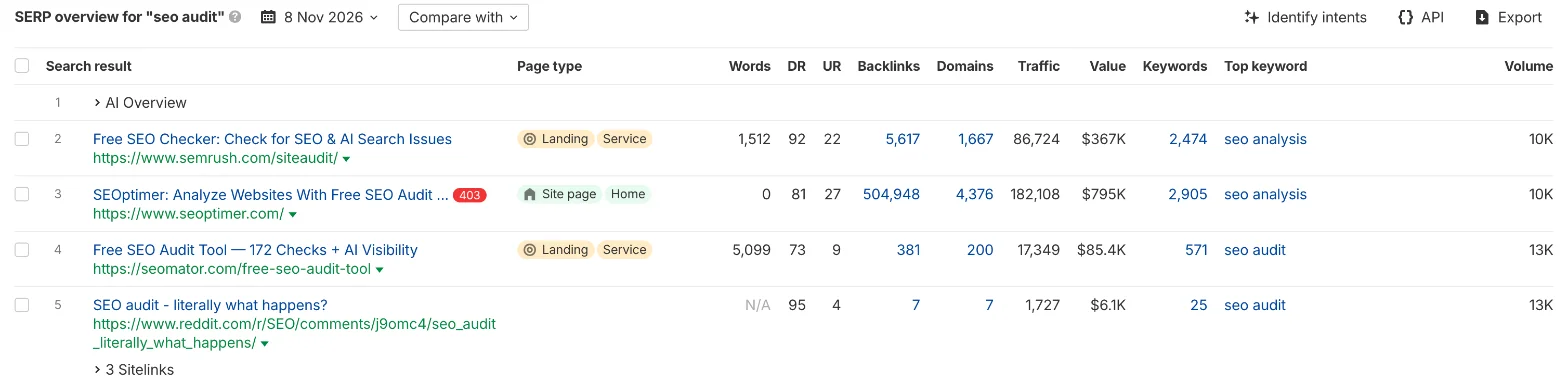
Ahrefs' snapshot of the US results on November 8 shows the order: an AI Overview, Semrush's page, SEOptimer, then ours. Our page ranks there with links from 200 domains, against 1,667 for Semrush's page and 4,376 for SEOptimer's. Four days later, on November 12, a check of the same US results put our page third, behind SEOptimer and Semrush: the place Ahrefs recorded on March 18, nine days before the update began. Single checks move by a place or two; Search Console's daily average for the page stayed between 4.3 and 4.8 over those two weeks.
Read the page-level row, not the query average. Google's explanation of the metrics says the position shown is "the topmost position occupied by a link to your property or page in search results, averaged across all queries in which your property appeared." Search Console's query-level average for "seo audit" over 12 October–8 November reads 18.2; for one page's position, read that page's row.
We worked on five things for the page and the site around it, several of them at the same time.
The page's clicks for the term fell from 1,052 in March to 354 in April, as the whole site's clicks fell, while the site's referring domains grew. We read that as a site-wide problem first, and checked the page itself second.
In August the results above us covered both SEO and AI search visibility. Our page said nothing about AI search, and its 13,348 words were mostly an essay about audits, not the tool.
On August 10 we put the audit form in the page's own HTML, cut the page to 4,667 words, named the 172 checks and AI visibility in the title and added a named reviewer (Step 4).
Between July 14 and August 31 we cut our English posts from 196 to 99 and removed ten tools. On August 29 we redirected or marked as gone the URLs Search Console couldn't find (Steps 3 and 6).
We linked to it from our homepage on October 7, our About page on October 8 and our event pages on October 19, and on October 20 added a header field that runs the audit.
Clicks for the term rose in September, as the whole site's did, after the rebuild and the cleanup; the internal links came in October, once the rise had begun. I won't credit any single change with the return. We changed too much at once, while Google kept re-ranking. We don't rank first for "seo audit", and the US hasn't fully come back.
To audit your own page and check where it ranks for one query:
Expect weeks to months, with no guaranteed result.
Search Engine Land's guide puts it this way: "Recovery from a core update is usually a gradual process, with small improvements accumulating over several weeks or months." seomator.com's clicks turned five months after the fall began, three weeks after the audit page rebuild and two days after the URL cleanup, with no announced core update running.
What we saw at each stage:
| Stage (2026) | What we saw |
|---|---|
| Rollout, 27 March onward | Clicks clearly lower by April 1 |
| May core update, from 21 May | Clicks kept falling: 16,194 in May, 11,925 in June |
| Changes, late June to end of August | Clicks flat, 10,887 in the 20 July–16 August window |
| Turn, 31 August | 826 clicks against 472 the Monday before |
| 12 October–8 November | 31,609 clicks, 91% of the March baseline |
Search Console, sc-domain:seomator.com, all countries.
Not every page came back. Our domain authority checker now brings more Google clicks than any other page on the site, and three tools are still well below March. Google clicks to the tool pages named in this post, March against now:
| Page | 1–28 March | 12 October–8 November |
|---|---|---|
| Domain authority checker | 623 | 9,590 |
| Free SEO audit tool | 9,202 | 8,908 |
| Sitemap finder | 4,091 | 3,476 |
| Meta tags checker | 1,688 | 529 |
| Website crawl test | 1,470 | 513 |
| Mobile-friendly test | 822 | 259 |
| Reverse email lookup | 2,748 | Removed |
Search Console, sc-domain:seomator.com, all countries.
We used five tools, and only Ahrefs costs money.
| Tool | What we used it for | Price | Best for |
|---|---|---|---|
| Google Search Console | Clicks, positions, missing URLs | Free | Measuring the drop and the return |
| Google Search Status Dashboard | Ranking update dates and lengths | Free, public | Confirming which update hit you |
| Ahrefs | Referring domains | Starter $29 a month, Lite $129 a month (billed monthly, checked November 12, 2026) | Deciding which removed URLs deserve a redirect |
| git | A dated record of every change | Free and open source | Knowing what you changed and when |
| SEOmator free SEO audit | A first pass over a site's SEO and AI search issues | Free, no account | Finding broken pages, titles and markup |
About Search Console calls it "a free service offered by Google", and git is released under the GNU General Public License.
Thirteen questions people ask about core update recovery, answered from seomator.com's 2026 data.
You recover from a Google core update by improving the site the update judged, not by undoing anything, and no step guarantees a return. Check whether the update caused the drop, remove pages your site shouldn't rank for, rebuild the pages it exists for, show who stands behind it, fix crawl errors, and measure in matching windows.
seomator.com did that in 2026: its Google clicks fell 69% between a March baseline and a July–August low, then reached 91% of March by early November, 28 days each in Search Console. We can't show which of our changes did it.
A Google core update is a broad change to how Google's search systems assess content, made several times a year and announced on the Search Status Dashboard. It doesn't target a site or a page, so a drop after one is a re-ranking rather than a penalty.
Our timeline of Google's algorithm changes shows how the updates have grown. Google announced three core updates in 2025 (March 13, June 30 and December 11) and three in 2026 (March 27, May 21 and November 10).
The last Google core update is the November 2026 core update, which began on November 10, 2026 and was still rolling out on November 12. The Search Status Dashboard lists each ranking update with its start date and, once it ends, its length.
These are 2026's ranking updates on the dashboard:
| Update (2026) | Started | Length |
|---|---|---|
| February Discover update | 5 February | 21 days 17 hours |
| March spam update | 24 March | 19 hours 30 minutes |
| March core update | 27 March | 12 days 4 hours |
| May core update | 21 May | 11 days 21 hours |
| June spam update | 24 June | 2 days 1 hour |
| August spam update | 18 August | 2 days 16 hours |
| September spam update | 24 September | 13 days 16 hours |
| November core update | 10 November | Rolling out on 12 November |
Google Search Status Dashboard, read November 12, 2026.
There's no fixed Google core update recovery time: effects can show within weeks or take months, and there's no guaranteed recovery. A site still flat after a few months may be waiting for the next core update.
seomator.com's clicks turned on August 31, 2026, five months after the March 2026 core update began, three weeks after we rebuilt our main tool page and two days after we cleaned up our missing URLs. No announced core update ran then. One site's timing isn't a forecast for another.
Sites can recover between core updates or at the next one, after Google's systems reassess real changes. seomator.com's clicks rose on August 31, 2026, with no announced core update running, and reached 91% of March by early November.
Wait at least a week after a rollout ends before you judge any change, and compare windows of the same length. A recovery read during a new rollout can reverse within days.
No, Google announced no core update in October 2026. The September 2026 spam update began on September 24 and took 13 days and 16 hours, so it ended in early October. The next ranking update was the November 2026 core update, from November 10.
If your traffic moved in October, look at the spam update's dates, at seasonal demand and at your own changes before you assume a core update. seomator.com's clicks held through October, in a range of about 600 to 1,700 a day, weekends included.
For seomator.com, no: clicks kept falling after the May 2026 core update began. Our monthly Google clicks were 38,372 in March, 18,896 in April, 16,194 in May and 11,925 in June, according to Search Console.
We had made none of our main changes yet; the first post removals came on July 14. We can't separate the May update's effect from the March one's in this data, and we didn't see a later update reverse an earlier one by itself.
Delete a page after a core update only when it doesn't belong on your site; improve or merge the rest. We deleted pages that served searches we don't sell to, such as a reverse email lookup with 2,748 clicks in March, and rebuilt thin pages on our own topic.
Give a removed page a permanent redirect when it has its own referring domains or was merged into another page, and a relevant replacement exists: the post it was merged into, or the closest equivalent page. Without one, let it return 410 or 404. By August 31, 2026 we had gone from 196 English posts to 99 and removed ten tools.
Recover a lost keyword ranking by making the page the best answer for the query again, then giving Google time to reassess it: read what outranks it now, fix what the page lacks, remove what doesn't belong on your site and link to the page from your main pages.
Our free SEO audit tool's US average position for "seo audit" went from 12.5 in the 20 July–16 August window to 5.5 in 12 October–8 November, by Search Console's page row. Worldwide, its clicks for the term came back to 99% of March.
No, a core update drop is not a manual action, the penalty Google applies when a human reviewer finds pages that break its spam policies. Search Console's Manual actions report lists those, and seomator.com had none through its 2026 drop.
A core update re-ranks pages across the web, and a page that falls may be outranked by pages that serve the search better. If the Manual actions report is empty, treat the drop as a quality and relevance question, and keep checking technical causes, migrations and demand alongside it.
More backlinks did not protect seomator.com from a core update drop. Ahrefs counted 2,004 referring domains to our site on March 1, 2026 and 2,638 on August 1, while our 28-day Google clicks went from 34,748 in the March baseline to 10,887 by mid-August.
A core update judges whether the site serves the searches it ranks for, and our growing link count didn't stop the fall. Spend the first effort on what the site publishes, and use your link data to decide which removed pages deserve a redirect.
A site migration can cause a traffic drop of its own, and the dates are the first thing to check. A migration problem tends to show around the cutover, when redirects, canonicals or rendering break; a drop that starts inside a rollout window points to the update. Neither rule settles it alone.
seomator.com moved from Webflow to a new build between July 3 and July 22, 2026, three months after its clicks began to fall in early April, so the migration couldn't have started the drop. Check your migration anyway, starting with redirects and canonicals.
If your site doesn't recover, keep improving it and keep measuring: a recovery isn't guaranteed, and some pages don't come back. Three of our tools, the meta tags checker, the crawl test and the mobile-friendly test, were still well below March in our latest window.
Check the steps again in order: whether the drop was the update after all, which pages still serve searches you don't sell to, and whether your core pages beat what outranks them now. Effects can still show between updates; if nothing moves for months, the next core update may be the next chance.
Start with what is broken on your own site today: run the free SEO audit tool from the list above on your homepage, then on your biggest losing page, and keep both reports.
The figures come from Search Console, Google's Search Status Dashboard, the site's git history and Ahrefs, read on November 12 and 13, 2026.
Clicks and positions come from Google Search Console for the domain property sc-domain:seomator.com, web search. Days are Google's Pacific-time days. Site totals are Search Console's own totals; page and query rows are top rows and are never added up.
Windows are 28 days, so each holds four of every weekday: 1–28 March, 20 July–16 August and 12 October–8 November 2026. Monthly figures are whole months. The "seo audit" figures are the page-level rows for seomator.com/free-seo-audit-tool, worldwide, in India and in the US; monthly clicks are whole months, August 2025 to October 2026.
The November 12 position is one check of Google's US results through Serper, a results API. "seo audit" positions over the long run come from Ahrefs, because Search Console misreported positions from May 13, 2025 to April 27, 2026 and keeps only 16 months of data. Each is one check of Google's US results, the one nearest the date we asked for: 15 January and 15 July 2024; 15 January, 15 April, 14 July, 7 September and 12 November 2025; 14 January, 12 February, 18 March, 13 April, 15 May, 14 June, 12 July, 11 August, 8 September, 9 October and 8 November 2026. The June 14 check (first) disagrees with Search Console's 23.7 for that day, and we don't rely on it.
Impressions, CTR and average position before April 27, 2026 are not compared. Google's data anomalies page says a logging error misreported impressions, and with them CTR and average position, from May 13, 2025 to April 27, 2026; clicks were not affected. Every comparison with March uses clicks.
The results we read are Google's top 10 for "google core update recovery" in the US on November 12, 2026: nine pages read, one video not. "Seven of the nine" and similar counts refer to them.
Dates of changes are the author dates in the site's git history, not deploy dates. Update dates and lengths come from Google's Search Status Dashboard. Referring domains and the traffic estimate come from Ahrefs: the API, pulled on November 12, and the Site Explorer chart, captured on November 13, which uses Ahrefs' average-volume traffic estimate. Our case study's October pull gave slightly different figures for the same months.
What this can't show: how much each change did, because they overlapped while Google kept re-ranking the web; whether the return survives the November 2026 core update; and anything about sites other than seomator.com.
Who wrote it, what changed and how to tell us about a mistake.

Emre Elbeyoglu
Founder & CEO, SEOmator
16+ years in B2B SaaS SEO and growth
Emre Elbeyoglu is founder and CEO of SEOmator. Alongside running the company, Emre is its Head of Growth and leads all of SEOmator's growth work. Emre is also the founder and director of Next Marketing Technology Ltd, the London company that has owned and operated SEOmator since 2023. Emre has worked in B2B SaaS SEO and growth marketing for more than 16 years and builds every acquisition channel on search: that approach has generated $10M+ in total revenue from organic search across Emre's products, driven 300K+ monthly organic visitors and earned 10K+ referring backlinks.
In 2013 Emre co-founded Flatart, a digital marketing agency that ran SEO and growth programs for brands including Investing.com, Rakuten and EuroDNS. That consulting work turned into products: Popupsmart, an AI-powered conversion rate optimization platform used by 600+ clients, and LiveChatAI, an AI customer support tool covered by WIRED. Emre also publishes growth marketing experiments at GrowthMarketing.ai.
Published.Written by Emre Elbeyoglu
Spot a mistake or a number that has gone stale? Tell us. We correct it and log the change in the History above. Report an error →
SEOmator plans and pricing
Most of this cluster ends in the same question: what does the tooling cost? Here is every plan, side by side.
SEOmator plans and pricing· 23 min read
Learn how to do an SEO audit of any website in 2026 — technical, on-page, off-page, and AI-search checks — then run a free audit to fix issues fast.
· 14 min read
Use a CMS checker or 9 manual checks to see what CMS a site runs. In our October 2026 test of 1,127 homepages, the generator tag named just 1 in 3.


