Free YouTube Rank Checker: The Live Top 20 for Any Keyword

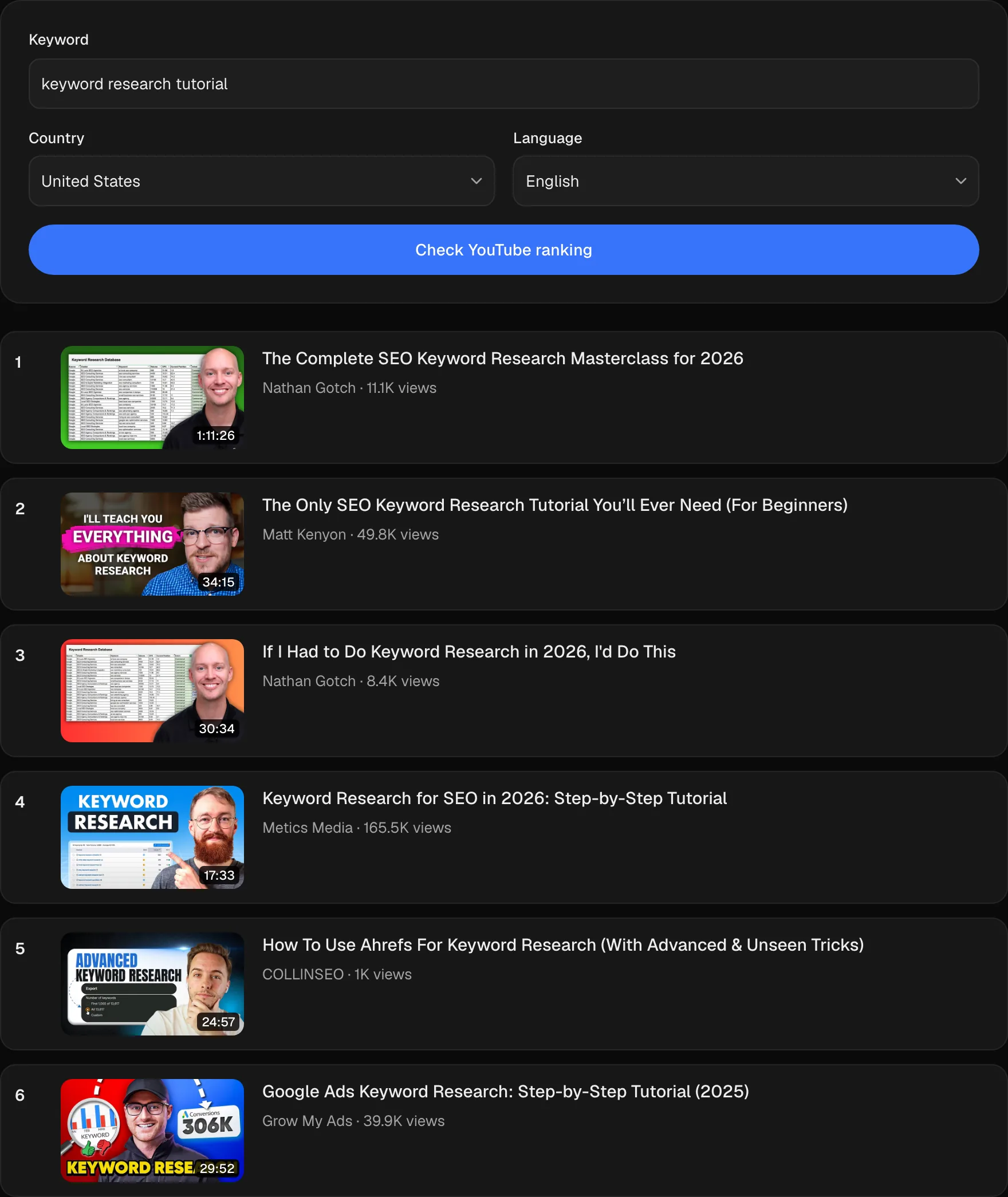
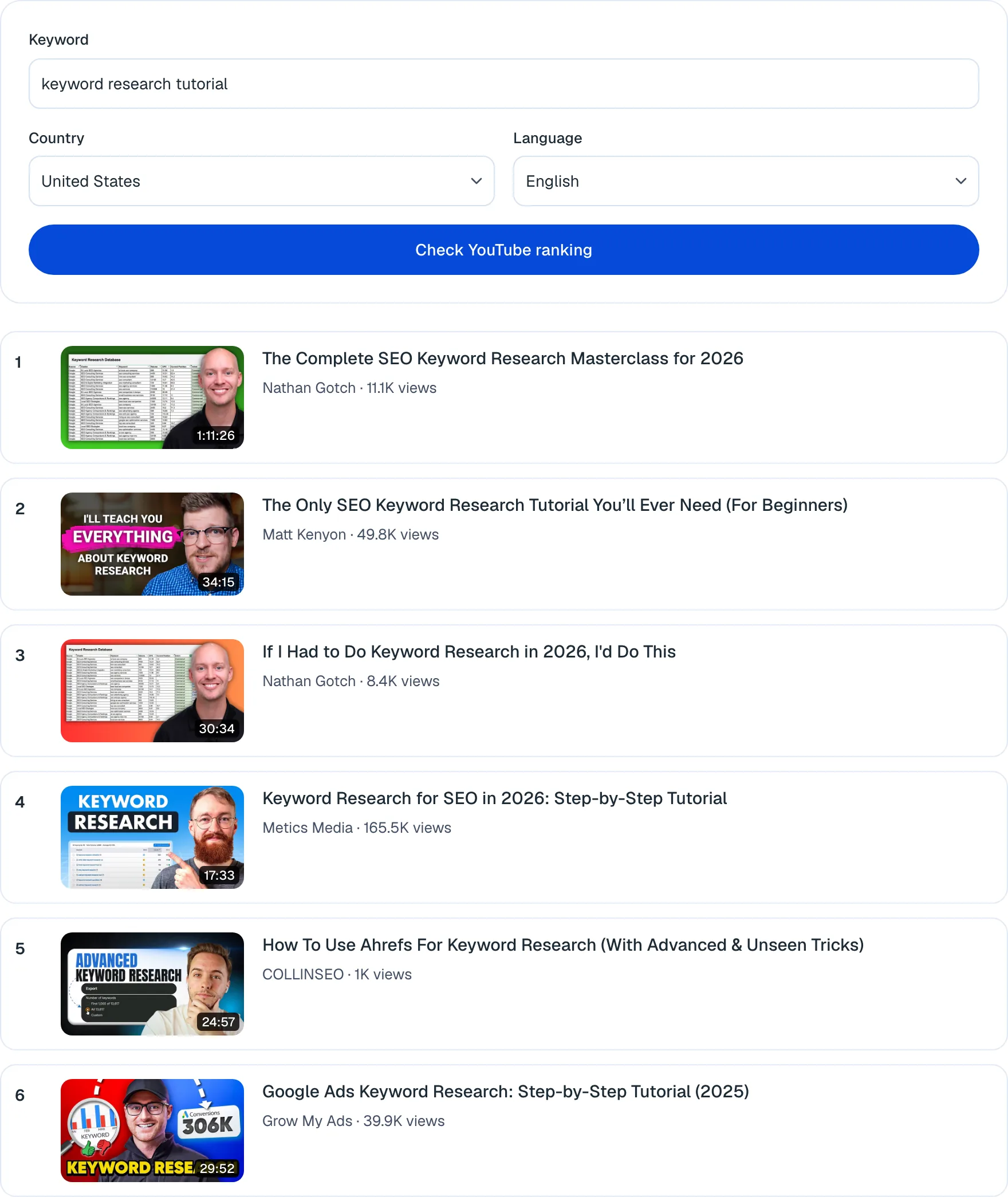
The free YouTube rank checker returns the live top 20 videos YouTube shows for any keyword, in 213 countries and 129 languages, each with its position, channel, view count and duration. Every run is a fresh, depersonalized YouTube search through SEOmator's own SERP data network — not a cached average. No signup.

Isabella EdwardsReviewed by Isabella Edwards, Technical SEO Content Manager

How does the YouTube rank checker work?

Each check runs a fresh YouTube search through SEOmator's own SERP data network from the country and language you choose, reads the video results in the order YouTube returned them, and numbers them. Nothing is signed in, so what comes back is the depersonalized ranking — roughly what a stranger to your channel sees, not the one your watch history would produce.

  1. Enter the keyword

    Type the search a viewer would actually use, not your video's title. No account, no channel connection, no video ID.

  2. Pick the country and language

    YouTube localizes results heavily. Choose from 213 countries and 129 languages so you check the market your audience searches from, not the one you happen to sit in.

  3. Read the ranked list

    The top 20 come back in order, each with its position, thumbnail, duration, channel and view count — so you can see who outranks you and what they did differently.

What features are free, and what does an account add?

Everything in this grid works right now, no sign-up. The marked features unlock when you create a free SEOmator account.

The live top 20 for any keyword

Type a search and get the videos YouTube ranks for it right now, numbered from one.

213 countries, 129 languages

YouTube's results change market to market. Check the country and language your audience searches in.

Thumbnail and duration on every result

See the packaging that won: the image and the length a viewer judges before deciding to click.

The channel behind every ranking video

Each result names and links its channel, so you can tell one channel owning the query from twenty different ones sharing it.

View count on every ranked video

Position tells you where a video sits. Views tell you what it took to get there — and whether the gap is closeable.

A live YouTube query on every run

Nothing is served from a stored database, and no position is an average of last month.

Free account

Rank history and trends

Positions tracked over time, so you see direction instead of a single snapshot.

Free account

Ranking alerts

Get told when a keyword moves, rather than remembering to re-check it by hand.

Free account

Full site audits

251 technical checks on the website your videos send viewers to, ordered by impact.

Create a free SEOmator account to unlock rank history, alerts and full site audits.

Sign up free

Expert review of the YouTube rank checker

Isabella EdwardsReviewed byIsabella Edwards · Technical SEO Content Manager

I use this the way I use any rank checker: to tell a packaging problem apart from a demand problem. If a video is nowhere in the top 20 for the phrase it was built around, the title and the first line of the description are almost always where I start — YouTube has to be able to tell what the video is about before retention can do anything for it. What I like is that it doesn't ask you to sign in, so the list you get is depersonalized: roughly what a stranger sees rather than what your own subscribers see. Two limits I'd want stated plainly. It returns the ranking for a keyword, not "your rank" — you have to find yourself in the list, and if you're outside the top 20 it tells you that but not how far outside. And search position sits upstream of the numbers YouTube actually rewards: a video can rank third for a query and still lose to the browse and suggested surfaces that send most channels most of their views.

View Isabella's profile

How does our expert use this tool?

Isabella EdwardsIsabella Edwards · Technical SEO Content Manager
  1. Check the keyword before you check the video

    Run the phrase first and read what YouTube already ranks for it. If the top 20 is wall-to-wall 45-second Shorts and you made an 18-minute tutorial, the ranking isn't the problem — you've answered a different question than the one being asked.

  2. Treat video as the surface that isn't shrinking

    Across the keywords we track, an AI Overview appeared on 27.4% of them in July 2026, up from 18.9% in January. Text results are losing room at the top of Google while video keeps its own. That's the argument for knowing your YouTube position even when YouTube isn't your main channel.

  3. Copy the duration cluster, not the top result

    Look at the lengths in the top 10 rather than at position one. When nine of ten sit between four and seven minutes, that's YouTube telling you how much answer this query wants. Matching the cluster beats copying whichever video happens to lead today.

  4. Read view counts as age, not as quality

    A two-million-view video from 2021 outranking a 3,000-view one from last month usually means accumulated watch time, not a better video. Those are the queries worth attacking — the incumbent is coasting on a number you can't see the date of from the ranking alone.

  5. Check the market your subtitles are in

    If you publish localized titles or subtitles, run the keyword in that country and language too. A video that ranks fourth in the US and nowhere in Germany is a metadata problem in one language, not a content problem in both.

  6. Write down the position with its date, country and language

    The tool stores nothing. A bare position is uncomparable a month later — those three fields are what turn a screenshot into evidence you can put in a report.

On this page
  1. 01How do you check where a video ranks on YouTube?
  2. 02What does YouTube actually rank on?
  3. 03Why is my video missing from the top 20?
  4. 04What the result rows tell you about the competition
  5. 05YouTube rank, Google rank and Studio are three different numbers
  6. 06How often should you check, and what do you do with the number?
  7. 07Does a YouTube position still matter when AI answers the query?
  8. 08What this checker can't tell you
  1. How do you check where a video ranks on YouTube?

    There are four ways, and they answer different questions. Searching YouTube yourself tells you what your account sees. YouTube Studio tells you how your video performed, but never where it sat. The checker above returns the neutral position for a country and language. Rank tracking gives you the same number stored day after day.

    MethodWhat it gives youBlind spot
    Search YouTube yourselfThe order your account producesWatch history and subs shape it
    YouTube StudioImpressions, CTR, watch timeNever reports a search position
    This checkerThe signed-out top 20 by marketOne keyword, no history
    Rank tracking (paid)The same positions, stored dailySetup and billing before answer one

    Most people reach for the first and stop there, which is the one method guaranteed to flatter you. If you've watched your own video, YouTube knows. Your channel's videos surface higher for you than for anyone else, and subscriber status alone is enough to reorder a results page.

    A private window helps more on YouTube than it does on Google, because signing out genuinely removes the watch history. It doesn't remove your IP address, though, so the market is still yours. If you publish for viewers in Brazil and check from Berlin, a private window returns a German result set with none of your history — cleaner, and still the wrong country.

  2. What does YouTube actually rank on?

    YouTube has described search ranking publicly as a combination of relevance, engagement and quality. Relevance is how well the title, description and metadata match what was typed. Engagement covers watch time, how much of the video people finish, and the click-through rate on the impressions it earns. Quality is a judgement about the channel and the subject.

    What YouTube has never published is the weighting. Anyone quoting you exact percentages is guessing, and the percentages tend to be suspiciously round.

    The more useful difference is what's absent. There is no link graph here. You cannot build backlinks to a YouTube position the way you can to a web page, and no amount of external authority moves a video up the results. That leaves two categories of lever: what the video tells YouTube it is, and what viewers do once they arrive.

    The first category is larger than most people use. YouTube generates automatic captions for the overwhelming majority of uploads, which means the words spoken in the video exist as text. Saying the phrase you're targeting out loud, early, costs nothing and is more likely to help than the tag field everyone still fills in. The description's opening line does real work too; the rest of it, below the fold, mostly doesn't.

    The second category is where videos are actually won and lost, and it's the one a rank checker cannot see.

  3. Why is my video missing from the top 20?

    Absence from the list is a symptom, not a diagnosis. These are the patterns worth checking before you conclude the video was bad.

    What you see in the resultsLikely causeWhat to change
    All Shorts, yours runs 18 minutesFormat mismatchCut a short version, keep both
    Winners answer a different questionIntent mismatchRetarget the phrase
    You rank, but only in your accountPersonalizationRe-check signed out
    Ranks in one country, nowhere elseMetadata in one languageLocalized titles and subtitles
    Every winner has 100K+ viewsAccumulated watch timeStart on a longer-tail phrase
    Your title omits the phraseRelevancePut the query in the title

    The format mismatch is the one people miss most often. A query whose top twenty is wall-to-wall sixty-second Shorts is telling you how much answer viewers want, and an eighteen-minute treatment of the same subject isn't competing badly — it's competing in a different category. The same goes the other way. If the winners all run twelve minutes and yours is ninety seconds, you have answered a question nobody asked in that form.

    The last row is the cheapest fix in this table and the most commonly skipped. If the phrase you want to rank for doesn't appear in the title, you are asking YouTube to infer relevance it could simply have been told.

  4. What the result rows tell you about the competition

    The position is one number. The row it sits in is a competitive brief, and reading it is where most of the value in a single check comes from.

    Duration clustering. Look at the lengths across the top ten, not at position one. When eight of ten sit between four and seven minutes, that's the amount of answer the query wants. Matching the cluster is a better bet than copying whichever video happens to lead today, because the leader may be there for reasons that have nothing to do with its length.

    Channel concentration. Count how many distinct channels hold the twenty slots. One channel with six of them has topical authority on the subject, and displacing it needs more than one good video. Twenty different channels means the query is open and a single well-targeted upload can take a position.

    View counts as age. A two-million-view video sitting above a three-thousand-view one usually reflects watch time accumulated over years, not a better video. Those are the queries worth attacking. The incumbent is coasting on a number whose date you can't see from the ranking alone, and a fresher, closer answer can take the slot.

  5. YouTube rank, Google rank and Studio are three different numbers

    They get conflated constantly, and each one answers something the other two can't.

    The YouTube position is the order inside youtube.com search. That's what the tool above returns. It's the number that tells you whether your video is discoverable to someone who doesn't know your channel.

    The Google position is separate. Google indexes YouTube watch pages and shows video results in its own layout, on its own schedule. A video can sit on Google's first page for a query and be fortieth on YouTube for the same words, or the reverse. If Google is where your audience starts, check both: run the identical phrase through the Google SERP rank checker and compare.

    YouTube Studio's numbers are about your video, not about the results page. Impressions, click-through rate and average view duration are the honest measures of what happened after the ranking did its job. Studio's comparison labels are the ones that cause trouble: "1 of 10 by views" ranks a video against your own last ten uploads. Your best video out of ten can be absent from the top twenty for the keyword it targeted. Those two numbers have nothing to do with each other.

  6. How often should you check, and what do you do with the number?

    For a new upload, three checks are usually enough: 48 hours after publishing, at one week, and at one month. Positions move fastest in the first days while watch time accumulates, and a check on the afternoon of publication mostly measures nothing.

    Write down three things with every position: the date, the country and the language. Without them, a screenshot from last month is uncomparable, and "we were ranking fourth" turns into an argument nobody can settle.

    Then take one of three branches, because they need completely different work.

    If the video is absent from the top twenty, the problem is discovery. Rewrite the title so it contains the phrase people actually type, and put that phrase in the first line of the description. This is metadata work, and it can be done in ten minutes on a video you published a year ago.

    If the video ranks but isn't clicked, the problem is the thumbnail. YouTube gave you the impressions and viewers chose someone else's image. Studio's click-through rate for that video is the number to watch, and the useful comparison is against your own other videos on the same traffic source, not against a benchmark from an article.

    If the video is clicked but not watched, the problem is the first thirty seconds. Nothing in the ranking will fix that, and continuing to optimize metadata while retention leaks is the most common way to waste a month.

  7. Does a YouTube position still matter when AI answers the query?

    Across the keywords we track, an AI Overview appeared on 27.4% of them in July 2026, up from 18.9% in January. Text results are losing space at the top of Google, and pages that used to earn a click from position three now sit under a generated answer that often satisfies the query outright.

    Video hasn't been compressed in the same way. YouTube search is its own results page, unaffected by what Google puts above its own organic list, and video results on Google occupy a block that AI summaries have not replaced. That's the argument for knowing your YouTube position even when YouTube isn't your main channel: it's one of the surfaces where a ranking still reliably produces a view.

    That isn't a reason to move a content programme to video. It is a reason to check the position of the videos you already have, which most teams never do.

  8. What this checker can't tell you

    Four honest limits, and they matter for how you read the number.

    It returns the ranking for a keyword, not "your rank". You find your video in the list yourself. If you're outside the top twenty, the tool tells you that you're absent, not whether you're twenty-first or two hundredth.

    It has no memory. Each check is a live query and nothing is stored, so you get a dated snapshot rather than a trend. For one video that's the whole job. If YouTube is a channel you report on, you need the series, which is what rank tracking in a SEOmator account adds.

    It sees search only. Browse, suggested videos and the Shorts feed send most channels most of their views, and none of that traffic passes through a results page. A video can rank poorly and still perform, and the ranking won't explain why.

    It is depersonalized on purpose, which is a feature and a limit at once. The order you get is roughly what a stranger sees. It is not what your subscribers see, and it is not what you see.

    Start with one phrase you built a video around, run it in the market your audience searches from, and see whether you're in the list at all. That single answer decides which of the three branches above you're actually working on. When you're ready to look at the site those videos send viewers to, the free site audit covers the other half.

Who is this YouTube rank checker for?

Creators diagnosing a flat video

A video you were sure about isn't getting impressions. Check the keyword: if you're absent from the top 20, it's a discovery problem you can fix in the title and description — if you're in it and still flat, it's the thumbnail.

Agencies reporting on more than the website

A client's videos are part of the retainer but never make the deck. Pull the YouTube position beside the Google position for the same keyword, with the market and date named.

In-house teams researching before they film

Before committing a production day, check whether the query is owned by one channel or split across twenty, and how long the winning videos run. Pair it with the free keyword research tool to size the demand first.

Why use SEOmator's YouTube rank checker?

YouTube's own results, live

Every check queries YouTube search itself in real time. Nothing is served from a cached database, and no Google video result stands in for a YouTube one.

Free, with no sign-up wall

The full ranked list renders on the page. No credit card, no email gate, no trial that expires after three queries.

Signed out on purpose

The check carries no watch history, so the order you see is the discoverable one — not the ranking your own account would produce.

Your market, not ours

213 countries and 129 languages. A YouTube position only means something in the market you're actually trying to reach.

The whole row, not just a number

Thumbnail, duration, channel and view count come back with every position, so one check doubles as a competitive brief.

Part of a full toolkit

One of SEOmator's free SEO tools, alongside the Google and Bing rank checkers and a complete site audit.

The free toolkit behind real SEO workflows

countries you can check a YouTube ranking from
213
people ran SEOmator's free tools in 2026
500K+
no sign-up, no credit card, no expiring trial
$0

YouTube ranking frequently asked questions

  • What is a YouTube SERP rank checker, and why do I need it?

    It shows you the order YouTube puts videos in for a given search. This one returns the live top 20 for a keyword — each video's position, channel, view count and duration — so you can see whether your video is in that list at all and who is above it. YouTube Studio tells you how many impressions a video got and how many turned into clicks, but not where the video sat in the results those impressions came from. That position is the piece a rank checker adds.

  • Is this YouTube rank checker really free?

    Yes, and there is no result paywall. You don't create an account, hand over an email, or start a trial that expires after three searches — the full ranked list renders on the page. A free SEOmator account adds the things a single check can't give you: rank history over time, alerts when a keyword moves, and site audits. The check itself stays free either way.

  • How accurate is a free YouTube rank checker?

    The position is accurate for a signed-out search from the country and language you picked, at the moment you ran it. Two things make it differ from what you personally see. YouTube personalizes heavily, so a logged-in viewer with your watch history gets a different order — often your own video, much higher. And rankings move within a day as watch time accumulates on new uploads. Treat any single check as a dated snapshot, which is why the date, country and language are worth recording with it.

  • How do I check where my video ranks on YouTube?

    Enter the keyword you want to rank for, pick the country and language your audience searches in, and run the check. The tool returns the top 20 videos YouTube currently ranks for that phrase — find your video in the list and its number is your position. If it isn't there, you're outside the top 20 for that phrase in that market. Doing this signed out matters: searching on your own account shows you a ranking your watch history helped create.

  • What are the YouTube ranking factors?

    YouTube has publicly described search ranking as a combination of relevance, engagement and quality. Relevance is how well the title, description and metadata match the query. Engagement is watch time and how much of the video people actually finish, plus click-through rate on the impressions it receives. Quality is a judgement about the channel and topic. What YouTube has not published is the weighting between them, so treat anyone quoting exact percentages with suspicion. What's reliably true in practice: relevance decides whether you're eligible for the query at all, and retention decides whether you keep the position once you have it.

  • Do I need technical knowledge to use it?

    No. There are three fields — keyword, country, language — and a button. There is nothing to install, no channel to connect, and no API key to paste. The judgement is in reading the result, not in producing it.

  • What can this tool tell me that YouTube Studio can't?

    Studio is the better source for everything about your own video: impressions, click-through rate, average view duration, traffic sources. What it doesn't show is the competitive picture — the ranked list your video is competing inside. This tool shows the other nineteen videos: their titles, lengths, channels and view counts. Studio tells you your video underperformed; the ranked list tells you what it lost to.

  • What does "1 of 10 ranking by views" mean in YouTube Studio?

    That's Studio comparing a video against your own recent uploads, not against YouTube search. "1 of 10" means it's the best-performing of your last ten videos by views — a purely internal ranking that says nothing about where it sits in anyone's search results. Your best video out of ten can still be absent from the top 20 for the keyword it targeted. The two numbers answer different questions: Studio's is "how does this compare to my other work," a rank checker's is "how does this compare to everyone else's."

  • Is a 4% click-through rate good on YouTube?

    It's around the middle of the range most channels see, and on its own it means very little. CTR is measured against impressions, so it moves with where those impressions came from: a video shown mostly on the home feed to people who don't know you will show a lower rate than the same video shown to search traffic that asked for exactly this. Compare a video's CTR to your own channel's other videos on the same surface, not to a number from an article. And read it beside average view duration — a high CTR with a fast drop-off is a thumbnail writing a cheque the video doesn't cover.

  • What's the difference between a free rank check and paid rank tracking?

    A free check is one live look at one keyword: accurate, dated, and gone as soon as you close the tab. Paid rank tracking stores each check, so you get a trend line instead of a snapshot, alerts when a position moves, and history you can put in front of a client. If you're diagnosing one video, the free check is the whole job. If YouTube is a channel you're accountable for, you need the series.

  • Can a YouTube rank checker improve my engagement and watch time?

    Not directly — it measures, it doesn't change anything. What it does is tell you which problem you have. If you're absent from the top 20, the fix is discovery: the title and the opening of the description have to match how people actually search. If you're ranking but not being clicked, the fix is the thumbnail. If you're clicked but not watched, the fix is the first thirty seconds. Those are three different jobs, and the ranked list is the cheapest way to work out which one you're facing.

  • Will this guarantee that I rank #1 on YouTube?

    No, and be wary of anything that says otherwise. Position depends on how well your metadata matches the query, how much of the video people watch, how your channel performs on the topic, and how entrenched the incumbents are — several of which you don't control and none of which a checker changes. What it gives you is the honest current number, and a view of what's beating you, which is the only sound place to start.

Related guides

Deeper reading from the SEOmator blog on what this tool measures.

5 Ways of How to Monitor Organic Rank

5 Ways of How to Monitor Organic Rank

Whether you’re a new business just rounding off your digital strategy or an established brand that’s been around for a while, knowing how to monitor organic rank is a skill essential to your success story.

Get started to see how your website performs.

Elevate your online presence with our tool: Get found, Get ahead

Pricing