
· 14 min read
30 Link Building Statistics You Should Know for 2026
91.3% of the AI Overview citations we tracked in H1 2026 went to pages already in the organic top 20. See the 30 link building numbers that matter in 2026.
SEOmator's free domain authority checker returns any domain's real Moz Domain Authority out of 100, with its spam score, MozRank, linking root domains and total inbound links — plus the DA history behind today's score. Each check reads Moz's current metrics live, not a cached copy. No signup: enter a domain above.
 Reviewed by Charles Duncan, Co-founder & CTO
Each check sends the domain to Moz's link index and reads back the metrics it holds right now: Domain Authority, spam score, MozRank, linking root domains, inbound links, and the stored history of past DA values. Nothing is estimated on our side and nothing is cached — though the score itself only changes when Moz refreshes its own index, not when you re-run the check.
Type a domain — yours or a competitor's. No account, and no ownership verification, because comparing domains is the point.
The domain goes to Moz's link index, which returns the authority score together with the link counts and spam signal behind it.
You get the DA out of 100, the four metrics that explain it, and a history line — so you can tell a stable 45 from one that just fell there.
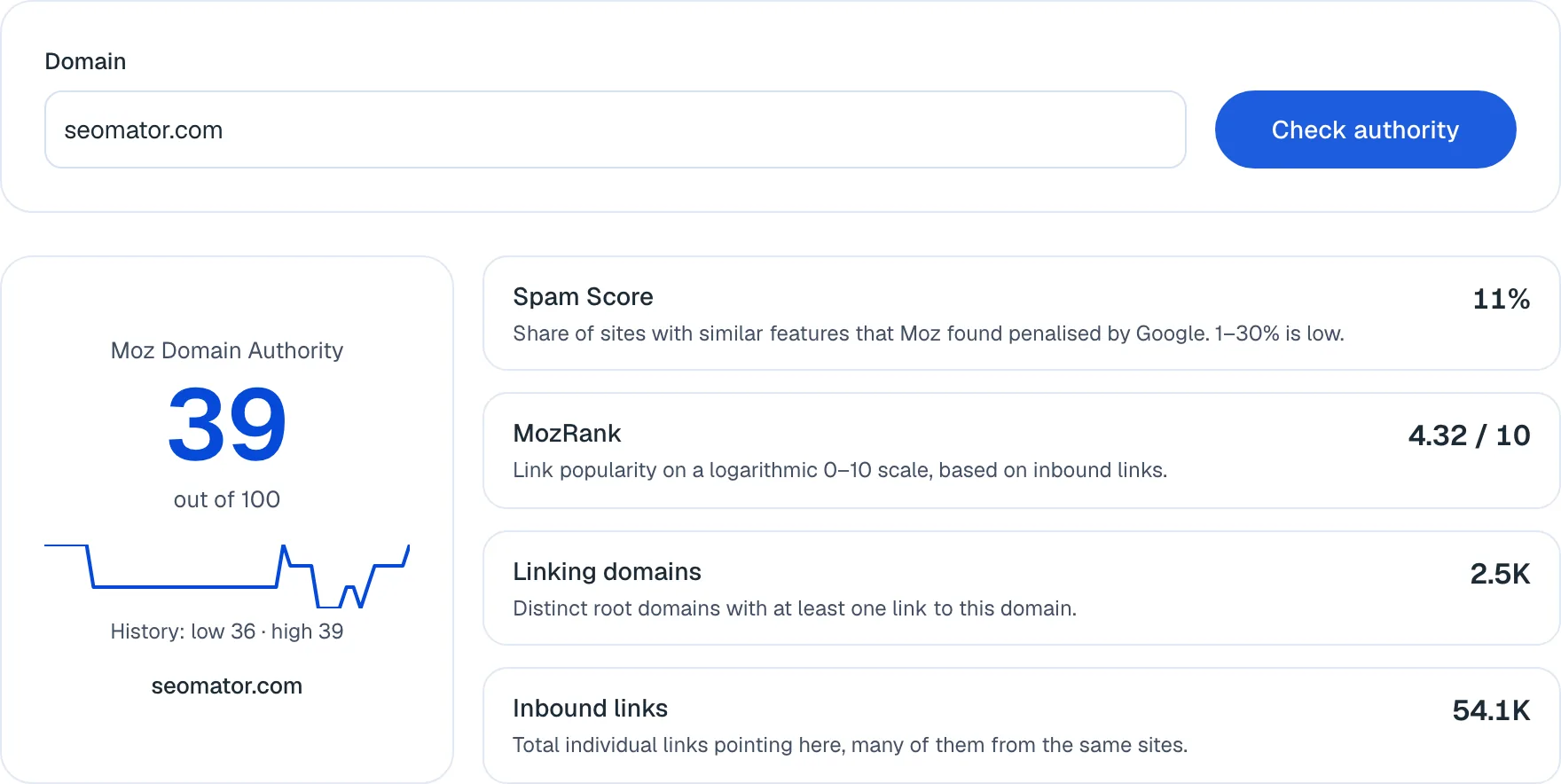
Everything in this grid works right now, no sign-up. The marked features unlock when you create a free SEOmator account.
The actual DA out of 100 that Moz publishes — not a lookalike score invented to fill the gap.
A history line of past DA values, so you can see whether today's number is a plateau, a climb, or a fall.
The share of sites with similar features that Moz found penalised by Google: 1–30% is low, 61% and up is high. High DA plus high spam score is a warning, not a win.
Distinct referring root domains next to total inbound links. The gap between the two tells you whether a profile is broad or just repetitive.
Moz's logarithmic 0–10 link-popularity score — a useful second opinion when two domains share the same DA.
Check domains you don't own, so competitor research and link vetting work exactly like checking your own site.
Backlink Explorer lists the actual referring domains, anchor text and target pages, instead of only counting them.
Track a set of domains — yours and your competitors' — and see movement reported to you rather than re-checked by hand.
Complete technical audits across your whole site against the audit engine's 251 rules, with issues ranked by impact.
Create a free SEOmator account to explore the links behind the score, monitor domains, and run full site audits.
Sign up free Reviewed byCharles Duncan · Co-founder & CTO
I run the crawling and backlink infrastructure here, so I'll be blunt about what this is: a clean read of Moz's own Domain Authority, with the link counts and spam signal that explain it, plus the history line most free checkers leave out. That last part is what makes it worth using — a DA of 52 means something very different when it has been 52 for two years than when it was 61 last quarter. The honest limitation: DA is Moz's prediction, not Google's. Google does not use it, does not see it, and will not rank you for improving it. Treat it as a comparative yardstick against the specific competitors you are up against, never as a target in itself.
 Charles Duncan · Co-founder & CTO
Broken internal links and deleted pages with no redirect spend authority you already earned on dead ends. A site audit finds them in one pass. Fix that before you spend a month on outreach.
A DA of 38 is weak in SaaS and strong in a local trade. In our 1 October 2026 check of 40 keywords, the #1 result had the highest DA on its page only 12.5% of the time. Run the three domains ranking above you for your money keyword and read your number against theirs. That comparison is the only version of DA that means anything.
Then read the ratio against domains of similar authority, because it grows with size. In our October 2026 check, page-1 domains under DA 40 had a median of 28 links per linking domain, and those at DA 70 and up had 207. A DA-30 site at 300 links per domain is the outlier worth a closer look: that is usually site-wide footer and template links inflating the count.
A DA of 55 with a 65% spam score is not a strong domain. It is a domain that resembles sites Google penalised, and Moz rates anything from 61% up as high. Of the 258 domains ranking on page 1 in our October 2026 check, 99.2% sat in Moz's low band. Check it every time you evaluate a link prospect.
One score cannot tell you whether you are climbing or sliding, and the history line can. A DA that dropped two points is a different problem from one that has never moved.
Domains sold on their authority score are often inflated with expired-domain redirects or link networks, which is exactly what the spam score is for. Run this check before money changes hands, and pair it with a backlink check on the same domain.
Enter the domain in the checker above. Moz's spam score appears next to Domain Authority in the same result, free and without an account. Spam Score is the percentage of sites with similar features that Moz has found penalised or banned by Google, scored on 27 features. In our 1 October 2026 check, the median domain ranking on Google's page 1 scored 2%, and 99.2% of those 258 domains sat in Moz's low band.
| Spam score | Moz band | What to do |
|---|---|---|
| 1–30% | Low | Read the DA next |
| 31–60% | Medium | Review its backlinks |
| 61–100% | High | Treat as a red flag |
The score measures resemblance, not guilt. Moz itself says a high score doesn't mean a site is necessarily spammy, only that it is worth a closer look. Page 1 is the useful benchmark here: when almost every domain Google ranks there sits under 30%, a guest-post site at 45% is unusual enough to check by hand. Read the spam score before the DA when you evaluate someone else's domain, because a high DA with a high spam score is the classic signature of a domain inflated on purpose. To see which links produce the score, run the same domain through the free backlink checker.
The checker returns four numbers alongside DA. Each answers a question the score alone cannot.
Spam Score has its own chapter above. The short version: read it before the DA.
MozRank is a logarithmic 0–10 link-popularity score. It weights the authority flowing to the domain rather than the breadth of it, so it is a useful tie-breaker: two domains at DA 45 where one has MozRank 4.1 and the other 2.8 are not equivalent.
Linking domains and inbound links are the two counts that actually build the score, and the ratio between them is the most useful thing on the panel. Divide inbound links by linking domains, then compare the result with domains of a similar DA, because the ratio grows naturally as a site gets bigger. Across the 267 domains ranking on Google's page 1 in our 1 October 2026 check, the median was 97 links per linking domain, and it climbed with authority: 28 for domains under DA 40, 69 for DA 40–69, and 207 for DA 70 and up.
So a high ratio is not a red flag on its own. Large sites collect site-wide links naturally, from partner footers, blogrolls and syndicated content. It becomes one when it doesn't match the score. A DA-25 domain with 400 links per linking domain sits at about 14 times its peers' median, and that pattern usually means footer links, sidebar widgets, template links or a directory linking from every page: a big link count from few sites that decided to link. This one division, read against the right peers, tells you more about a link profile than the DA does, and it takes two seconds.
The checker draws it under the score: the series of past Domain Authority values Moz has stored for the domain, with the lowest and highest it reached. Falls are normal. In our 1 October 2026 check, 61% of the 267 domains ranking on Google's page 1 sat below their own stored peak, and the median domain had gained just 2 points from its first stored value to its latest. Moz doesn't date those values (each domain in that check had between 33 and 55 stored values), so read the shape, not the months.
A steady climb means new domains are linking to you faster than the web around you grows. A plateau means new links come from domains that already link to you, or not at all, and the linking-domains count will be flat too. A step down is usually links you lost (a removed site-wide link, a linking site that went offline) or a Moz index update that moved the whole curve.
To tell those two causes of a step down apart, run the domains ranking above you. If their series show the same recent step, it was the update and nothing about your site changed. Our own domain is a working example: on 1 October 2026, seomator.com's stored series ran between 36 and 39. Read one value against the next and that looks like movement; read the whole line and it is a plateau.
Four honest limits, so you know when to reach for something else.
Which links produce the score. You get counts, not the list. To see the actual referring domains, their anchor text and the pages they point at, run the free backlink checker or use Backlink Explorer on the paid platform.
Anything about individual pages. DA is domain-level. A strong domain can carry a weak page, and rankings are won by pages — check a specific URL with the page authority checker instead.
What Google thinks. This is Moz's estimate of link authority. It correlates with ranking ability; it is not a ranking factor and no amount of it guarantees a position.
Whether your site is technically able to rank. Authority is one input. Crawlability, indexation, rendering and speed are others, and they fail far more often — a full site audit covers the rest.
Method for the study figures above: on 1 October 2026 we pulled Google's US page 1 for 40 keywords across 8 industries and ran every ranking domain through this checker: 379 results, 267 unique domains with a Domain Authority. Spam-score figures cover the 258 of those domains that returned a score. A single snapshot of a third-party metric.
A prospect asks why they are not ranking. Pull their DA next to the three domains outranking them, with the spam score to show whether their existing links are an asset or a liability.
You have been building links for two quarters. The history line shows whether the work registered, and the linking-domains count shows whether it registered as breadth or just volume.
A guest-post site quotes you a price. Check its DA and spam score in one pass before you pay — a high score with penalised-profile signals is the most common way outreach budgets get wasted.
The metric Moz actually publishes, at no cost and with no query cap — not a substitute score dressed up as authority.
Most free checkers show one number. This one shows where that number has been, which is where the useful part lives.
Spam score, MozRank, linking domains and inbound links ship with every check, so you can see why a domain scores what it does.
The full result renders on the page. We don't hold a score hostage for an email address.
Competitors, link prospects, acquisition targets. Ownership is never checked, because comparison is the whole point.
One of 29 free SEO tools, from a backlink check and page-level authority to a full site audit.
Domain Authority (DA) is a 0–100 score created by Moz that predicts how likely a domain is to rank in search results, calculated mainly from the size and quality of its backlink profile. It is Moz's model, not Google's: Google publishes no authority score and does not use DA as a ranking factor. DA is best read as a comparative yardstick between domains competing for the same queries.
Enter the domain in the checker above. It returns the current Moz DA out of 100 plus the spam score, MozRank, linking root domains and inbound links behind it, with no account required. Moz reports the same metric in its own Link Explorer and its MozBar browser extension, and most paid SEO suites either license it or publish their own equivalent. Free checks run one domain at a time, so for hundreds of domains you will want an API or a paid tool.
There is no absolute threshold, because DA is relative. A 35 can dominate a niche with weak competition, while a 60 can be the weakest domain on a competitive commercial SERP. The practical test: check the domains currently ranking in the top three for the keyword you want and compare. If they sit 20 points above you, links are a real constraint. If you are within a few points, DA is not what is holding the page back.
DA rises when your backlink profile improves, so the work is earning links from relevant, credible domains — and it is slow, because Moz only recalculates as it refreshes its index. Two things pay off before outreach does: fix broken internal links so the authority you already have reaches your pages, and clean up spam links dragging the profile down. Content other sites have a concrete reason to cite is what makes the links happen at all.
As a yardstick, yes; as a target, no. Google doesn't use Moz's Domain Authority, and page-1 positions don't follow it: in our 1 October 2026 check of 40 keywords, position and DA were unrelated (Spearman's ρ = 0.04), and a third of the results pages ranked a domain under DA 30. DA still earns its place in one comparison. If the domains ranking above you sit 20 points higher, links are probably the constraint; if you are level with them or ahead, fix the page instead.
Most domains sit low, and an average figure is close to useless. DA is logarithmic by design, so the scale is crowded at the bottom: moving from 20 to 30 is far easier than 60 to 70, and the majority of registered domains never leave single digits because they attract almost no links. Compare against the domains on your SERP, not against the web.
For a site under a year old, a DA of 20 is a normal and healthy starting point — it means real domains have started linking to you. Whether it is good depends entirely on your competition: 20 can rank for long-tail and local queries but will struggle against domains in the 50s for commercial head terms. Check the top three results for your target keyword and read your 20 against their numbers.
Usually one of four reasons. New links are coming from domains that already link to you, which raises inbound links but adds no new linking domains. The links are from low-authority or spammy sites, which Moz discounts. Moz has not refreshed its index since you earned them, so there is a lag of weeks. Or competitors gained authority faster — DA is scored on a curve, so standing still while the web rises can cost you a point with nothing on your site getting worse.
Usually because you lost links (a site-wide link was removed, a linking site went offline), because Moz devalued links you have, or because Moz refreshed its index and the whole curve moved. Drops are common even among domains that rank well: in our 1 October 2026 check, 21% of the 267 domains on Google's page 1 had fallen 3 or more points between two consecutive stored values. Look at the history line under your score, then run the domains ranking above you. If they fell too, it was the update, not your site.
No. Domain Authority is Moz's metric and Domain Rating (DR) is Ahrefs', each computed from its own web index with its own model, so the two rarely agree on the same domain — gaps of 10 points or more are normal. Neither is a Google metric. Pick one and use it consistently, because comparing a DA against a DR tells you nothing.
Not honestly. DA follows your backlink profile, earning links from credible domains takes months, and Moz then needs an index refresh before the score moves. Services promising a jump in days are usually selling link-network placements or expired-domain redirects, which surface in the spam score and can cost you far more than the number is worth. The fastest legitimate gains come from fixing what is already broken — internal links, indexability, thin pages — not from buying new ones.
Not in one check here. Domain Authority scores a whole domain and Page Authority scores a single URL, so they come from different lookups, and this checker reports the domain-level metrics: DA, spam score, MozRank and the two link counts. For most decisions the domain view comes first: compare your DA with the domains ranking above you, and look at page-level strength only once you know links are the constraint. To see PA for one URL, Moz's own MozBar extension shows it on any page you visit.
Low, and Moz publishes the bands: 1–30% is low, 31–60% medium and 61–100% high. It's the share of sites with similar features that Moz found penalised or banned by Google, so it measures resemblance, not guilt; Moz itself says a high score doesn't mean a site is necessarily spammy. For context, of the 258 domains ranking on Google's page 1 for 40 US keywords in our 1 October 2026 check, 99.2% sat in the low band and the median was 2%.
Yes. Under the score, the checker draws the series of past DA values Moz has stored for the domain, with the lowest and highest it reached. Moz doesn't attach dates to those values, so read the shape rather than specific months: a steady climb, a plateau, or a sudden drop that lines up with lost links or a Moz index update.
No. The checker takes one domain per run, and runs are limited to one every ten seconds so the free tool stays available for everyone. For a short list, such as your domain and the three ranking above you, run them one after another and note each score with the date. For hundreds of domains, a paid API is the right tool.
Deeper reading from the SEOmator blog on what this tool measures.
· 14 min read
91.3% of the AI Overview citations we tracked in H1 2026 went to pages already in the organic top 20. See the 30 link building numbers that matter in 2026.

· 12 min read
We probed 232 ranking domains on 31 July 2026: 87.9% keep the blog in a subfolder, but 66% run docs on a subdomain. See the split, then pick yours.

· 17 min read
The median e-commerce site we audit scores 68 (D+); 52% carry Product schema errors. Run this 10-step audit to find your leaks and fix them in order.
Elevate your online presence with our tool: Get found, Get ahead

