


How to Check When a Website Was Last Updated
Two of the most-recommended ways to check a site's last-updated date are dead, and the rest disagree. Here's what still works, and how to cross-check it.

Oğuzhan Ulukaya · Software Developer, SEOmator
Full-stack TypeScript developer building B2B SaaS products since 2021
- Updated
- 11 min read
- 6 sources
- Tested 125 top-ranking pages

How we know this
Full method ↓- Tested
- The raw HTML of 125 pages ranking in Google's US top 10 for 20 everyday informational queries, checked for publication-date and last-modified signals · October 31, 2026
- Method
- Serper pulled the US top 10 for each query; video, forum and social results and PDFs were skipped. One plain HTTP fetch per page, then regular expressions for JSON-LD datePublished and dateModified, article:published_time and other date meta tags, time elements, dated URL paths and the Last-Modified response header
- Limits
- One dated snapshot, US/English only. Raw HTML only, so dates injected by JavaScript are missed; 21 of 146 sampled pages blocked or failed the fetch. First run: 135 pages on 26 September 2026.
- Run by
- SEOmator
 Written up by Oğuzhan Ulukaya
On this page7 sections
Two of the methods most guides still recommend for checking when a website was last updated are dead: Google retired its cache in 2024, and the old PHP command URL never returned a date at all. Seven methods do still work, from the HTTP Last-Modified header to the Wayback Machine — and none of them is reliable on its own.
Knowing that date allows you to understand your competitors better, keep track of your own website’s update schedule, or simply ensure you are consuming the most relevant and recent information.
One distinction worth drawing before we start: the last modified date tells you when a page was last touched, not when it first went live. If what you actually need is the original publication date — for citing a source, or judging how stale a claim is — check the byline or the page’s datePublished structured data rather than assuming the last-modified date is the publication date. The publication-date section below covers each method, with data on how often each one works.
Now, let’s explore different methods to see the last modified date of a web page.
Which method should you use?
Pick by what you're actually trying to learn. A ten-second console check answers "is this page stale?"; a sitemap sweep answers "how often does this publisher ship?"; only the Wayback Machine answers "what changed, and when?".
| Goal | Method | Time | Reliability |
|---|---|---|---|
| Spot-check one page right now | document.lastModified in the browser console | ~10 seconds | Low to medium — falls back to the current time |
| Get the server's own answer | HTTP Last-Modified header | ~15 seconds | Medium — optional, and often missing |
| Audit a whole site's freshness | Sitemap <lastmod> | ~1 minute | Medium — no sitemap on roughly 3 in 10 sites |
| Read the publisher's declared date | JSON-LD dateModified and meta tags | ~30 seconds | Medium — accurate when honest, trivial to inflate |
| See the date Google shows searchers | site: search snippet | ~20 seconds | Low: Google's own estimate, updated only on recrawl |
| Compare versions across months or years | Wayback Machine | 2–5 minutes | High for what changed, low for the exact date |
| Settle a date you don't trust | Cross-check two or more of the above | ~3 minutes | Highest |
The reliability column reflects how often each signal is actually present on real sites. Source: SEOmator crawling and audit data, Jan–Jul 2026 (109,440 top domains scanned for agent-readiness signals on 2026-07-20; 100K+ websites audited, 50M+ pages crawled).
7 ways to check when a website was last updated
Each method has its own advantages and complexities, and we'll guide you through all of them, step by step.
1. Using HTTP Header Checker to check the last modification date
HTTP headers contain useful information about server requests and responses. Among these data, you can find the 'last-modified' header, which indicates the date and time the web page was last altered.
Here's how to uncover it:
- Visit SEOmator’s Free HTTP Header & Status Code Checker.
- Type or paste the URL of the webpage you want to inspect, and click ‘Submit’.
- The tool will show you various information including the date.
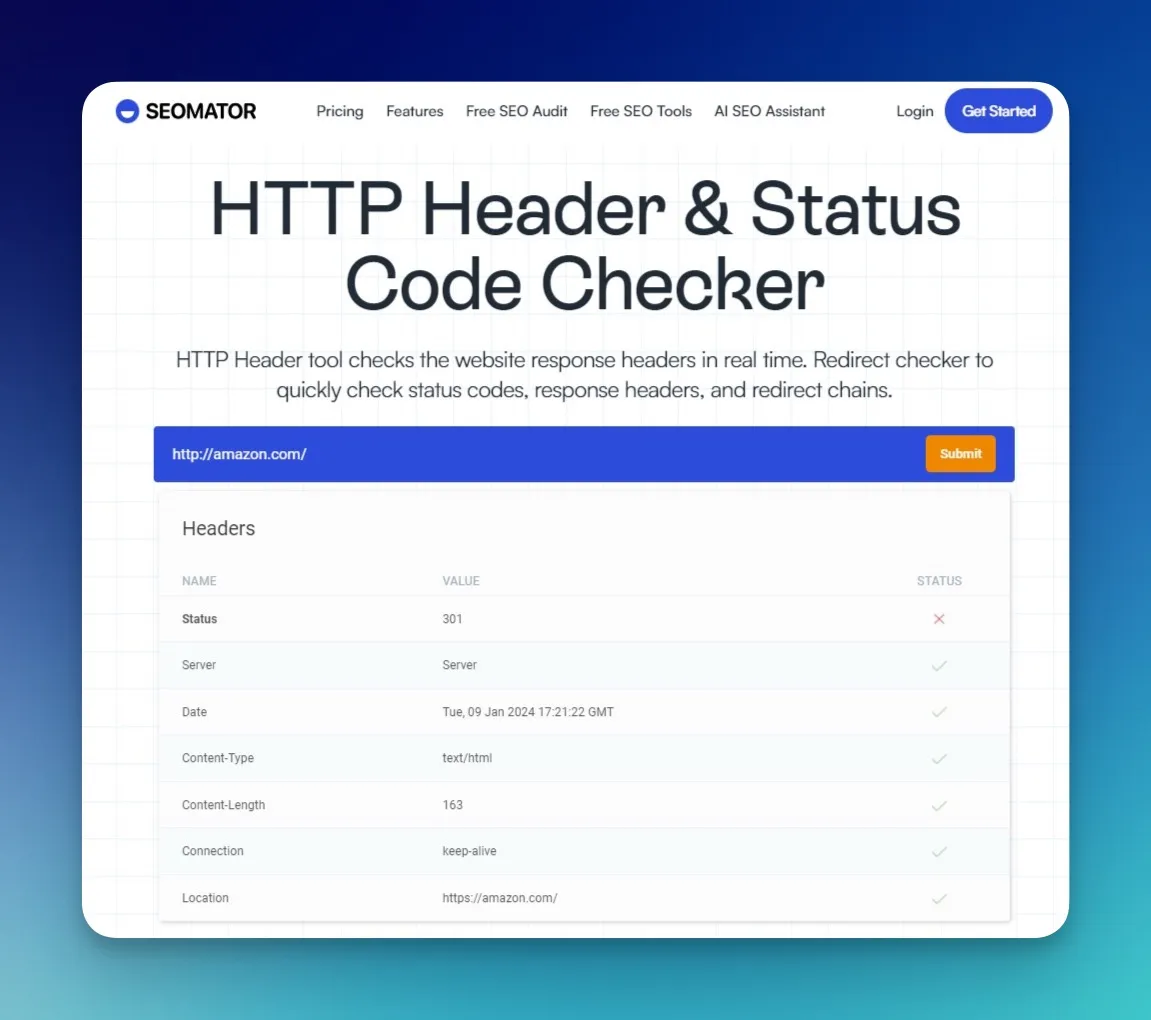
How far should you trust the result? The header is optional, and plenty of servers never send it — dynamic pages and CDN-fronted sites either omit it or stamp it with the moment of your request. Of the 125 top-ranking pages we fetched on 31 October 2026, only 37.6% sent one at all. Even when it's there it's a rough instrument. MDN Web Docs calls it a validator "less accurate than an ETag" for determining file contents; http.dev adds that the timestamp has one-second granularity, so two edits inside the same second are invisible to it.
When we run this check, the first question is whether the header exists at all, because its absence is information too: it usually means the page is generated on the fly. For the mechanics underneath, see how Last-Modified and If-Modified-Since actually work.
📌
Pro Tip: If you live in a terminal, curl -I https://example.com returns the same response headers in one line — much faster when you're checking a batch of URLs instead of one.
2. Checking source code to see last updated date
The source code is like the blueprint of a website. It's sometimes a treasure trove of information - including the date of the website's last update. However, not all websites display this data in their source code, so it might not always work but is certainly worth trying.
Here's how to view the source code:
- Go to the web page you want to check.
- Right-click anywhere on the page, and select 'View Page Source' or 'Inspect Element'.
- Press Ctrl+F (Command+F on Mac) to bring up the search box and type in 'Last Modified'.
- Look for a line that says something like
<meta name="Last-Modified" content="2021-04-22T07:30:04Z" />. The date and time in the content section is what you're looking for.
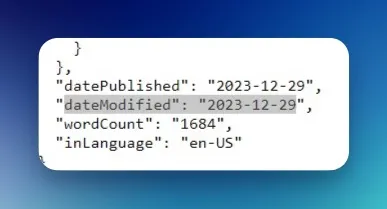
There's a catch bigger than "not all websites display this data". View Page Source shows the raw HTML the server sent — not the page you're looking at. Anything JavaScript writes after load, including a date stamped into a footer by a CMS widget, never appears there.
We can size that gap. Raw-vs-rendered mismatch — content in the rendered DOM but absent from the raw HTML — is the 8th most-failed rule in our audit engine, hitting 31.4% of the sites we audit (Jan–Jul 2026); our site crawler renders JavaScript the way Googlebot does, which is how we see it. The fix takes one keystroke: use Inspect Element instead, because the Elements panel shows the rendered DOM, dates and all.
📊
By the Numbers: On 31.4% of the sites we audit, content exists in the rendered DOM but not in the raw HTML. On roughly one site in three, a JavaScript-injected date will never show up in View Page Source.
3. Checking sitemap to see last update date
A sitemap is essentially a roadmap of a website, often used by search engines to crawl and index a site more effectively. Sitemaps also usually contain the last modified dates for each page. It's a bit more technical than previous methods but potent once mastered!
Here's how:
- Type or paste the sitemap URL into your browser's address bar and press enter. If you don’t know the sitemap of a website, you can find it by using SEOmator’s free sitemap finder tool, or work through the manual patterns in our guide to finding a site's sitemap.
- Look through the XML file for ‘lastmod’ tags. The dates listed next to these tags represent the last time each webpage was updated.
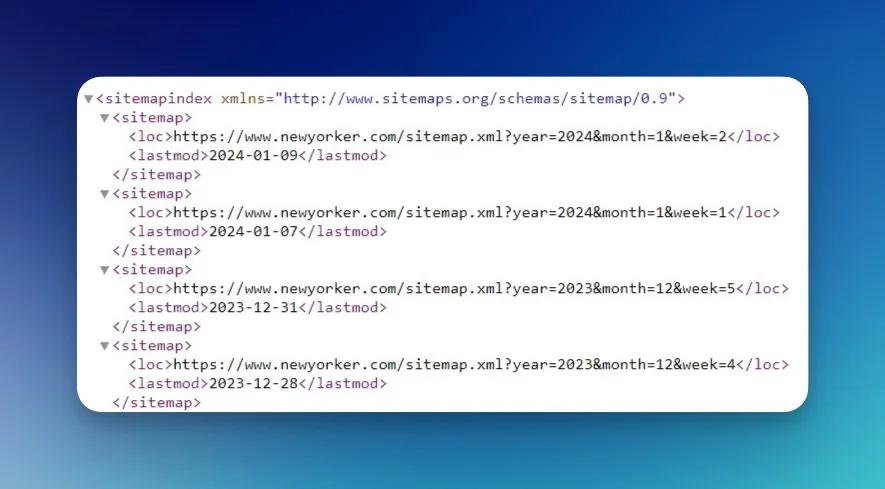
Know the odds before you build a workflow on this one. Across the 109,440 top domains we scanned on 20 July 2026, only 70.4% publish a sitemap at all, and 78.2% publish the robots.txt that makes a sitemap discoverable — the rest leave you guessing at /sitemap.xml and /sitemap_index.xml by hand.
When one does exist, lastmod is the best signal for auditing a competitor's publishing cadence, because it covers every URL at once. Don't read it as gospel: some CMS platforms re-stamp it on trivial saves, and others never touch it after the first publish.
🔑
Key Takeaway: Only 70.4% of the 109,440 top domains we scanned on 20 July 2026 publish a sitemap at all. Plan for the sitemap method to fail on about three sites in ten, and have a fallback ready.
4. Using Google Search to check last modification date
Google, our good old friend, can also give snippets of this information. This method relies on Google's indexing and doesn't work with websites Google hasn't crawled.
Here's the process:
- In the Google search bar, type "site:www.example.com" (replace 'example.com' with the actual URL).
- Look at the snippets under each search result. Sometimes, you'll find a date there - that's Google's best guess as to when a page was last updated.
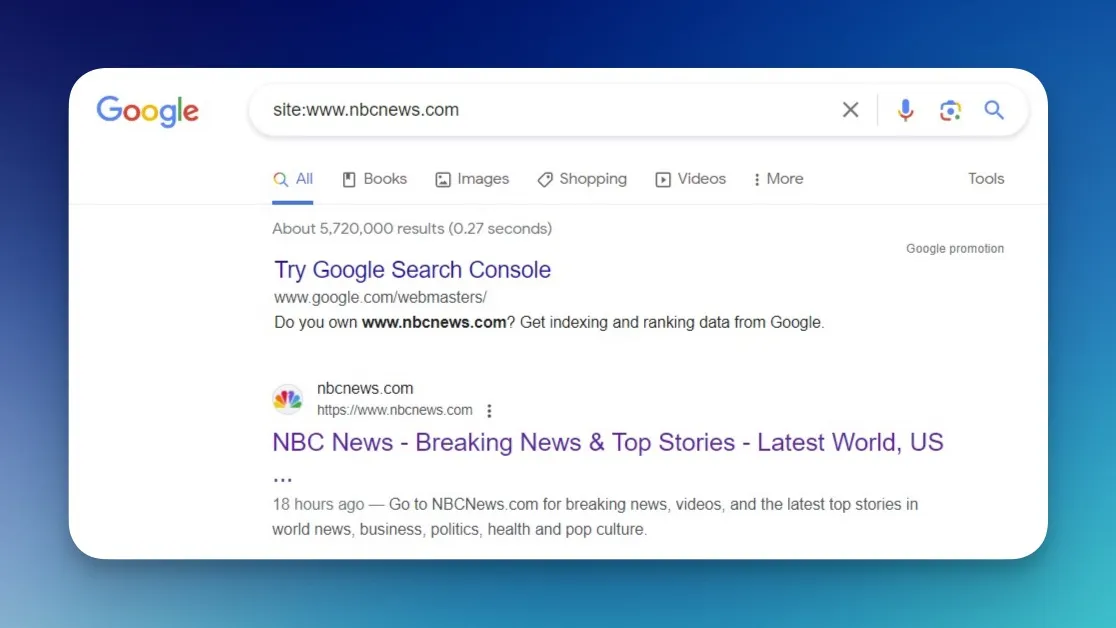
Be clear about what that date is: Google's own estimate of when the page was published or significantly updated, built from several signals on the page, according to Google's documentation on byline dates. It isn't an edit log. It can only move after Googlebot recrawls the page, so on low-priority URLs it can trail a real edit by weeks, and it helps to know how often Google recrawls a site before reading anything into a snippet.
One more failure mode. A page carrying a noindex directive won't appear in a site: search at all, and an empty result looks identical to a page Google has never found — so check for a noindex meta tag first.
⚠️
Common Mistake: Reading a site: snippet date as an exact edit date. It's Google's estimate, taken from the page's own date signals. A page can be rewritten today and still show last month's date until Googlebot comes back.
5. Running document.lastModified in the browser console
The fastest check on the list, and it needs no tool, extension, or account. Every browser exposes the document's last-modified value to JavaScript, so you read it straight off the page you're already on.
Here's how:
- Open the page you want to check.
- Press F12, or Ctrl+Shift+J (Cmd+Option+J on Mac), to open DevTools.
- Click the Console tab.
- Type
document.lastModifiedand press Enter.
js
document.lastModified
// → "07/21/2026 14:32:08"
The string comes back in your local time, in MM/DD/YYYY hh:mm:ss form, and it's the Last-Modified value the browser received with the document.
The caveat matters more here than anywhere else. When a document is generated dynamically and carries no Last-Modified header, the specification has document.lastModified fall back to the current time — so a result reading "a few seconds ago" almost always means "no date available", not "edited seconds ago".
💡
Quick Insight: Run it twice, thirty seconds apart. If the returned time moves with your clock, the page has no real Last-Modified value and the number is meaningless.
6. Checking structured data and meta dates
Publishers who care about how their content looks in search usually declare the update date themselves, in machine-readable markup. Three places carry it: the dateModified property inside an Article or BlogPosting JSON-LD block, and the article:modified_time and og:updated_time meta tags.
Here's how to find them:
- Open the page and view the source (Ctrl+U, or right-click and View Page Source).
- Press Ctrl+F and search for
dateModified, thenmodified_time. - Read the ISO timestamp in the matching value.
Inside a <script type="application/ld+json"> block, it looks like this:
json
{
  "@context": "https://schema.org",
  "@type": "BlogPosting",
  "headline": "How to Check When a Website Was Last Updated",
  "datePublished": "2024-01-11",
  "dateModified": "2026-07-25"
}
And in the head, as Open Graph and article meta tags:
html
<meta property="article:modified_time" content="2026-07-25T09:14:00+00:00">
<meta property="og:updated_time" content="2026-07-25T09:14:00+00:00">
This is the most precise date on the page when it's true, and the easiest one to inflate when it isn't — nothing validates it. A publisher can bump dateModified nightly without touching a word of body copy. Read it as a claim, then check the claim against the content.
🚩
Red Flag: A dateModified from this week sitting on a page whose examples, screenshots, and statistics are all two years old. The markup is publisher-declared, so treat a mismatch as a signal about the publisher.
7. Checking Internet Archive to see last update date
The Internet Archive's Wayback Machine takes 'snapshots' of web pages over time, allowing you to see when a page was updated.
Follow these steps:
- Go to The Wayback Machine.
- Enter the website's URL.
- Peruse the timeline of 'snapshots'—these dates indicate when the site was updated.
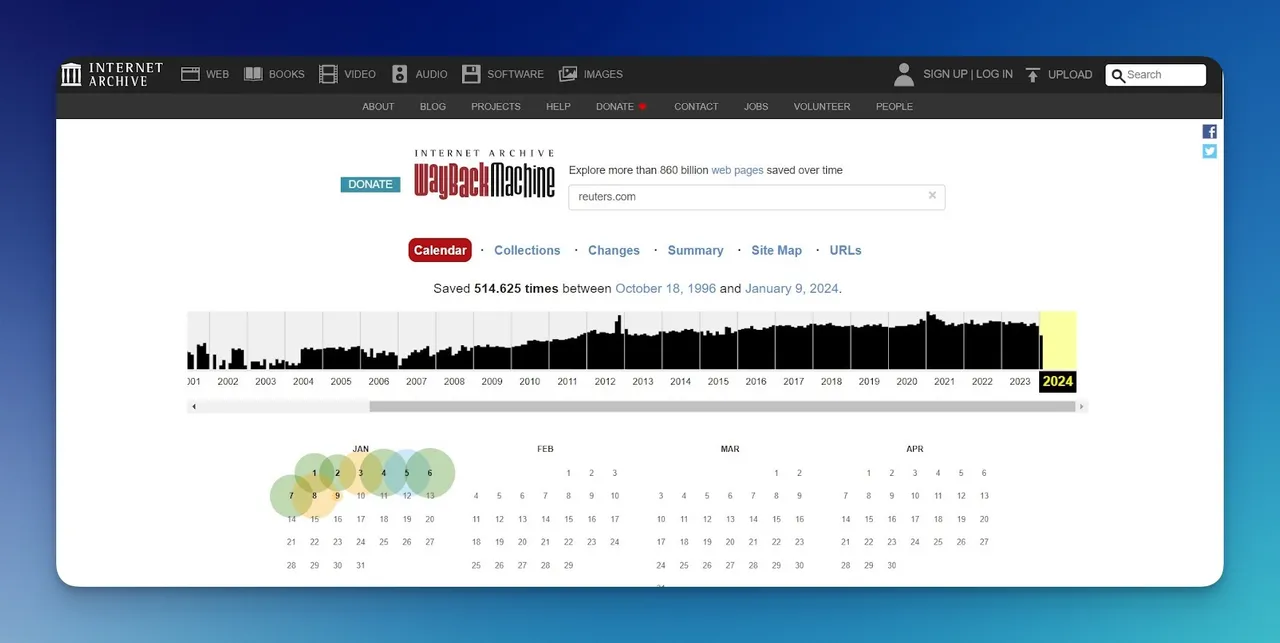
This is the only method that shows what changed rather than claiming when. Open two snapshots side by side and the edit is visible in the copy itself. The trade-off is coverage: the archive crawls popular URLs often and obscure ones rarely, so a gap in the timeline proves nothing.
How to find when an article was published
To find when an article was first published, check the byline, then the page's datePublished in its JSON-LD, then the article:published_time meta tag. If none of them exist, the earliest Wayback Machine snapshot gives you an "on or before" date. Expect to need that fallback more than half the time.
We measured that. On 31 October 2026 we fetched 125 pages ranking in Google's US top 10 for 20 everyday questions, the same 20 we first checked in September, from "what is a roth ira" to "how to make sourdough bread", and checked each page's HTML for the common publication-date signals:
| Publication-date signal | 31 Oct 2026 (125 pages) | 26 Sep 2026 (135 pages) |
|---|---|---|
| Any machine-readable publish date | 40.8% | 47.4% |
datePublished in JSON-LD | 32.0% | 37.0% |
article:published_time meta tag | 24.0% | 25.2% |
| Other date meta (Dublin Core, citation, pubdate) | 6.4% | 11.1% |
<time datetime> element | 8.0% | 11.9% |
| Date in the URL path | 2.4% | 5.2% |
| None of the above | 56.8% | 50.4% |
Source: SEOmator check of pages ranking in Google's US top 10 for 20 informational queries, fetched 31 October 2026 (125 pages) and 26 September 2026 (135 pages). Raw HTML only; video, forum and social results were skipped, and 21 of the 146 pages sampled in October blocked or failed the fetch. Each run draws a fresh top 10, so the columns compare samples, not the same pages, and a gap of a few points can be sample noise rather than a trend.
📊
By the Numbers: More than half of the pages ranking in Google's US top 10 for 20 everyday questions (56.8% of 125, checked 31 October 2026) carried none of the publication-date signals we looked for in their HTML. The byline is often the only clue.
Read the byline, and tell "published" from "updated"
Most articles print a date near the headline or the author's name, and the MLA Style Center adds the copyright line at the bottom of the page as another place to look. The catch is which date you're reading. In our October sample, 22.4% of pages declared a dateModified later than their datePublished, so the date beside a headline is often the latest edit, not the first appearance. A copyright year is the weakest hint of all, because many sites print the current year automatically.
Search the source for datePublished and published_time
Use the same steps as Method 6, but search for datePublished and published_time instead. They were the two most common signals in our sample, and scholarly pages add their own, such as citation_publication_date. Our count used raw HTML, so pages that inject markup with JavaScript would add a few more; Inspect Element (Method 2) catches those. Either way, these are publisher claims, and nothing validates them.
Look for a date in the URL
News sites and WordPress blogs with date-based permalinks put the date in the path, as in /2024/05/12/headline/. It takes a second to check, but it was rare among top-ranking pages: 2.4% of our October sample. Image URLs can help as well. WordPress files uploads under /wp-content/uploads/YYYY/MM/ by default, which tells you the month an image went up. That's a hint rather than proof, since images can be added long after the text.
Bracket it with Google's before: and after: operators
Search for the exact headline in quotes and add before:2025-01-01. If the page still appears, Google dates it before that day, so move the date back until it drops out. Both operators still filter, which we confirmed when testing our Google search operators cheat sheet. The date is Google's own estimate, so read the result as a range, not a timestamp.
Use the first Wayback Machine snapshot as an upper bound
Open the URL in the Wayback Machine (Method 7) and jump to the earliest capture. The article existed on that day, so it was published on or before it. For obscure pages the first capture can trail publication by months, which is why this sets an upper bound and nothing more.
Why is it important to keep a website up to date?
Modern internet users can tell in an instant whether a website is current or if it’s suffering from neglect. Frequent website updates matter for your site's relevancy, trust, and ranking.
So, not only should you know how to find the last modified date of a web page, you should also be committed to updating your own website regularly.

But what makes routine updates so important?
⭐ Relevancy and user experience
Updating your website ensures that your content remains relevant to your users. Trends change, information evolves, and technology advances. If your website content is outdated, users may find your site unhelpful. This could potentially lead to higher bounce rates and lower engagement, thus impacting your overall web performance.
Imagine yourself in the shoes of a visitor to your website. A site with fresh, current information not only provides a great user experience but also creates a good impression. It tells your visitors that you care about their needs and stay updated with industry trends.
To improve the relevancy of your website:
- Keep your blog posts and articles up-to-date. Pay attention to posts that receive a high amount of traffic and ensure that they contain the most recent information.
- Review and update your product or services pages frequently to reflect your current offerings.
- Regularly check and update your contact information, FAQs, and other details.
- Update the visuals, such as photos, videos, and other graphic content, occasionally to keep the look of your site fresh and engaging.
⭐ SEO advantage
Search engine optimization (SEO) strategies are dynamic, pivoting on the continually changing algorithms of search engines. Regular content updates signal to search engines that your site is alive and kicking, which could give your site an SEO ranking boost.
When you frequently update your website, Google, Bing, and other search engines will index your site more often. New content could potentially be a ticket to better rankings since Google algorithms are partial to fresh and relevant content.
Here are some ways to keep your site SEO-friendly:
- Freshen up your keywords by reexamining them periodically to ensure they align with the latest SEO trends.
- Introduce new content that is helpful and informative for your audience. Regular blog posts or resources can be useful for this.
- Consider occasionally reshuffling and reformatting existing content. Even subtle changes like adding new images, headlines, or reformulating content in a different context, can help.
- The comment section is also valuable. User-generated content, such as comments or reviews, could get the new content ball rolling. Encourage interactions, and make sure to respond.
- Clean up old, outdated content. Any articles or information that might be outdated or irrelevant should be removed or updated.
⭐ Trustworthiness and credibility
Just like any physical store, clutters, cobwebs, and stale stocks don't make for a welcoming or trustworthy environment. Similarly, a modern, regularly updated website appears professional and reliable. It shows that you value your business and your customers and are engaged in your industry.
Ensure that every detail on your site, from the copyright year in your site’s footer to the latest team member's photo in the 'About Us' page, is current.
Well-maintained sites reduce customer churn and encourage repeat visits.
Issues about checking the last updated date of a website
While we have a range of methods to determine when a website was last updated, it's also important to keep the potential criticisms and controversies in mind.
These issues don't necessarily undermine the process of finding out the last known modified date, but they're useful to consider to place this digital sleuthing work in a broader context.

Here's what you need to know:
🚩 Lack of universality in perception of updates
Not all changes made on a website necessarily indicate a real update.
For example, a minor graphic modification or a slight alteration in website theme may not qualify as a significant update for some, while others may consider it part of website refreshing.
- Text content vs. non-text content: The changes in non-text content like images, videos, PDF files, etc., often aren't reflected as updates by search engines. So, there's a possibility that a website may have undergone extensive changes in its non-text content but still appears 'unchanged' due to lack of revised text content.
- Visible changes vs. non-visible changes: Often, behind-the-scenes updates like improvement in HTML coding, changes in meta description, or modification of technical SEO elements are overlooked.
🚩 Dependence on the site owner
It's often up to the website owner whether to display the last updated date or not. Some websites may be manipulated by site owners to appear as 'recently updated' when they're not, just to seem more current and reliable.
In contrast, some site owners remove or hide the last updated date of 'evergreen content' (content whose relevance doesn't depend on freshness) to avoid it looking outdated, even if it's not. This creates ambiguity in determining the authenticity of the perceived update.
🚩 Different sources, different results
Often, using different methods to check when a website was last updated may yield varying results due to the differences in indexing methods and frequency. For instance, the 'last-modified' date seen in the source code may differ from the date found in the page's structured data.
Which one then should you consider? Here's where controversies arise. Some argue that the HTTP header check or source code check gives the most accurate results, while others claim the .XML Sitemap or Google Search methods are more reliable.
When they disagree, here's the order we trust them in, strongest first: a visible editorial date backed by a real content diff, then schema dateModified, then sitemap lastmod, then the HTTP Last-Modified header, and last of all document.lastModified on a JavaScript-heavy page. If you need to settle this across hundreds of URLs rather than one, a crawl test collects headers and sitemap dates for every page in a single pass.
✅
Do This Next: Never act on a single signal. Take the fastest two — the HTTP header and the sitemap date — and only reach for the Wayback Machine when those two disagree.
🚩 Two methods that used to work, and no longer do
Two techniques you'll still meet in other guides are dead ends, and both circulate widely enough to be worth naming.
Google Cache. Google removed the "Cached" link from search results in February 2024 and retired the cache: operator around September 2024, calling the feature a relic of an era when loading a page was unreliable. webcache.googleusercontent.com no longer serves cached copies, so any guide still recommending it hasn't been touched in two years. The Wayback Machine, Method 7 above, is the replacement Google itself pointed people toward.
The PHP "command URL". Appending /?=PHPE9568F36-D428-11d2-A769-00AA001ACF42 to a URL never returned a modification date. It was an Easter egg that displayed the PHP logo image, one of several hidden in PHP over the years. Admins disabled it with expose_php=Off, and it was removed from PHP entirely in version 5.5.
Frequently asked questions
How do I check when a website was last updated in Chrome?
Open the page, press F12 or Ctrl+Shift+J, click the Console tab, type document.lastModified and press Enter. Chrome returns the document's last-modified time in your local timezone. If the value matches the moment you ran it, the page has no real date and you should try the HTTP header instead.
How can I see when a website was last updated on iPhone?
Safari on iOS has no developer console by default, so use a tool rather than the browser. Paste the URL into the free HTTP header checker from Method 1 and read the last-modified row. Alternatively, open the site's /sitemap.xml directly in Safari and search for the page's lastmod value.
Can you inspect a page to see when it was last updated?
Yes, and Inspect Element beats View Page Source for this. The Elements panel shows the rendered DOM, so a date written into the page by JavaScript is visible there even though it never appears in the raw HTML. Search the panel for "updated", "modified", or "dateModified".
How do I use document.lastModified to find a page's last update?
Type document.lastModified in the browser console and press Enter. It returns a string like 07/21/2026 14:32:08. Treat it with care: when a document has no Last-Modified header, the specification says the value falls back to the current time, so "just now" usually means "no date available".
What's the best free website last updated checker?
For a single URL, a free HTTP header checker is the quickest honest answer, because it reports exactly what the server claims with no interpretation layer. For a whole site, a sitemap finder plus the lastmod tags gives you every page's date at once. Cross-check both before you trust either.
How do I check when a website was last updated using HTML?
Search the page source for four things: a <meta name="Last-Modified"> tag, an article:modified_time meta property, an og:updated_time property, and dateModified inside a JSON-LD block. Any one of them is publisher-declared, so it's precise when honest but easy to inflate.
How accurate is the last-modified date on a website?
It varies by method and none is authoritative. The HTTP header is optional and often absent behind CDNs; sitemap lastmod is missing on roughly three sites in ten; schema dates are self-reported; the Google snippet date is Google's own estimate. Accuracy comes from agreement between two or more signals, not from any single one.
How do I see the update history of a website?
Only the Wayback Machine gives you history rather than a single date. Enter the domain at archive.org, pick two snapshots from the calendar, and compare them. The archive samples popular URLs frequently and obscure ones rarely, so gaps in the timeline don't mean the page sat unchanged.
How do I find out when an article was published?
Check the byline first, then search the page source for datePublished and article:published_time. If neither exists, use the earliest Wayback Machine snapshot as an "on or before" date. In our October 2026 check of 125 top-ranking pages, only 40.8% carried a machine-readable publication date, so you'll often need the fallback.
How can I find the date of an article with no date?
Work outward from the page. Look for a date in the URL, bracket the exact headline with Google's before: and after: operators, then check the Wayback Machine's first capture. None of these gives an exact timestamp, but two signals that agree give you a range you can defend.
Why does a website's last updated date matter for SEO?
Search engines use freshness as one input among many, and readers use it as a trust cue. For competitive work the date is more useful still: it tells you which rivals refresh their content and which have let it decay, which is how you pick the pages worth outranking first.
Conclusion
There are several ways to figure out when a web page was last modified. As with any method, it's important not merely to know how to use each method or tool, but to understand each one's limitations.
Checking when a website was last updated is not a flawless process and can sometimes stir up controversies, but it nevertheless remains an invaluable practice for marketers, SEO experts, and curious netizens alike.
To sum it up, a regularly updated website can boost its search engine rankings. Learning when a website was last updated lets you gauge its SEO efforts and identify competitors who take their search engine optimization seriously.
Start with the two fastest checks — the HTTP header and the sitemap lastmod — and escalate only when they disagree. When the site is your own, run a full audit instead: it surfaces stale pages, missing sitemaps, and raw-vs-rendered gaps in one pass.
🔎_You may also want to read:_
About this article
Who wrote it, what changed and how to tell us about a mistake.
- Written by

Oğuzhan Ulukaya
Software Developer, SEOmator
Full-stack TypeScript developer building B2B SaaS products since 2021
Oğuzhan Ulukaya is a software developer at SEOmator, which he joined in September 2026. He is a product-focused full-stack developer who works in TypeScript, with React and Next.js on the front end, and his recent work puts vector databases and AI features into production.
Oğuzhan has built B2B SaaS products since 2021. Based in İzmir, Türkiye, he has worked at Next Yazılım Teknoloji on Popupsmart since 2022, on the AI customer support tool LiveChatAI since 2023 and on QRCodeDynamic since 2026, after starting out as a frontend developer at Saypr. He holds a BSc in Computer Science from Dokuz Eylül University.
- History
Re-ran the publication-date check on 125 top-ranking pages (31 October 2026) and updated every figure that comes from it. Corrected Method 4: the date in a Google snippet is Google's estimate of when the page was published or updated, not a crawl date.Written by Oğuzhan Ulukaya
Added the section on finding when an article was published, built on a check of 135 pages ranking in Google's US top 10, plus two FAQ answers.Written by Isabella Edwards
Correctness repair: dropped the dead Google Cache and PHP command-URL methods, added document.lastModified and structured-data checks, a method picker and an FAQ.Written by Isabella Edwards
Published.Written by Isabella Edwards
- Errors
Spot a mistake or a number that has gone stale? Tell us. We correct it and log the change in the History above. Report an error →
SEOmator plans and pricing
Most of this cluster ends in the same question: what does the tooling cost? Here is every plan, side by side.
SEOmator plans and pricingExplore more stories



· 14 min read
CMS Checker: 9 Ways to Tell What CMS a Site Uses
Use a CMS checker or 9 manual checks to see what CMS a site runs. In our October 2026 test of 1,127 homepages, the generator tag named just 1 in 3.


· 16 min read
What is SEO? How it works, tested on 20 real sites
We ran a 251-rule audit on 20 well-known homepages: none scored 100 and the median site failed 13 rules. Learn what SEO is, how it works, and audit yours.
