

· 16 min read
Google vs Bing 2026: Market Share and Crawl Data
Bing crawls roughly 36 pages for every visitor it sends back; Google needs about five. We compared both engines on market share, AI search, ad costs, and our own crawler data.
The free Bing SERP checker shows exactly where your domain ranks in Bing for any keyword, in 213 countries, on desktop or mobile, down to the top 100. Each check is a live Bing query through SEOmator's own SERP data network, never a cached average — and Bing's results also feed Microsoft Copilot, DuckDuckGo and Yahoo. No signup.
 Reviewed by Charles Duncan, Co-founder & CTO
Each check runs a fresh Bing query through SEOmator's own SERP data network from the country, language and device you choose, reads the organic results in order, and finds your domain — the same pipeline behind our paid rank tracking.
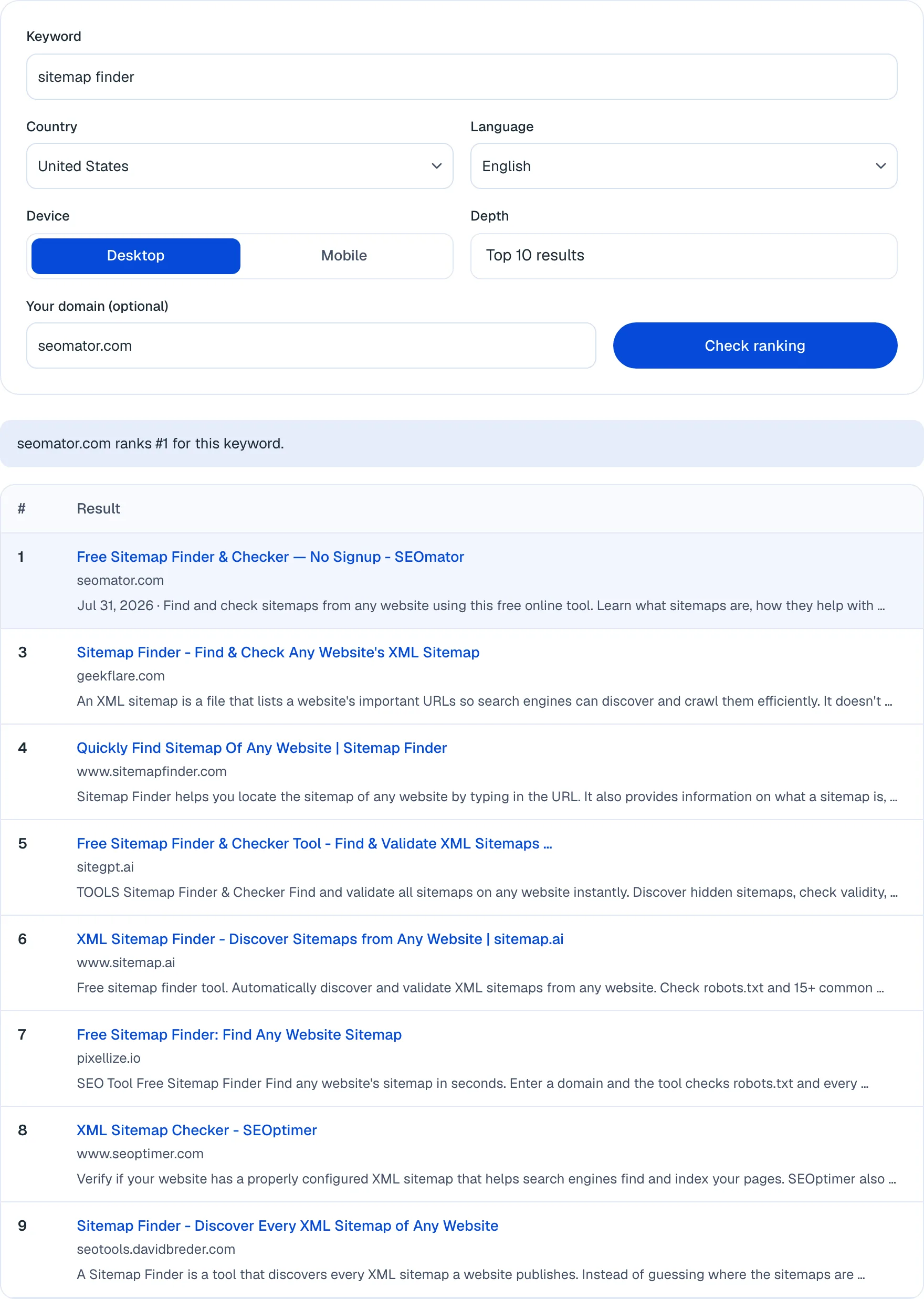
Type the query you want to check and the domain you're looking for in Bing's results. No account, no verification.
Bing's results differ by country, language and device, so set all three — then choose how far down to look, from the top 10 to the top 100.
We query Bing in real time and show your position plus the results above and below you, so you can see exactly who you'd have to pass.
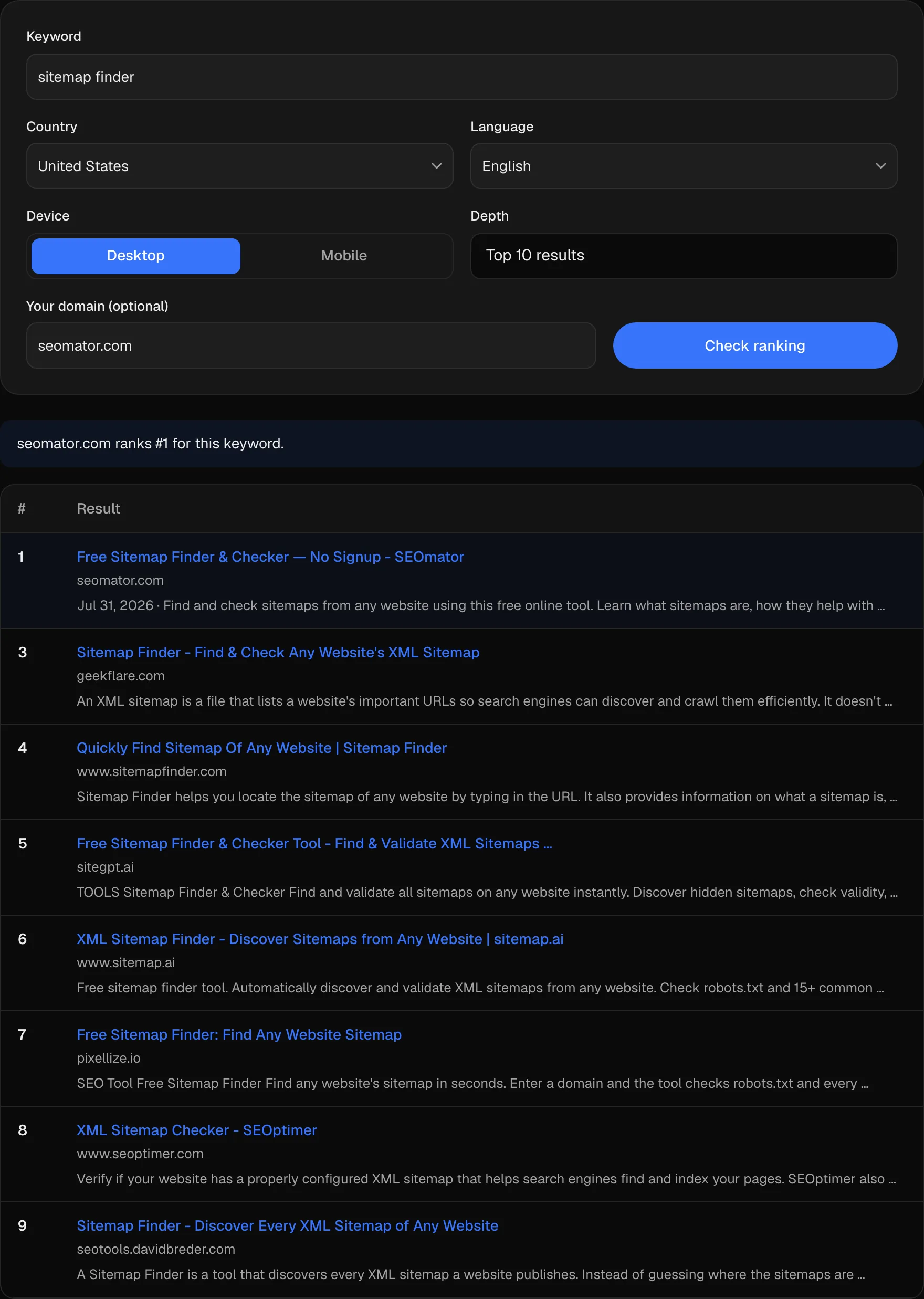
Everything in this grid works right now, no sign-up. The marked features unlock when you create a free SEOmator account.
Enter a query and your domain. We fetch the current Bing SERP and show where you sit in it.
Bing localizes heavily. Check the market your buyers search from instead of the one you sit in.
Run the same keyword on both device types — Bing skews desktop, and the two SERPs are not identical.
Top 10 for a quick answer, or 100 deep when you're tracking a keyword that hasn't reached page one yet.
Your domain's row is marked inside the full listing, with every competing page around it in view.
Every check queries Bing live. No stored database, no position averaged over last month.
Bing positions tracked over time, so you see direction instead of a single snapshot.
Get told when a keyword moves, rather than remembering to re-check it by hand.
251 technical checks across your whole site, with the issues ordered by impact.
Create a free SEOmator account to unlock rank history, alerts and full site audits.
Sign up free Reviewed byCharles Duncan · Co-founder & CTO
I own the crawler and rank-tracking infrastructure at SEOmator, and this checker runs the same live pipeline as our paid Bing tracking. The number it returns is a real, depersonalized Bing position for the market you picked, not an average across markets like the one in Bing Webmaster Tools. The reason I keep it free is that it settles arguments: comparing a keyword's Bing position with its Google position is the fastest way I know to tell a Google-side algorithm change apart from something broken on your own site. Two honest limits. It reports the organic position only, so it can't tell you whether Copilot quoted you in the answer sitting above those results. And one check has no memory — if Bing revenue matters to you, you need a series, not a snapshot.
 Charles Duncan · Co-founder & CTO
Put Bingbot's crawl volume from Bing Webmaster Tools next to the visits Bing sends you. A big gap is normal: Microsoft reads far more of a site than its click volume suggests, and that reading is what its answer surfaces draw on. So a Bing position is worth knowing even when Bing traffic looks small.
If Google slides and Bing holds, the cause is usually on Google's side, not your page. If both fall together, look at your own site first: crawl access, status codes, a lost link. That one comparison saves a day of guessing.
When a page ranks in Google and is missing from Bing entirely, client-side rendering is my first suspect. Load the URL with JavaScript disabled — if the body text disappears, that's what Bing indexed.
Bing acts on IndexNow submissions quickly, which makes it a faster feedback loop than Google for testing whether a change registered at all. Publish, submit, check the position mid-week.
Bing's results shift more between countries than most people expect. Checking a German keyword from a US IP tells you almost nothing about what a customer in Munich sees.
The tool stores nothing. A bare position is uncomparable later — three fields of context turn it into evidence you can put in a report.
You have four options, and they answer different questions. A manual search tells you what you see; Bing Webmaster Tools tells you what Bing recorded for your verified site; a SERP checker like the one above tells you the neutral position for a specific country, language and device; the API route tells you all of that at scale. Most people need the third one, and reach for the first by habit.
| Method | What it gives you | Blind spot |
|---|---|---|
| Manual search (free) | A rough position, in your own market | Your IP, language and history colour it |
| Webmaster Tools (free) | Average position, clicks, impressions | Averaged across markets; your site only |
| This checker (free) | Exact position by country, language, device | One keyword per check, no history |
| Bing API / data provider (paid) | The same data for hundreds of keywords | Setup and billing before the first answer |
Two habits are worth breaking. Don't check in a private window and call it neutral: private browsing hides your history, not your IP address, so the market is still yours. And don't read a Webmaster Tools "average position" of 8.4 as a rank of 8 — it's a mean across every market, device and query variation Bing recorded, which is a different number from "where does this page sit for this keyword in Germany on mobile".
A Bing results page is a stack of blocks, and organic results are only one of them. The elements you'll meet most often:
The practical consequence: ranking first is not the same as being first on the page. On a query that fires a Copilot answer, an image pack and four ads, the top organic result can sit below the fold. The checker above returns your position in the organic list, which is the number you can influence with SEO. Read it alongside what the page actually looks like when you search it yourself.
Because they're two separate systems that happen to look alike. Four differences do most of the work:
Separate crawlers, separate indexes. Bingbot and Googlebot visit your site independently, at different rates, and each builds its own index. A page Google indexed on Tuesday may not be in Bing's index for another week, and a page Bing dropped may still rank in Google. Different index, different results.
Different amounts of the web. Google's index is larger. On long-tail queries, Bing often has fewer candidate pages to rank, which is why a small site sometimes ranks noticeably higher in Bing for a term it can't crack in Google.
Different weighting. Bing's published webmaster guidelines put clear, obvious relevance signals first: the query terms in the title, headings and body, plus site-level authority and engagement. Google leans harder on query interpretation, rewriting and expanding what you typed. A page written to match a phrase literally therefore tends to do relatively better in Bing.
Different personalization. Both engines localize and personalize, but not identically, and Bing's results for the same query can differ sharply between the US, the UK and Germany. That's the reason the checker asks for a country and language instead of guessing.
None of this means you optimize for Bing separately. It means Bing is a second, independent read on the same work — and when the two engines disagree loudly, the disagreement itself is diagnostic.
Bing's click share is smaller than Google's, and no honest tool page will tell you otherwise. The argument for checking it anyway is what sits downstream of the index.
Bing's results also serve Microsoft Copilot, DuckDuckGo and Yahoo. When you rank in Bing, you're eligible in places that never show a Bing logo — which is why "Bing traffic" in your analytics understates Bing's actual reach.
The crawl side is louder than the click side. Open Bing Webmaster Tools and compare how many of your pages Bingbot fetches with how many visits Bing sends back: Microsoft reads far more of a site than its click share suggests, and that reading is what its answer surfaces, Copilot included, draw on.
So the honest test is your own data, not a market-share chart. Open your analytics, filter organic sessions by search engine, and look at revenue or signups rather than sessions. Bing traffic skews toward desktop and older Windows-default users, and in some B2B and finance niches it converts better than the volume suggests. If Bing is 3% of your sessions and 8% of your demo requests, it has earned a keyword check.
If the checker returns a full result list and your domain isn't in it, the usual cause isn't ranking — it's that Bing never got a clean copy of the page. Four failures account for most of it, and all four turn up constantly in site audits.
Content that only exists after JavaScript runs. Sites built on client-side frameworks often ship body text that is present in the rendered page but absent from the raw HTML. Google usually renders its way past that. Bing is less forgiving, so a page whose body text arrives via client-side JavaScript can be indexed as a near-empty shell. If a page ranks in Google and is invisible in Bing, check this first: fetch the URL with JavaScript disabled and see what's left.
Broken internal links. Bing discovers pages by following links; a page whose only inbound links return 4xx is a page Bing has no route to.
Redirect chains. Each hop is a chance to lose the signal, and chains build up quietly with every migration and slug change. Point old URLs at the final destination in one step; the redirect checker shows every hop.
Blocked or ambiguous crawl instructions. A stray Disallow, a noindex left over from staging, or a canonical tag pointing somewhere else all remove the page from consideration silently. A robots.txt test and a full site audit catch these in a minute.
Once the page is fetchable, submit it. Bing Webmaster Tools accepts direct URL submission, and IndexNow pushes the change the moment you publish rather than waiting for the next crawl.
The same broad forces as Google — relevance, authority, technical health, engagement — with different emphases. The parts you control, roughly in the order they tend to matter:
Ranking positions also move for reasons that have nothing to do with you: index refreshes, algorithm updates, a competitor publishing, seasonality. That's why a single check is a data point and a series is a signal.
Three moments are worth a check. A baseline before you change anything, so later movement means something. Two to four weeks after a change to a page's title, content or internal links — earlier than that and Bing may not have recrawled. And after any drop you spot in Google, because comparing the two engines narrows the cause faster than staring at one.
That last one is the most useful and the least practised. What a divergence usually means:
| What you see | Likely cause | Check first |
|---|---|---|
| Google drops, Bing holds | A Google-side change, not your page | Google update dates, then content quality |
| Both drop together | Your site: regression, de-index, lost link | Crawl access, status codes, canonicals |
| Bing drops, Google holds | Bing-specific crawl or index trouble | Bingbot hits in your logs, then Bing's index report |
| Neither has the page | It was never indexed | Submitted? Reachable? Not blocked? |
Whatever the number, write it down with its date, country and device. A position without that context can't be compared to anything, which is how "we used to rank third" turns into an argument nobody can settle.
Four honest limits, so you know when to reach for something else.
No history. Each run is a live snapshot with nothing stored. For a trend line you need recurring rank tracking, which is the paid side of our platform.
Organic positions only. Ads, local pack entries and shopping cards aren't ranked here, and neither is your position inside a Copilot answer. If the AI answer is what you care about, a GEO audit is the closer fit.
Country and language, not city. The check runs at country level. Local businesses competing street by street need local rank tracking with real coordinates.
One keyword at a time. Fine for a spot check or a sales call, slow for a hundred keywords. That's the point at which manual checking stops being the cheap option.
For the Google side of the same keyword, run the Google SERP rank checker and compare the two positions directly. The pair of numbers tells you more than either one alone — and a Bing-versus-Google gap that won't close is usually a content-clarity problem, which our Google and Bing comparison walks through in detail.
Source for the crawler and audit figures above: SEOmator crawling and analytics data, January–July 2026 (100K+ websites audited, 50M+ pages crawled, 50M+ users tracked monthly across 500+ sites running our analytics).
A client asks why a keyword you fixed still looks flat. Pull the Bing position alongside the Google one and show which engine actually moved, with the market and device named.
Google rankings fell overnight. Check the same keywords in Bing: holding steady points at a Google update, falling together points at your own site — then confirm with a free site audit.
Your buyers work on managed Windows machines where Bing is the default. Track the terms they use in Bing directly instead of assuming your Google rank covers them.
Every check queries Bing itself in real time. Nothing is served from a cached database, and no Google result stands in for a Bing one.
The full result renders on the page. No credit card, no email gate, no trial that expires after three queries.
213 countries, 129 languages, desktop or mobile. A Bing rank only means something in the market you compete in.
Page-two keywords are where most of the work happens, so the check doesn't stop at 10 results.
Run the identical keyword through the Google SERP rank checker and compare the two positions side by side.
One of 29 free SEO tools, from backlink checks to a complete site audit.
They are built by separate systems. Bingbot and Googlebot crawl your site independently and each maintains its own index, so a page can be current in one and stale or absent in the other. Google's index is larger, which is why small sites often rank higher in Bing on long-tail queries. Bing also weights literal keyword matches in titles and body text more heavily, while Google does more query rewriting and interpretation. The page layouts differ too: Bing's results carry Copilot answers, knowledge cards and image packs in their own arrangement above the organic list.
To improve your website's SERP position on Bing, you should focus on creating high-quality, relevant content, building a strong backlink profile, and optimizing your website for user experience and search engine optimization.
No — paid ads and organic positions are separate. Microsoft Advertising can put you above the organic results, and that placement is marked as an ad, but buying it does not move your organic rank. Ads and SEO work on the same page and on different mechanisms.
Bing updates its SERP algorithm regularly, but the frequency of updates can vary. Some updates are small and incremental, while others are more significant. The company does not disclose the exact timing of updates.
For a one-off answer, use a Bing SERP checker like the one on this page: enter the keyword and your domain, pick the country, language and device, and read the position. For a trend line you need recurring rank tracking, which stores each check so you can see direction rather than a single day. Bing Webmaster Tools also reports an average position for verified sites, though it averages across every market and device.
Some common SERP features include Featured Snippet, Knowledge Graph, Image Pack, Video Pack, Site Links, Local Pack, News Pack, Top Stories, People Also Ask and Shopping Pack.
Neither answer is clean. OpenAI has not published a permanent search provider for ChatGPT, and its search results come from a mix of its own crawler (OAI-SearchBot) and third-party providers. The engine that unambiguously runs on Bing's index is Microsoft Copilot; DuckDuckGo and Yahoo also serve Bing results. That is the practical reason to know your Bing position: it gates visibility on surfaces that never show a Bing logo.
Search Bing for the exact URL, or use a `site:` query for the domain — but treat both as indicative, since operator results are sampled rather than complete. The reliable route is Bing Webmaster Tools, which reports index status per URL for verified sites and lets you submit a URL directly. If a page is missing, the usual causes are a blocked path, a leftover noindex, a canonical pointing elsewhere, or body text that only exists after JavaScript runs.
Usually you don't optimize for Bing separately — the same technical health, clear on-page relevance and links serve both. What is worth doing separately is checking Bing, for two reasons: its results also feed Microsoft Copilot, DuckDuckGo and Yahoo, and a Bing-versus-Google gap on the same keyword is a fast diagnostic. Look at conversions rather than sessions before you decide how much Bing matters to you; Bing traffic skews desktop and, in some B2B niches, converts above its share.
Yes. Enter their domain instead of yours and the check highlights their position for that keyword in the market you select. Because the tool returns the full organic listing, you also see everyone ranking between you and them, which is the more useful part: it shows what has to be passed, not just the gap.
Deeper reading from the SEOmator blog on what this tool measures.
· 16 min read
Bing crawls roughly 36 pages for every visitor it sends back; Google needs about five. We compared both engines on market share, AI search, ad costs, and our own crawler data.
· 8 min read
Search Console and a live rank check rarely agree: on our own site they were 4.9 positions apart. 5 ways to monitor organic rank, and which number to trust.
Elevate your online presence with our tool: Get found, Get ahead


