SEOmator Handbook
Nothing changes on a customer's site until they publish it.




All contents
SEOmator is the AI SEO Manager for B2B SaaS: keyword and prompt tracking, a playbook that decides, and an agent that does the tasks you approve. It's run by Next Marketing Technology Ltd, a software company registered in London, and built by a small team that works remotely.


SEOmator launched in May 2014. Since 2023 it has been owned and run by Next Marketing Technology Ltd, a private limited company registered in England and Wales (company number 14384054). Emre Elbeyoglu, who founded Next Marketing Technology and is its director, has run SEOmator as Founder & CEO since September 2026. The registered office is in London (Flat 23, Kings College Court, 55 Primrose Hill Road, NW3 3EA), and the team works remotely.
The name SEOmator is a registered UK trade mark (UK00004362356). No outside investor has backed SEOmator or its parent company, which also runs other AI-native marketing products: WebsearchAPI, markdown.new, GEO.new, TinyAnalytics, Growthmarketing.ai and enricher.io.
These are the people who build and support SEOmator. Emre and Oğuzhan have worked in the same team for more than five years, on different products, and Mert has worked with them since 2024. Before SEOmator, the three of them built and supported the B2B SaaS products Popupsmart and LiveChatAI.
 Emre Elbeyoglu, Founder & CEO, who also leads growth. He has run SEO and growth work since he co-founded the agency Flatart in 2013, and that consulting work turned into the products Popupsmart and LiveChatAI.
 Isabella Edwards, Technical SEO Content Manager. She leads our technical SEO writing (audits, Core Web Vitals and on-page fixes) and explains the reasoning behind each fix so a non-specialist can follow it.
 Oğuzhan Ulukaya, Software Developer since September 2026. He has built B2B SaaS products in TypeScript since 2021, Popupsmart and LiveChatAI among them, and his recent work puts AI features into production.
 Mert Özeren, Customer Success Specialist since September 2026. He has worked on the customer side of B2B SaaS since 2020, most recently on Popupsmart and LiveChatAI, and he's usually the one who turns what a user describes into what engineering needs to fix.
 Eva Morrison, Business Development Representative since November 2026, with more than six years in marketing: digital campaigns, content and social media.
Nobody on this list publishes to your site. The agent drafts, your team reviews, and you publish (how approval works).
SEOmator works by the operating principles of Next Marketing Technology, its parent company. Three of them:
- Operator-led. We build from problems someone on the team has had in their own work, recently, not from theory.
- Outcomes over impressions. Pipeline, revenue, retention and activation decide what we do. We track traffic and impressions, but they don't drive decisions, which is why the playbook starts with revenue pages.
- Public by default. We write in public and explain our pricing and product decisions. This handbook is one example, and so is our open-source audit engine.
The other two are "compound, don't churn" and "AI by default, not AI as a feature".
SEOmator is for any business that wants customers from Google and AI answers. Most of our know-how is in B2B SaaS, and that's the market the playbook is written for.


The usual buyer is a head of growth or a marketing lead at a B2B SaaS company, with no SEO specialist on the team, who needs signups from Google and from AI answers. A SaaS company's signups come from a few kinds of page: integrations, alternatives, comparisons and pricing. The playbook starts there. If you run several products, markets or clients, that's the Scale plan, and Enterprise adds volume, single sign-on and invoices (plans).
Online stores, local and service businesses, professional firms, publishers, marketplaces and new sites use the same platform: site audits, daily rank tracking, keyword research, backlinks and AI visibility tracking, with the agent drafting fixes that wait for your approval. What they don't get is the B2B SaaS playbook: SEOmator started in that niche, and the playbook's order of work is written for software companies. The free SEO tools are open to anyone, on any kind of site, without signing up.
A playbook picks what to fix first. Our agent drafts the fix, your team reviews it, and nothing on your site changes until you publish it.
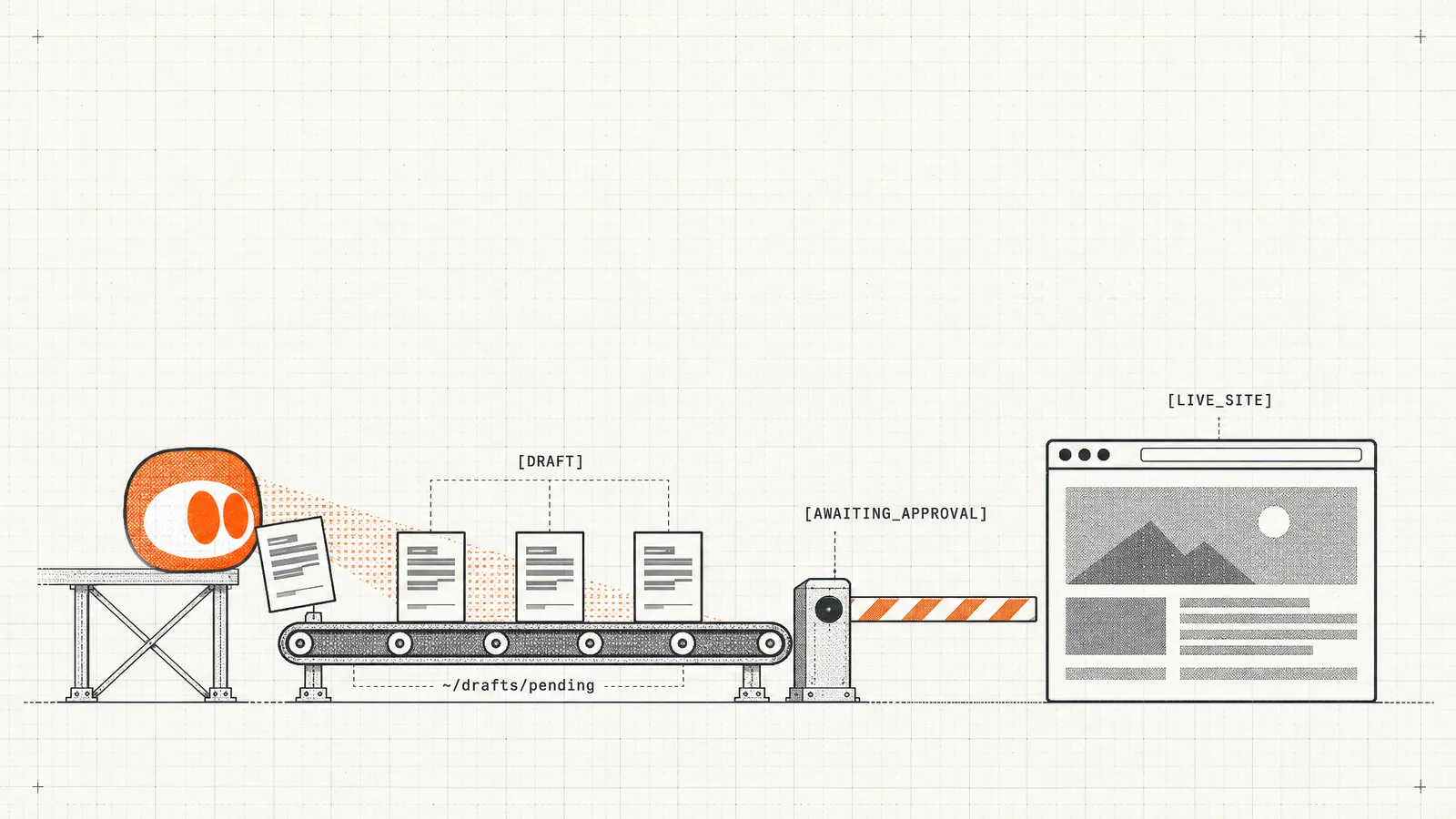

Every change goes through the same four steps, in this order:
The agent drafts it
SEOmator's agent writes the fix the playbook picked: a new page, a change to an existing one, or an outreach email.
Who: SEOmator's agent.
Your team reviews it
Someone on your team reads the draft and edits it until it's right.
Who: your team.
You approve it
The draft waits for your yes. So does every outreach email: nothing is sent before you approve it.
Who: you.
You publish it
The approved change goes live on your site. Until this step, your site stays exactly as it was.
Who: you.
We built it this way on purpose. A draft is cheap to fix before it goes live, and it's your brand and your signups on the line. As our About page puts it: "If you want an agent to change your live site without review, we're the wrong tool." Everything else SEOmator won't do is listed on our facts page.
The playbook turns what SEOmator finds on your site into one to-do list, ordered by what each task is worth. Revenue pages come first, then technical, on-page and off-page work. Each task tells you why it matters, roughly how long it takes and what it can change, so your team starts with the work worth doing.
Every day, SEOmator checks your Google rankings and asks AI assistants the questions your buyers ask. You see whether your brand is named, which of your pages get cited, and which competitors are named instead. The pricing page lists which assistants each plan tracks.
You pay us in one of three ways: a plan you run yourself, credits for what you use, or a monthly package where our team does the work. We don't sell rankings.


There's a free plan, and paid plans sized by how much you track. Every plan has unlimited seats, and each paid plan starts with a free trial that doesn't need a card. Prices and limits live on the pricing page. If this page and that one ever disagree, the pricing page is right.
Credits pay for usage. Each plan comes with monthly credits that cover tracking, workflows and the agent. Credits you buy also pay for the Data API, which sells SEOmator's raw data per call and only needs a free account. Failed calls cost nothing. Pack prices and per-call prices are on the pricing page.
If you'd rather not run SEO yourself, our team does the work for you on a monthly package (AI SEO services). The four steps stay the same: your team reviews each draft, and you decide what goes live.
Nobody controls Google or the AI answers, so nobody can honestly promise you a ranking or a citation. Where you rank also depends on search engine updates, on what your competitors ship and on your domain's history. What we promise is the work, with dated results that show what it changed. Each customer story names its customer, its source and its dates.
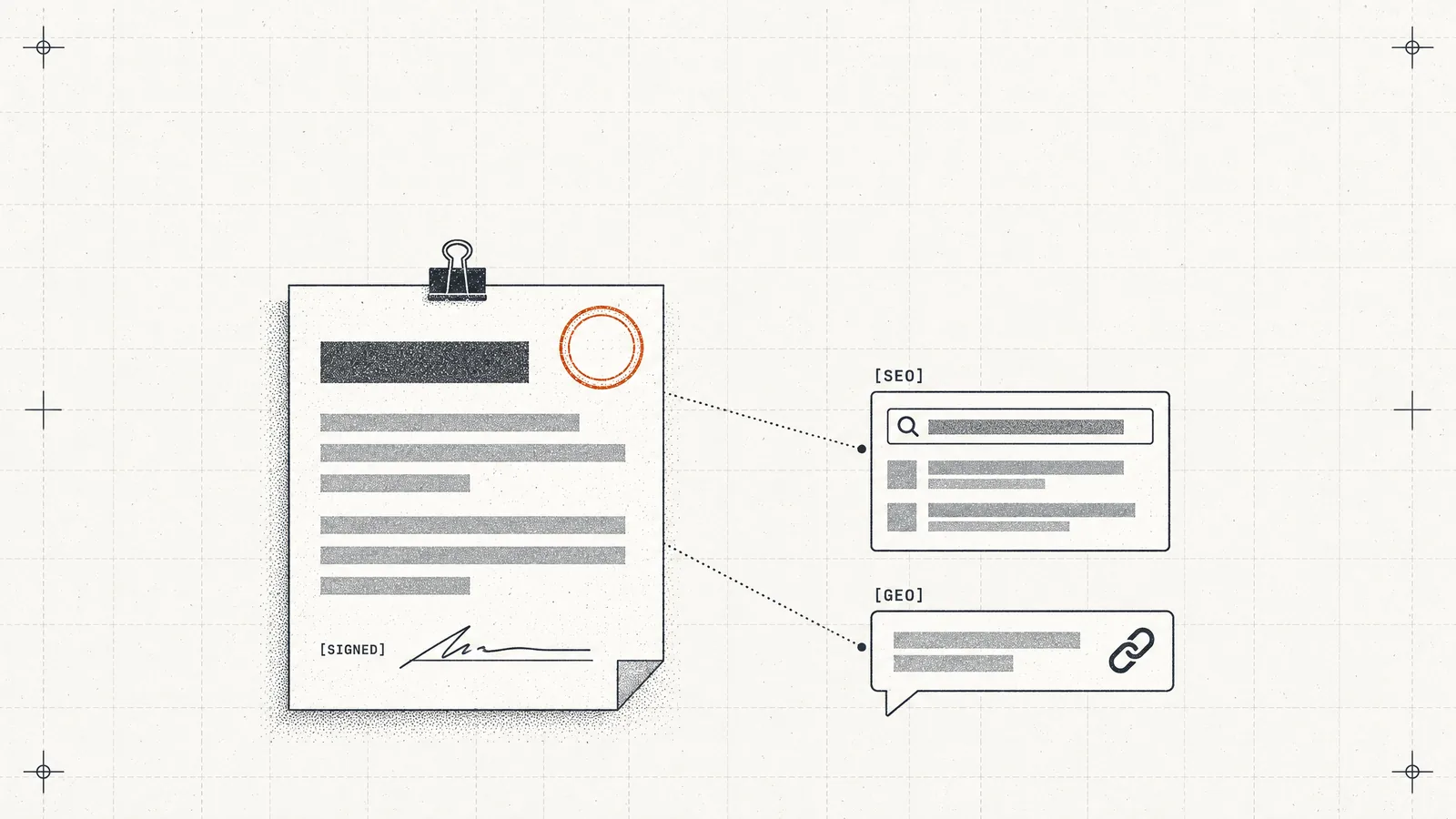
We start with the pages that bring signups, and every page we draft has to give readers something the top results don't. We sign and date the work (editorial standards), and we earn links instead of buying them. These are the rules behind the playbook. The playbook itself isn't public.

Visits are easy to grow and say little about revenue. If we judged our work by sessions, we'd end up writing posts that bring sessions. So the playbook judges a page by the signups it can bring, and starts with those pages.
If a page says what the top ten results already say, a search engine has no reason to rank it above them, and an AI answer can repeat it without sending anyone to you. So every page we draft brings something of its own: numbers from your own data, a free tool, a tested answer or an expert's view.
We don't pay for links. A site links to you when you give it something worth citing: your own findings, a free tool, an expert's answer, or a fix for a mention of you that's broken or has no link. The agent finds those sites and drafts each pitch, and nothing is sent until you approve it.
Every article we publish is signed by the person who wrote it, dated, and corrected in the open when it's wrong.


Every article names its author and the date it was last updated. A byline is a real person with a profile page you can check, and when someone leaves, the articles they wrote keep their name.
Our rule is that a number carries the date it was checked, or we don't publish it. Where a post rests on its own evidence, it shows how we know: what was tested, the method, its limits and who ran it. We publish a customer's figures only with that customer's approval. The rest of what you can hold us to is on our About page.
Most posts are written by our own team. Guest authors are practitioners at other companies who write only about work they do, under their own name, with their employer named on their profile, and we never present them as staff. A SEOmator editor reviews every guest piece for accuracy and clarity before it goes up, and any conflict of interest is disclosed at the top of the article. When a post names a reviewer, the review happened, and the post gives its date. We don't sell bylines, and no contribution depends on a link, a mention or a payment. Our authors page has the rest.
If something on this page, or anywhere on seomator.com, is wrong, write to support@seomator.com with the page and the fact. We'll correct it and date the change. Every blog post ends with the same invitation, and its history lists each correction.
Our SEO audit engine is open source under the MIT licence, so you can read exactly what each check measures.


It ships as a command-line tool and a Claude Code skill that check a page against a fixed set of rules. Each rule returns pass, warn, fail or "not measured", and every failure comes with a fix. We opened it because an agent shouldn't act on an audit nobody can check. Only the audit engine is open; the agent and the web app aren't.
It also has the limits of a lab tool. A plain audit covers one page, and a crawl stays short unless you raise the limit. Its rules are thresholds, not judgment, and its speed scores come from one lab load, not from your real visitors.
Details: how the CLI works · source on GitHub
Write to us by email or through the contact page. Corrections go to the same address (how we handle them).


Questions about SEOmator or your account go to support@seomator.com or the contact page. To access, correct, export or delete your data, email hello@seomator.com, as the Trust Center explains.
If you're writing about SEOmator, our facts page has the facts, the names and the words to use.
To see how this would work on your site, book a demo.