Free GEO Audit Tool: Optimize Your Website for AI Search Engines

Audit your website's readiness for ChatGPT, Perplexity, Google AI Overviews, Gemini, and Copilot with SEOmator's free GEO audit tool. Analyze up to 50 pages and get instant citability scores, E-E-A-T breakdowns, schema gap analysis, AI crawler access reports, and prioritized optimization recommendations. No registration needed. 100% free forever.

  • Before I start explaining

    I've spent years building SEO tools at SEOmator, but nothing prepared me for the shift we're living through right now. Search has fundamentally changed, and most businesses have no idea whether their content is structured for AI engines to actually use it. That's exactly why I built SEOmator's free GEO audit tool: to crawl your website, analyze your content block by block, and tell you exactly what to fix so AI search engines can cite, reference, and recommend your pages. We have audited +1M pages on our free seo audit tool so it's time to do that GEO Audit tool for AI Search traffic.

    Let me be direct: I built this tool because I watched it happen to us first. One of our clients, a SaaS company with solid Google rankings, saw their organic traffic drop by 30% in six months. Their rankings hadn't changed. Their content was still good. But when we dug into the actual structure of their pages, the problem was obvious: their content wasn't written in a way AI engines could extract and cite. No self-contained answer blocks. No structured data tables. No author bylines. Their robots.txt was even blocking two major AI crawlers without anyone realizing it. The content was great for humans—but invisible to machines.

    That experience convinced me that every business needs a proper GEO audit—one that crawls actual pages, scores actual content blocks, and provides actual fixes—without needing an enterprise budget or a specialized agency.

  • What Is a GEO Audit and Why I Built This Free

    GEO stands for Generative Engine Optimization—the practice of optimizing your website's content, structure, and technical setup so AI search engines like ChatGPT, Perplexity, Google AI Overviews, Gemini, and Copilot can understand, extract, and cite your pages when answering user queries. A GEO audit crawls your site, analyzes every page against the signals these AI platforms actually use, and tells you precisely what to change.

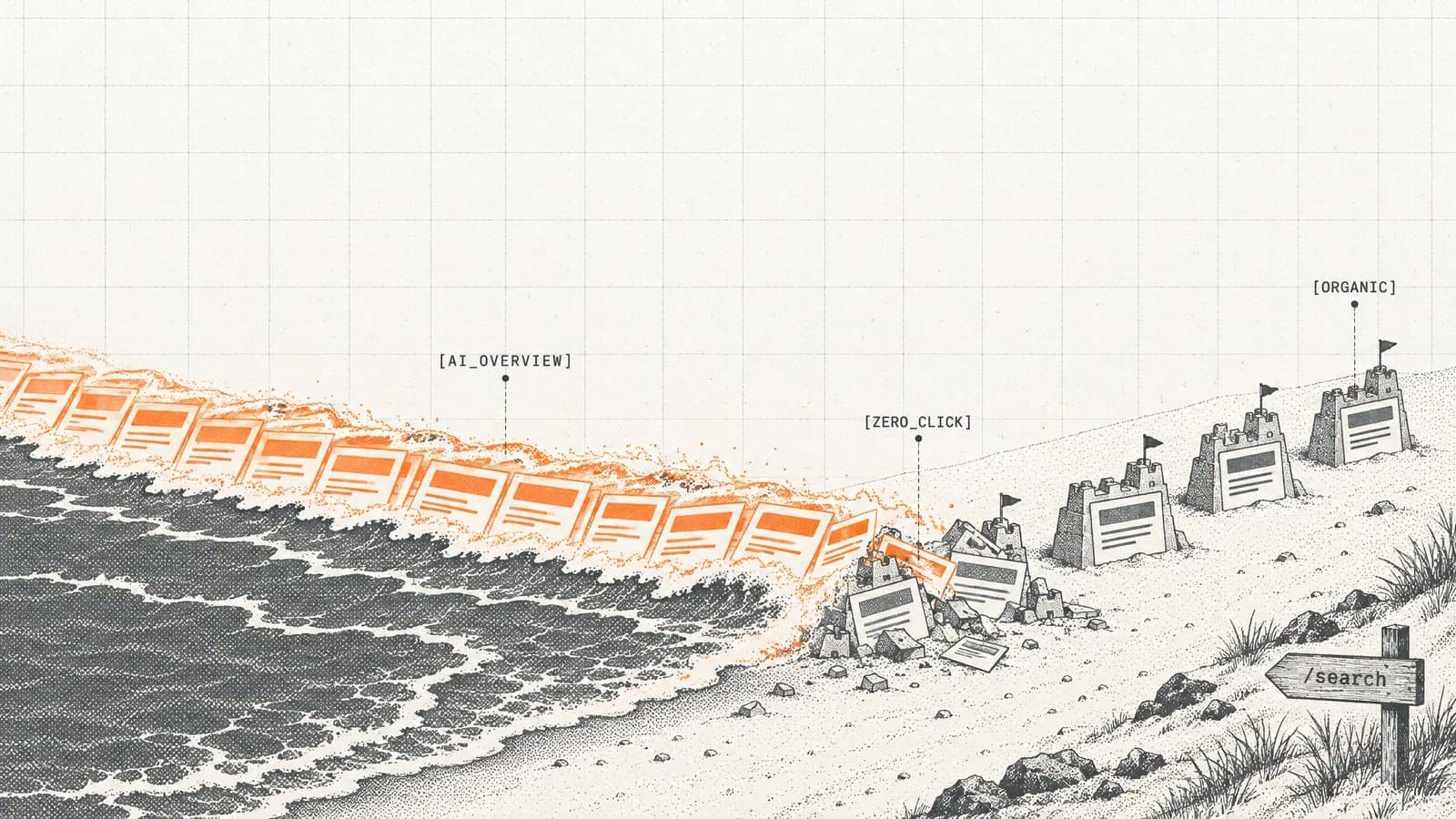
    Here's what really motivated me to make this tool completely free: According to Gartner, organic search traffic is projected to decline by 25% or more by the end of 2026, as users shift to AI chatbots and conversational search. AI-referred web sessions jumped 527% year-over-year in the first five months of 2025 alone. ChatGPT now processes over 2 billion queries daily with more than 880 million monthly users. Google AI Overviews appear in roughly 25% of all searches—up from 13% just a year earlier. And Perplexity has surpassed 780 million monthly queries.

    This isn't a future trend—it's happening right now. Yet most websites have never been audited against the criteria AI engines actually use to select citations. The GEO market, valued at $848 million in 2025 and projected to reach $33.7 billion by 2034, is still largely inaccessible to small businesses. Enterprise companies pay thousands for AI optimization audits while small businesses and solo entrepreneurs are left guessing. At SEOmator, we believe AI search optimization intelligence shouldn't be a luxury. That's why this tool is completely free—no credit card, no registration, no catch. Just instant, page-level optimization insights when you need them.

  • How I Built SEOmator's Free GEO Audit Tool to Actually Help You

    When I designed this tool, I didn't want another surface-level score. I wanted a tool that crawls up to 50 of your pages, analyzes your content at the block level, checks your technical infrastructure, evaluates your schema markup, tests your AI crawler access, and hands you a prioritized list of exactly what to fix. Here's what you'll get:

    GEO Score with 6-Category Breakdown

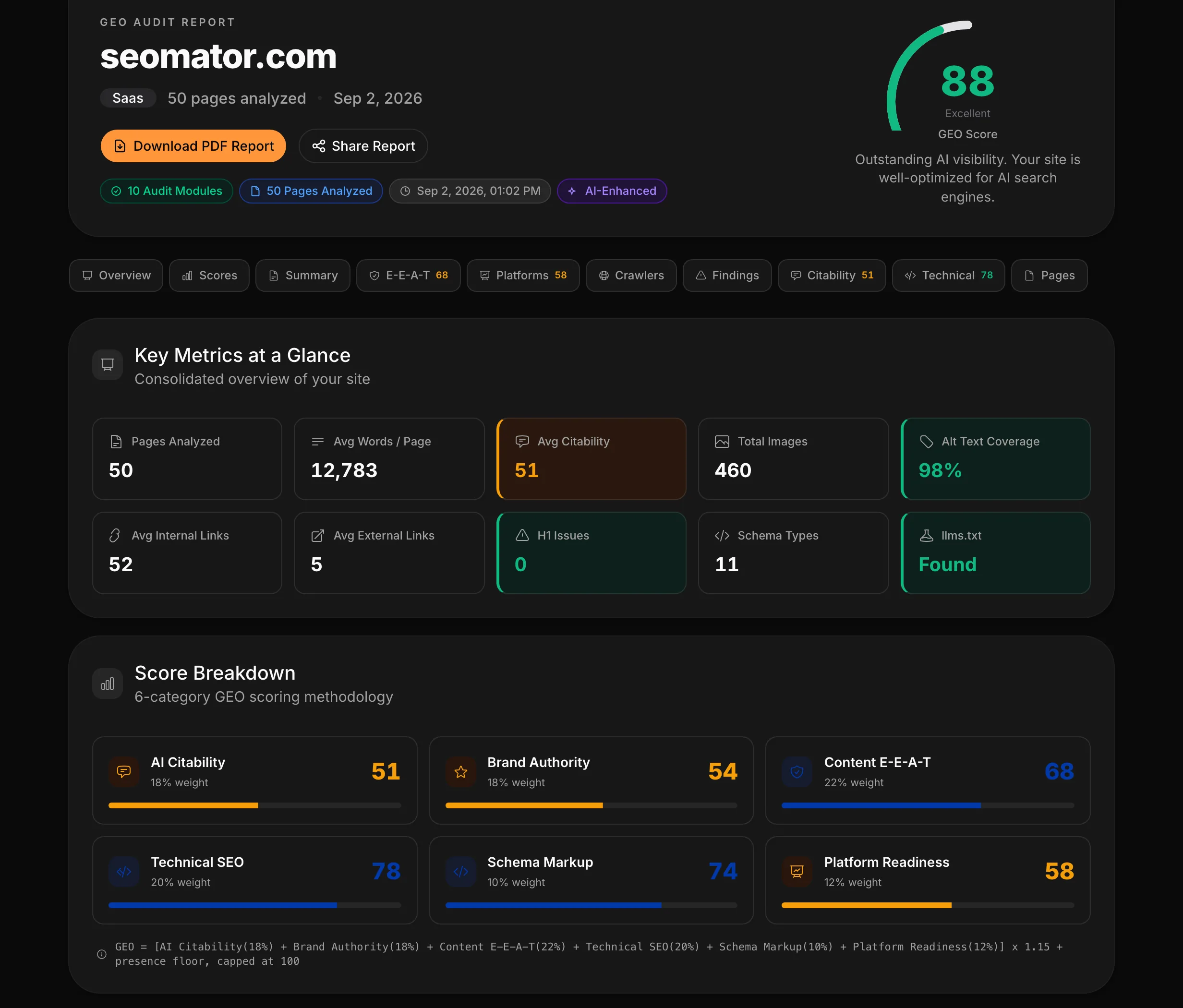
    A single composite score from 0 to 100, calculated using a weighted methodology: AI Citability (25%), Brand Authority (20%), Content E-E-A-T (20%), Technical SEO (15%), Schema Markup (10%), and Platform Readiness (10%). But I didn't stop at the overall score—each category gets its own score so you can pinpoint exactly where your site is strong and where it's leaking opportunity.

    Page-by-Page Content Analysis

    The tool crawls up to 50 pages and measures each one individually. For every page, you'll see the heading structure (H1 through H6), internal and external link counts, image counts with alt text coverage percentages, word counts, and schema types detected. I built this because GEO optimization isn't a site-wide toggle—it's a page-by-page discipline. Your blog might score 56 while your alternative comparison pages score 60. That difference tells you which content templates are working and which need restructuring.

    Block-Level Citability Scoring

    This is where most audit tools stop, and where ours goes deeper. We don't just score pages—we score individual content blocks within each page. Every paragraph gets evaluated on five dimensions: Answer Quality, Self-Containment, Structure, Statistics, and Uniqueness. A content block scoring 71/100 with 98% Self-Containment but only 38% Statistics tells you exactly what's missing: that paragraph reads well and stands alone, but it needs more data points to be citation-worthy. This granularity is what turns a vague "improve your content" recommendation into an actionable editing task.

    E-E-A-T Breakdown Across Four Dimensions

    Experience (first-hand knowledge, case studies, original research), Expertise (credentials, technical depth, structured content), Authoritativeness (citations, press mentions, brand recognition), and Trustworthiness (security headers, contact information, editorial standards). Each dimension scores separately out of 25. When I see a site with Trustworthiness at 25/25 but Expertise at 11/25, I immediately know the site has solid security fundamentals but needs more visible author credentials and deeper content structure. That specificity is what makes the audit actionable.

    AI Platform Readiness per Engine

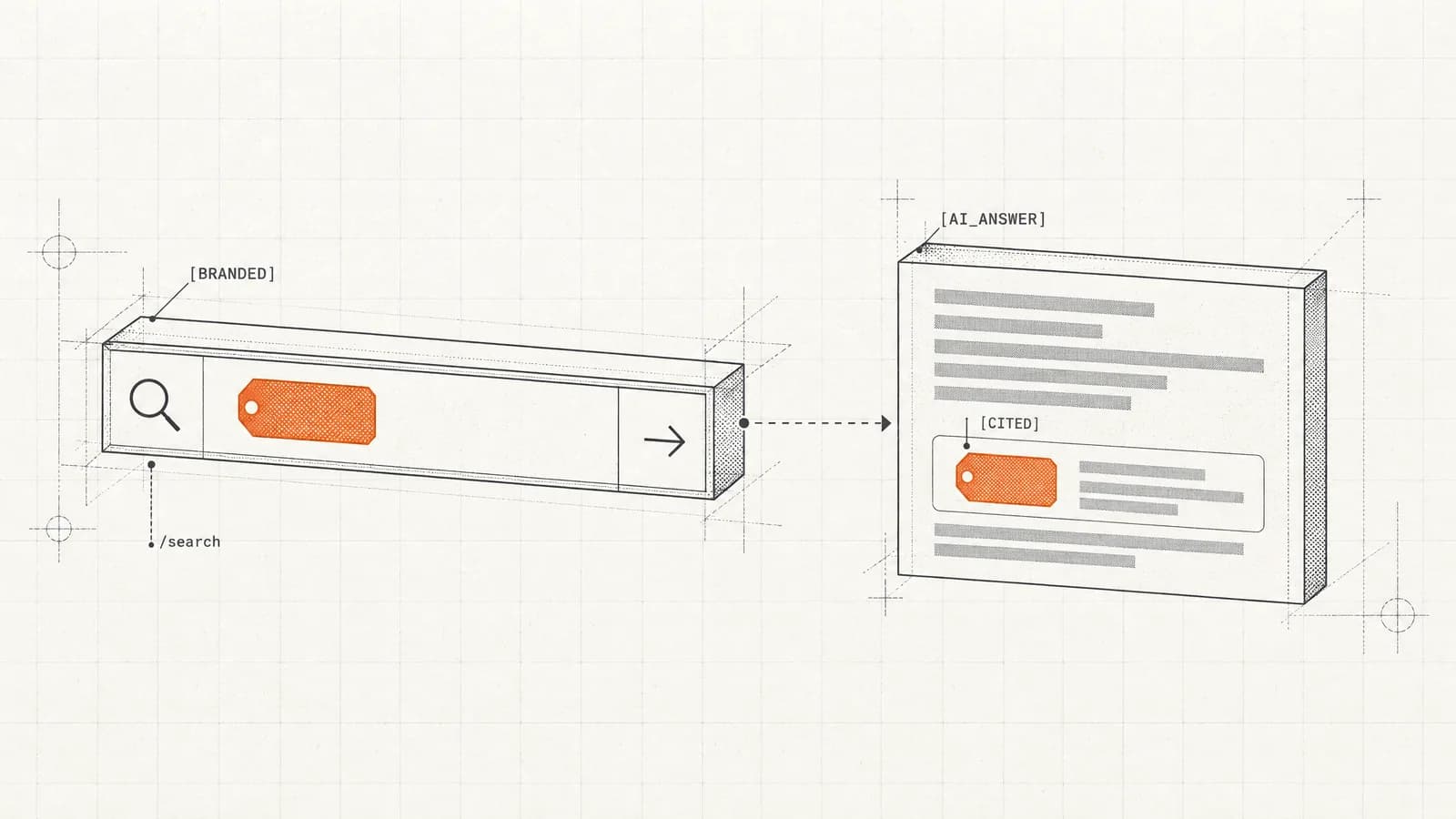
    Not all AI search engines are the same. ChatGPT heavily weights Wikipedia and Wikidata for entity understanding. Perplexity rewards Reddit presence and content recency. Google AI Overviews prioritize existing top-ranking content and structured data. Bing Copilot weights LinkedIn signals. Our tool scores your optimization level for five platforms individually—Google AIO, ChatGPT, Perplexity, Gemini, and Copilot—with platform-specific scores so you can optimize based on where your audience actually searches.

    AI Crawler Access Report

    We check your robots.txt against 14 AI-specific crawlers across three priority tiers. Tier 1 includes GPTBot, OAI-SearchBot, ChatGPT-User, ClaudeBot, and PerplexityBot—the crawlers for the platforms handling the most AI search queries. Tier 2 covers Google-Extended, GoogleOther, Applebot-Extended, Amazonbot, and FacebookBot. Tier 3 includes CCBot, anthropic-ai, Bytespider, and cohere-ai. You'll see exactly which bots are allowed and which are blocked, with an overall access rate percentage. Nearly 80% of top publishers now block at least one AI crawler—but many businesses are blocking the wrong ones by accident.

    Schema & Structured Data Gap Analysis

    We detect your current JSON-LD schemas, verify whether they're server-rendered, and identify which recommended schemas are missing. More importantly, we check your sameAs links—the connections between your site and platforms like Wikipedia, Wikidata, LinkedIn, YouTube, Twitter, GitHub, and Crunchbase. Missing sameAs links are one of the most common and fixable schema gaps we find, and they directly impact how AI engines understand your brand as an entity.

    Brand Authority Platform Presence

    We check whether your brand has an active presence across YouTube, Reddit, Wikipedia, LinkedIn, and GitHub—each weighted by their impact on AI citation signals. A missing Wikipedia entry isn't just a branding gap; it's a 20% penalty on ChatGPT's ability to recognize your brand as a real entity. This section tells you which platforms to prioritize.

    Technical SEO Infrastructure Check

    Eight categories—Crawlability, Indexability, Security, URL Structure, Mobile, Core Web Vitals, Server-Side Rendering, and Page Speed—each scored individually. AI crawlers need fast, accessible, well-structured pages. Server-side rendering is particularly critical because many AI crawlers don't execute JavaScript, so client-rendered content is effectively invisible to them.

    llms.txt Validation

    We check for the presence and proper formatting of your llms.txt file—the emerging standard for communicating with AI agents about your site's content and structure. Think of it as robots.txt for AI models: a way to help GPTBot, ClaudeBot, and other AI crawlers understand what your site offers and how to navigate it.

    Prioritized Findings with Impact Estimates

    Every issue we discover gets classified as Critical, High, Medium, or Low priority, with estimated score impact (like "+5-8 points") and implementation timelines (Quick fix, 1-2 weeks, 1+ months). I don't just tell you what's wrong—I tell you what to fix first and how much it's likely to move your score.

    Executive Summary with Projected Score

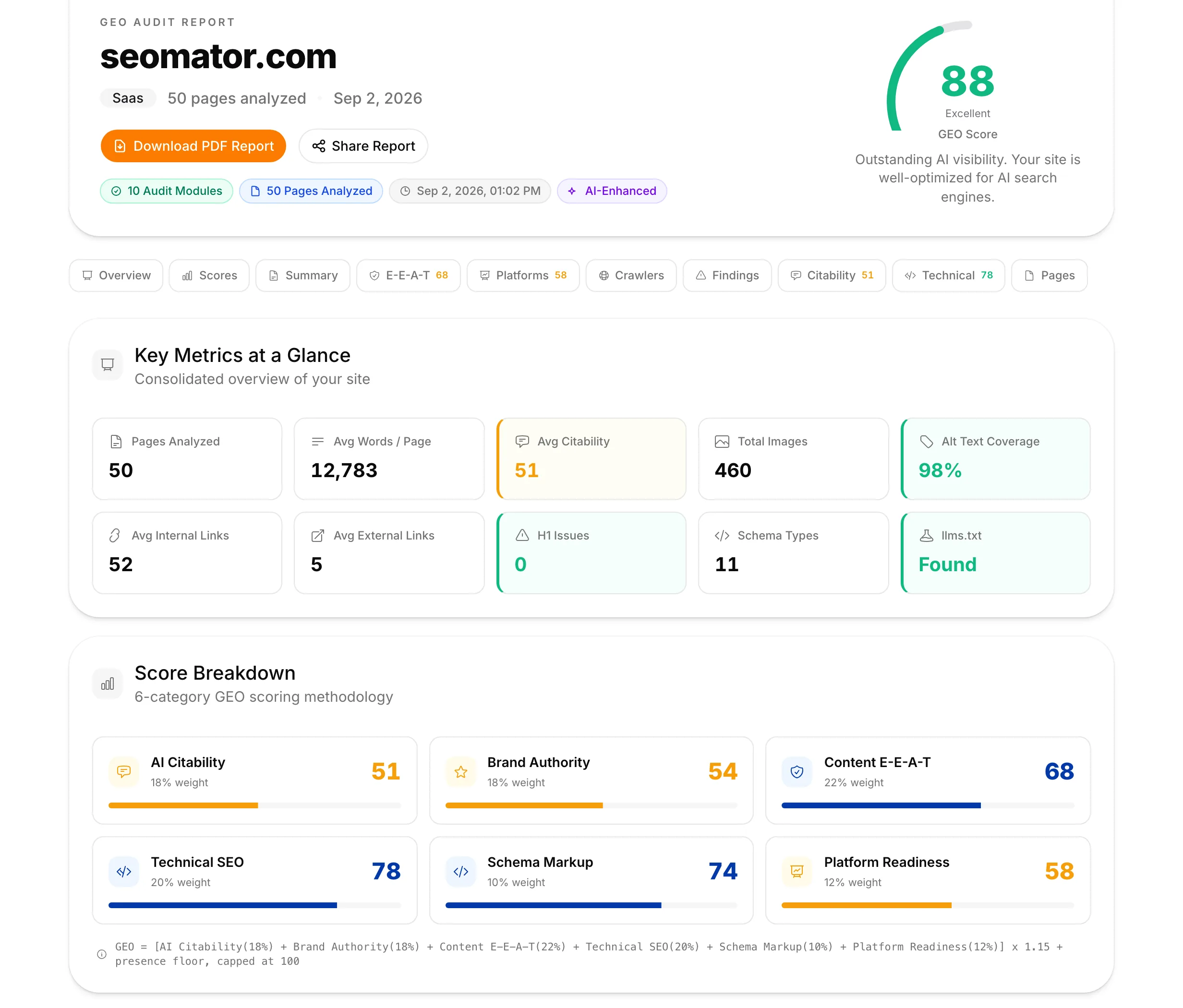
    Each audit includes a plain-language summary of your site's strengths, weaknesses, and biggest opportunities, along with a projected score range after implementing the priority actions. When I audit a site that scores 88 but could reach 100 with two specific changes, that clarity is what separates a useful audit from a data dump.

  • My Personal Approach to Using This Tool Effectively

    After helping thousands of users audit and optimize their sites, I've learned some patterns about how to get the most value from a GEO audit:

    Start with the Executive Summary, Then Drill Down: Your overall GEO score gives you the big picture, but the executive summary tells you the story. A site scoring 88 with a Schema Markup sub-score of 9/100 has one obvious priority. Read the summary first, then explore the category that's dragging your score down the most.

    Check Your AI Crawler Access Immediately: This is the fastest win in GEO. If major AI crawlers like GPTBot, PerplexityBot, or ClaudeBot are blocked by your robots.txt, nothing else matters—your content is invisible to those platforms regardless of quality. I've seen sites with amazing content score poorly simply because they accidentally blocked the bots that would have cited them. It takes minutes to fix and can unlock visibility overnight.

    Read Your Citability Scores at the Block Level: This is where the real optimization happens. Don't just look at the page-level citability score—examine which specific content blocks scored highest and lowest, and why. A block with 98% Self-Containment but 38% Statistics tells you it needs more data. A block with high Statistics but low Answer Quality tells you the data is there but the framing needs work. These block-level scores turn vague content advice into specific editing instructions.

    Compare Platform Readiness Scores: If your audience primarily uses ChatGPT for research, but your ChatGPT readiness score is 56 while your Perplexity score is 75, you know exactly which platform-specific signals to prioritize. The audit shows you these differences so you can focus on the platforms that matter most to your business.

    Use the Page-Level Table to Find Patterns: When you see that your alternative comparison pages consistently score 57-60 while your customer story pages score 45-48, that pattern reveals a content template issue. The comparison pages likely have better structure, more self-contained blocks, and more external links. Apply whatever's working in your high-scoring templates to your low-scoring ones.

    Tackle Findings in Priority Order: Critical findings first, then High, then Medium. Each finding includes an estimated point impact and implementation timeline. A critical finding like "No Wikipedia Presence" with a +3-5 point estimate and 1+ month timeline is worth starting now even though it takes time. A quick-fix finding like "llms.txt present and valid" confirms something is already working—don't touch it.

    Re-Audit After Every Round of Changes: Made your robots.txt changes? Run the audit again. Added Organization schema with sameAs links? Audit again. Restructured your top 10 pages with better opening blocks? Audit again. The tool is free—use it to measure the impact of every change you make.

  • Real Statistics That Changed How I Think About AI Search Optimization

    I want to share some numbers related to AI SEO that fundamentally changed my perspective on why GEO auditing matters:

    AI Overviews have grown from appearing in 6.49% of searches in early 2025 to over 25% by early 2026—and some studies report up to 50% for specific query categories. This isn't a slow rollout; it's an exponential expansion of the AI answer surface.

    Here's what's especially critical for content optimization: 44.2% of all LLM citations come from the first 30% of text on a page. That means your opening paragraphs aren't just introductions—they're your citation-or-bust moment. If your first 200 words don't directly and completely answer a query, AI engines move on to a competitor's page that does. Our citability analysis scores exactly this kind of structural readiness.

    The citation concentration is also striking: the top 20 most-cited domains account for over 66% of all AI Overview citations. Wikipedia, YouTube, Reddit, and Amazon dominate. But 80% of LLM citations don't even rank in Google's top 100 for the original query—which means traditional SEO rankings are an increasingly poor predictor of which content gets cited. The pages that win AI citations are the ones with the right structure, the right schema, and the right signals. That's precisely what our audit measures.

    What keeps me building better tools: 62% of enterprise brands are "technically invisible" to generative AI models. When asked direct questions about their core services, AI models fail to cite them in 81% of test cases. Yet only 16% of brands systematically track or audit their AI search optimization. The gap between the threat and the response is enormous.

  • Why I Made This Tool Completely Free (And Will Keep It That Way)

    I get asked this constantly: "What's the catch? Why is this free?"

    The answer is simple: I believe AI search optimization intelligence should be accessible to everyone. At SEOmator, we're building a comprehensive suite of SEO and GEO tools. While we offer premium features for enterprise-scale monitoring, competitive benchmarking, and ongoing optimization, a core GEO audit that crawls your pages, scores your content, and shows you what to fix should never be locked behind a paywall.

    The GEO market is projected to grow from $848 million in 2025 to $33.7 billion by 2034—a staggering 50.5% compound annual growth rate. The demand is there because the stakes are real. But I've watched too many small businesses fall behind in AI search simply because they never audited their content against the criteria AI engines actually use.

    My philosophy: if I can help even one business discover that their robots.txt is accidentally blocking GPTBot, or that their content blocks lack the self-containment AI engines need to cite them, or that a single missing schema type is costing them 5-8 points of optimization—the tool has done its job. Besides, when you experience the depth of our free audit, you'll remember SEOmator when you need more advanced GEO features.

  • What The Data From Our GEO Audit Actually Tells You

    Let me walk you through interpreting the results using a real audit example—Popupsmart, a SaaS popup builder we audited across 50 pages:

    GEO Score Interpretation: Popupsmart scored 88/100—rated "Excellent." But that single number hides critical detail. Their AI Citability scored just 50/100, Brand Authority 72/100, and Schema Markup a dismal 9/100—while Technical SEO (79) and E-E-A-T (78) were strong. Without the category breakdown, you'd think "88, great, nothing to do." With it, you see three high-impact improvement areas immediately.

    Citability Deep Dive: Their average citability was 50/100 across 50 pages. The top-scoring content blocks (71/100) were alternative comparison paragraphs—self-contained, specific, and structured enough for AI extraction. The weakest blocks (35-37/100) were vague marketing statements like "Game-changing solutions" and "Transform your emails with these solutions." Those blocks will never get cited because they contain no specific, extractable information. The audit shows you exactly which blocks are citation-ready and which need rewriting.

    E-E-A-T Breakdown: Trustworthiness scored a perfect 25/25—HTTPS, six security headers, privacy policy, contact page, all present. But Expertise scored just 11/25 because the content had only 12 H2 subheadings for structured expertise signals. And the audit flagged "Missing Author Bylines" as a High-priority finding—blog content and case studies lacked visible author credentials, which hurts E-E-A-T signals across every AI platform. That's a specific, fixable problem.

    Platform Readiness Differences: Perplexity scored 75 (Strong) thanks to active Reddit community presence—Reddit drives 20% of Perplexity's scoring. Google AIO scored 71 (Strong). But ChatGPT scored just 56 (Moderate) because of the missing Wikipedia/Wikidata presence—ChatGPT weights Wikipedia at 20% and Wikidata at 10% for entity understanding. And Copilot scored 52 (Moderate) because LinkedIn presence wasn't detectable—that's 10% of Copilot's scoring rubric missing. Each platform tells a different optimization story.

    Crawler Access: 93% access rate—13 of 14 AI crawlers allowed, with only Bytespider (TikTok's crawler) intentionally blocked. All Tier 1 crawlers (GPTBot, OAI-SearchBot, ChatGPT-User, ClaudeBot, PerplexityBot) had full access. This is exactly what you want—broad AI crawler access with intentional, not accidental, blocking.

    Schema Gap Analysis: JSON-LD format detected, server-rendered—great. Three schema types present: WebApplication, Organization, FAQPage. But two recommended schemas were missing: WebSite with SearchAction and BreadcrumbList. More critically, the sameAs links section showed gaps for Wikipedia, Wikidata, and LinkedIn. The audit generated the exact JSON-LD blocks needed to fix these gaps—copy, paste, deploy.

    Brand Authority: YouTube (85/100) and Reddit (90/100) strong. Wikipedia completely absent (0/100). LinkedIn unverifiable due to anti-bot protection (baseline 35/100). GitHub present (60/100) with 5 repositories. The audit's top recommendation: create a Wikidata item with key properties, then assess notability criteria for a Wikipedia article. That single action addresses the site's biggest brand authority gap.

    Technical Foundation: Seven of eight technical categories passed. Core Web Vitals failed at 7/15—the one area needing infrastructure investment. Server-Side Rendering scored a perfect 15/15, which matters enormously because many AI crawlers don't execute JavaScript.

    Prioritized Findings: 12 issues total—1 Critical (No Wikipedia Presence), 2 High (Missing Author Bylines, No Knowledge Panel), 5 Medium (Limited LinkedIn, Missing Data Tables, Insufficient Statistical Citations, plus two positive findings confirming Reddit presence and Schema.org implementation), and 4 Low (all positive—valid llms.txt, excellent crawler config, original case study research, solid SSR foundation). The projected score after implementing just the top two priority actions: 100/100, a 12-20 point improvement.

    That's the level of detail you get from every audit—specific, page-level, block-level, with exact fix instructions and expected impact.

  • Understanding the Bigger Picture: Why GEO Auditing Matters Now More Than Ever

    The digital landscape has undergone the most dramatic transformation since Google's inception, and most businesses are optimizing for the wrong signals. We've officially entered what industry experts call the "dual-search world"—traditional search engines and AI-powered answer engines operating simultaneously, with fundamentally different criteria for what content gets surfaced.

    Consider the scale: ChatGPT receives over 5.4 billion global monthly visits, exceeding Bing's 1.9 billion. It's now the fifth most-visited website globally. Google AI Overviews reach 1.5 billion users monthly across 200+ countries. Perplexity has surpassed 45 million active users. And Google AI Mode has rolled out globally, with zero-click rates reaching 93% in that interface.

    Traditional SEO tells you whether you rank. A GEO audit tells you whether your content is structured, schema'd, and technically accessible enough for AI engines to actually cite when they answer queries in your space. Those are fundamentally different questions, and in 2026, the second one increasingly determines where your traffic comes from.

    The businesses that audit and optimize for AI search today will own digital visibility tomorrow. Those that don't will watch their traffic decline while their Google rankings stay exactly the same—and they won't understand why until a competitor's GEO audit shows them the gap.

  • Getting Started Takes Literally 30 Seconds

    Using SEOmator's free GEO audit tool is absurdly simple: enter your website URL, select your industry, and click "Audit My Site." The tool crawls up to 50 of your pages and delivers a comprehensive report covering your GEO score, 6-category breakdown, page-by-page content metrics, block-level citability analysis, E-E-A-T scoring, platform readiness per AI engine, crawler access checks, schema gap analysis, brand authority assessment, technical infrastructure audit, llms.txt validation, and prioritized findings with impact estimates. No forms to fill out, no account to create, no credit card to enter.

    I designed it this way intentionally. In my experience, if an audit tool requires a 10-minute setup process, people won't use it consistently. And consistent auditing is what actually drives improvement in AI search optimization.

    The tool works on any device—I use it constantly on my phone when I'm reviewing competitor sites or preparing for client meetings. Instant, page-level AI optimization intelligence wherever you are, whenever you need it.

  • My Commitment to Privacy and Transparency

    I want to be completely transparent about privacy: your audits are private. I don't sell your audit data, I don't share your queries with third parties, and I don't build profiles of user behavior.

    The information we analyze comes from your website's publicly accessible pages—content, robots.txt, schema markup, security headers, and publicly available brand presence signals across platforms like YouTube, Reddit, and GitHub. We don't access private analytics, scrape personal information, or use techniques that violate privacy expectations.

    Our analysis is powered by 10 deterministic audit modules running on Kimi K2.5 via Cloudflare Workers AI—combining structured rule-based checks with AI-enhanced content analysis for accuracy and consistency. If you have specific compliance requirements, I'm happy to provide documentation of our data sources, processing methods, and privacy protections.

Frequently Asked Questions About AI SEO & GEO Audit Tool

  • Is the GEO audit tool really free, or is this a trial?

    It's genuinely free—no trial period, no expiration date, no "freemium" model where basic features are locked. I made this decision deliberately because I believe AI search optimization intelligence should be accessible to everyone. SEOmator offers premium tools for enterprise-scale monitoring, competitive benchmarking, and ongoing optimization workflows, but the core GEO audit—crawling up to 50 pages with full scoring and recommendations—stays free forever. No credit card required, no registration barriers, no catches.

  • What exactly does the GEO audit analyze?

    The audit crawls up to 50 pages on your website and evaluates them across 10 analysis modules: AI Citability (block-level content scoring), Brand Authority (platform presence across YouTube, Reddit, Wikipedia, LinkedIn, GitHub), Content E-E-A-T (Experience, Expertise, Authoritativeness, Trustworthiness), Technical SEO (crawlability, security, speed, SSR, mobile, URL structure), Schema Markup (JSON-LD detection, missing schemas, sameAs link gaps), AI Platform Readiness (per-engine scores for Google AIO, ChatGPT, Perplexity, Gemini, Copilot), AI Crawler Access (robots.txt checks for 14 crawlers across 3 tiers), llms.txt validation, heading structure analysis, and page-level content metrics including word counts, link counts, image counts, and alt text coverage.

  • How is a GEO audit different from a traditional SEO audit?

    A traditional SEO audit focuses on ranking factors for Google's organic search results—keyword optimization, backlinks, page speed, crawlability. A GEO audit focuses on the signals AI engines use to decide which content to cite in their generated answers. That includes content block citability (is this paragraph self-contained enough to extract?), schema markup completeness (can the AI engine understand your brand as an entity?), AI crawler access (is your robots.txt allowing or blocking GPTBot, ClaudeBot, PerplexityBot?), and platform-specific readiness (does your brand have the Wikipedia, Reddit, or LinkedIn presence that specific AI engines weight?). Both are essential in 2026—but they measure fundamentally different things.

  • How many pages does the GEO audit analyze?

    Our free audit crawls and analyzes up to 50 pages of your website—more than enough for most small and mid-sized sites to get a comprehensive picture. We intelligently select the most impactful pages based on your site structure, including your homepage, key landing pages, blog content, alternative/comparison pages, and product or service pages. Every page gets individual scores and metrics, so you can compare performance across your entire content library.

  • What should I do if my GEO score is low?

    Don't panic—a low score means opportunity, not failure. Start with the prioritized findings in your audit report. Critical findings should be addressed first, followed by High, then Medium. Common quick wins include updating your robots.txt to allow AI crawlers, implementing Organization schema with sameAs links, adding author bylines to blog content, and restructuring your opening paragraphs with direct, self-contained answer blocks. I recommend tackling one category at a time and re-auditing after each round of changes to measure progress. The projected score in your executive summary shows you exactly how much improvement is possible.

  • How often should I run a GEO audit?

    I recommend at least monthly. AI search algorithms evolve constantly—platforms update their retrieval models, new crawlers emerge, and your competitors are optimizing too. Monthly audits help you track score trends, catch regressions early (like a developer accidentally blocking an AI crawler), and measure the impact of your optimization efforts. For businesses actively implementing GEO improvements, bi-weekly audits are even better. The tool is free, so there's no cost barrier to frequent monitoring.

  • Does this tool check all AI search platforms?

    Our audit evaluates your optimization level across five major AI search platforms: Google AI Overviews, ChatGPT, Perplexity, Gemini, and Bing Copilot. Each platform has different scoring criteria—ChatGPT weights Wikipedia presence, Perplexity weights Reddit engagement, Copilot weights LinkedIn signals—which is why we provide individual readiness scores rather than a single number. We also check your crawler access for 14 AI-specific bots across three tiers, covering every major AI engine's crawler infrastructure.

  • What is citability and why does it matter?

    Citability measures how likely a specific content block on your page is to be extracted and cited by an AI engine when answering a user query. It's the most granular metric in our audit. We score individual paragraphs on five dimensions: Answer Quality (does it directly answer a potential question?), Self-Containment (does it make sense without surrounding context?), Structure (is it well-formatted with clear information hierarchy?), Statistics (does it include specific, citable data points?), and Uniqueness (does it offer information not easily found elsewhere?). High citability means AI engines can pluck your paragraph out of context and present it as a source. Low citability means your content gets retrieved but discarded—and ChatGPT discards 85% of the pages it retrieves.

  • Can a good GEO score guarantee my site will be cited by AI engines?

    No tool or strategy can guarantee AI citations—the algorithms are complex, constantly evolving, and influenced by factors beyond any single website's control, including the specific query, competing content, and the AI model's training data. However, a thorough GEO audit identifies and helps you fix every structural, technical, and content issue that's preventing AI engines from citing your content. Think of it like a health checkup: it can't guarantee you'll never get sick, but it identifies every treatable condition and tells you exactly what to address first.

Get started to see how your website performs.

Elevate your online presence with our tool: Get found, Get ahead

Pricing