


The Role of User Experience in SEO: Statistics and Best Practices
Learn how user experience (UX) influences SEO rankings, with key statistics and actionable best practices to improve site performance and engagement.
Choose an AI SEO course with Emre Elbeyoglu's nine-point checklist, verified course details, original search data, and a practical plan for your first month.

The right AI SEO course should help you audit a real page, improve it, and measure what changed. Use the nine checks below to assess curriculum, evidence, and total cost. Start with free training; pay when you need feedback on a specific problem that self-study hasn't solved.
Over the past year, I've personally enrolled in and completed every course on the shortlist below. I co-founded the agency Flatart before moving into software products, and today I'm co-founder and Head of Growth at SEOmator. When I look at a course, I want to know what I'll be able to do on a real website after taking it.
My buying rule is simple: choose the project before choosing the course. If your problem is that a product page never appears in relevant AI answers, a library of content-writing prompts may leave that problem untouched. If your problem is slow keyword analysis, a discussion of retrieval models may be interesting without improving your workflow.
The recommendations below draw on that firsthand experience, supported by public course details and other learners' reviews checked on 20 September 2026. You can read more about my background in my author profile.
We checked the reviewers' comments in their original public context and looked for commercial disclosures. Where feedback comes from peer commentary or an affiliate review, I say so.
Disclosure: I enrolled in all six shortlisted courses as a learner, including AI SEO Rainmakers. SEOmator doesn't sell an AI SEO course, and none of the course links on this page are affiliate links. Two free courses mentioned outside my shortlist come from Semrush and Ahrefs, which sell SEO software that competes with ours. They're included because they rank for this search.
At SEOmator, our work covers technical audits, organic rankings, and AI visibility. Our AI search optimization guide explains how those fit together.
For a free introduction, I'd start with HubSpot. For live teaching, I'd look at Maven. Reforge suits search strategy and budget decisions; SkillUp's Coursera course offers a short GEO syllabus with exercises. If you prefer ongoing study, iPullRank is a reference manual, and AI SEO Rainmakers is a community where you can discuss your work.
| Option | Best fit in my assessment | Published format | Cost checked 24 September 2026 | Limitation to consider |
|---|---|---|---|---|
| HubSpot AEO Fundamentals | A structured introduction with a certificate | Self-paced certification, 7 lessons | Free; Academy account needed | Completion still needs a practical project |
| iPullRank AI Search Manual | An experienced SEO who learns by reading | Online reference: 24 chapters plus an appendix | Free web resource | You'll need to organize your own practice and feedback |
| Maven AEO Masterclass | Someone who wants a scheduled live class | Live cohort with recordings | $499 USD | Confirm the live runtime; the page gives conflicting figures |
| AI SEO Rainmakers | A practitioner seeking continuing discussion | Paid community with live sessions and training | $299/month on Skool; joining rate can change | Check current joining and refund terms |
| Reforge Mastering Search & AI Optimization (SEO) | A marketer prioritizing search investments and explaining ROI | Self-paced, on-demand membership course | Individual membership: $1,995 USD/year plus tax | No published runtime; excludes deep technical and programmatic SEO |
| SkillUp AI SEO: Mastering Generative Engine Optimization (GEO), on Coursera | Someone with SEO basics who wants guided GEO exercises | Two modules, four hours, four assignments | Paid certificate access; included with Coursera Plus; price varies | A short course with simulated practice needs follow-up on a real site |
The official course page lists seven lessons and a runtime of two hours and twenty minutes. The syllabus connects search strategy and content work to measurement, and the certification is free with an Academy account.
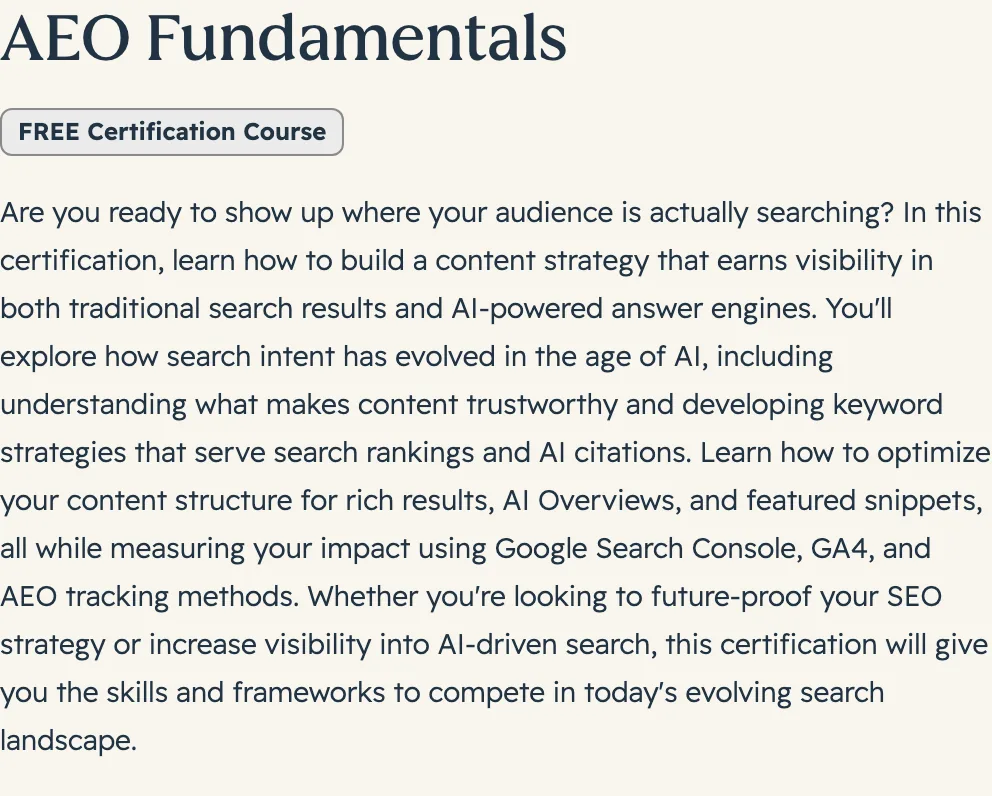
Public course page captured 20 September 2026.
Pros
Cons
In a HubSpot community discussion, two self-reported completers highlighted the framework for organizing tools and metrics. One commenter cautioned that it aligned terminology more than it introduced advanced tactics. The original poster disclosed working at Nextiny and involvement in HubSpot training, which is relevant context for that recommendation.
My verdict: after completing HubSpot, I see its strongest use as a shared starting point for a team. The connection between content, search visibility, and measurement matters to me because people can use the same AEO terminology while expecting very different results. A structured introduction gives you a basis for discussing what you're trying to improve and how you'll check it.
I'd recommend it to a marketer moving into AI search or an SEO lead bringing colleagues up to speed. Someone already running experiments will probably want more depth afterward. My next step would be a small assignment on the learner's own website: identify one problem, propose a change, and explain which metric should move. That tells me much more about their understanding than the certificate alone. As a free foundation, I think the course earns its place on this list.
The AI Search Manual is a reading resource rather than a conventional video course. Its public chapters cover how AI search works, content and technical considerations, and measurement. The site also has a changelog.

Public manual page captured 20 September 2026.
Pros
Cons
In the comments on Michael King's announcement, Montserrat Cano praised the organization into subtopics and readable presentation; George Williams specifically liked the Google chapter. These are peer reactions to the launch. I didn't find a course-rating dataset for the manual in the sources we checked.
My verdict: having worked through the manual, I see its value as a reference you can return to as your questions get more specific. When evaluating an AI-search tactic, I want an explanation of why it might work, which part of the system it affects, and what evidence would challenge it. The manual's coverage of mechanisms, technical considerations, and measurement makes it a useful companion to that kind of investigation.
I recommend it most readily to someone who already knows SEO and is comfortable studying independently. The chapter structure lets you follow the subject you need instead of treating every topic as equally urgent. You still have to turn the reading into a test and find someone to question your interpretation. For me, the best way to use this resource is to bring it a concrete problem, read the relevant material, and write down what you would check next.
Mostafa ElBermawy's AEO Masterclass listing advertises a cohort on 28–29 October 2026, recordings, and lessons about content, technical AEO, and measurement. The scheduled class gives you a deadline to sit down and study.
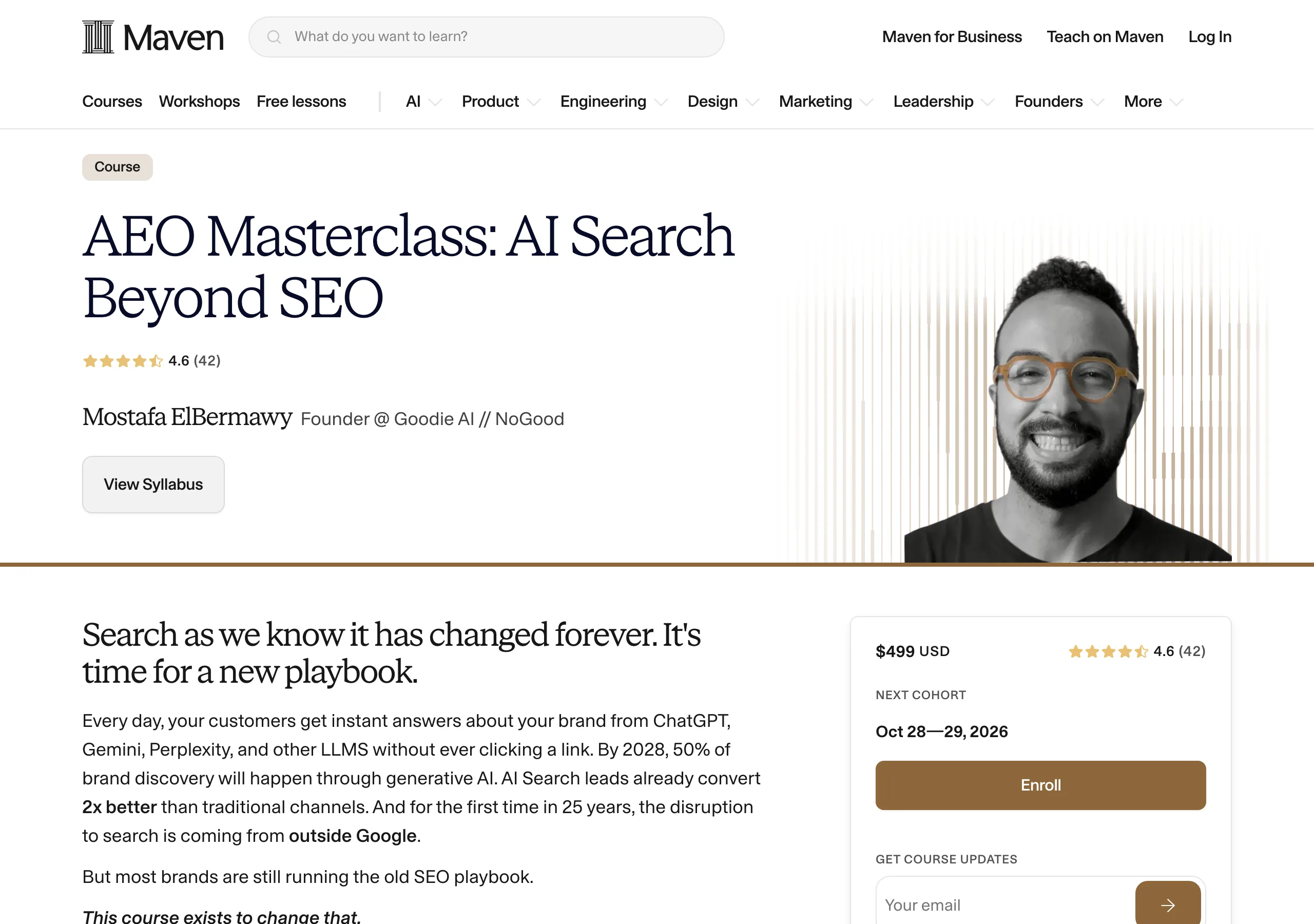
Public enrollment page captured 20 September 2026.
Before buying, resolve a discrepancy: the page summarizes the live teaching as two days of one-hour sessions, while its calendar shows two ninety-minute slots (4:00–5:30 PM UTC, checked 24 September). I wouldn't calculate cost per hour from that until the provider clarifies it. Ask what opportunities exist to discuss your own site, too; live attendance doesn't automatically mean an individual review.
Pros
Cons
We read the five visible alumni reviews on Mostafa's Maven profile. Allie and Ingrid described useful ideas to bring back to their teams. Ashley found the material informative but criticized the pace and limited time for questions. Maven labels these as reviews from earlier live cohorts of this course.
My verdict: after completing the masterclass, I see the strongest case for Maven when someone needs scheduled teaching to turn scattered reading into a plan. Content decisions, technical access, and measurement belong in the same discussion. I like evaluating training around those connections because a recommendation about one page can depend on what the rest of the site is doing.
At $499, I'd make the decision around the questions you need answered. Bring a specific page, a baseline, and a point you're unsure about. Then confirm whether the next cohort offers enough time to discuss it. Ashley's concern about pace makes that a useful question for the provider; it remains her reported experience. I'd shortlist Maven for a marketer who already has a project and wants a scheduled opportunity to think it through. I'd start a complete beginner with the free foundation first.
The AI SEO Rainmakers page on Skool describes ongoing training led by Charles Floate, weekly live Q&A, tools, and site audits. It suits an established practitioner who has recurring campaign problems to discuss. The value depends on whether those conversations help you with your actual work.
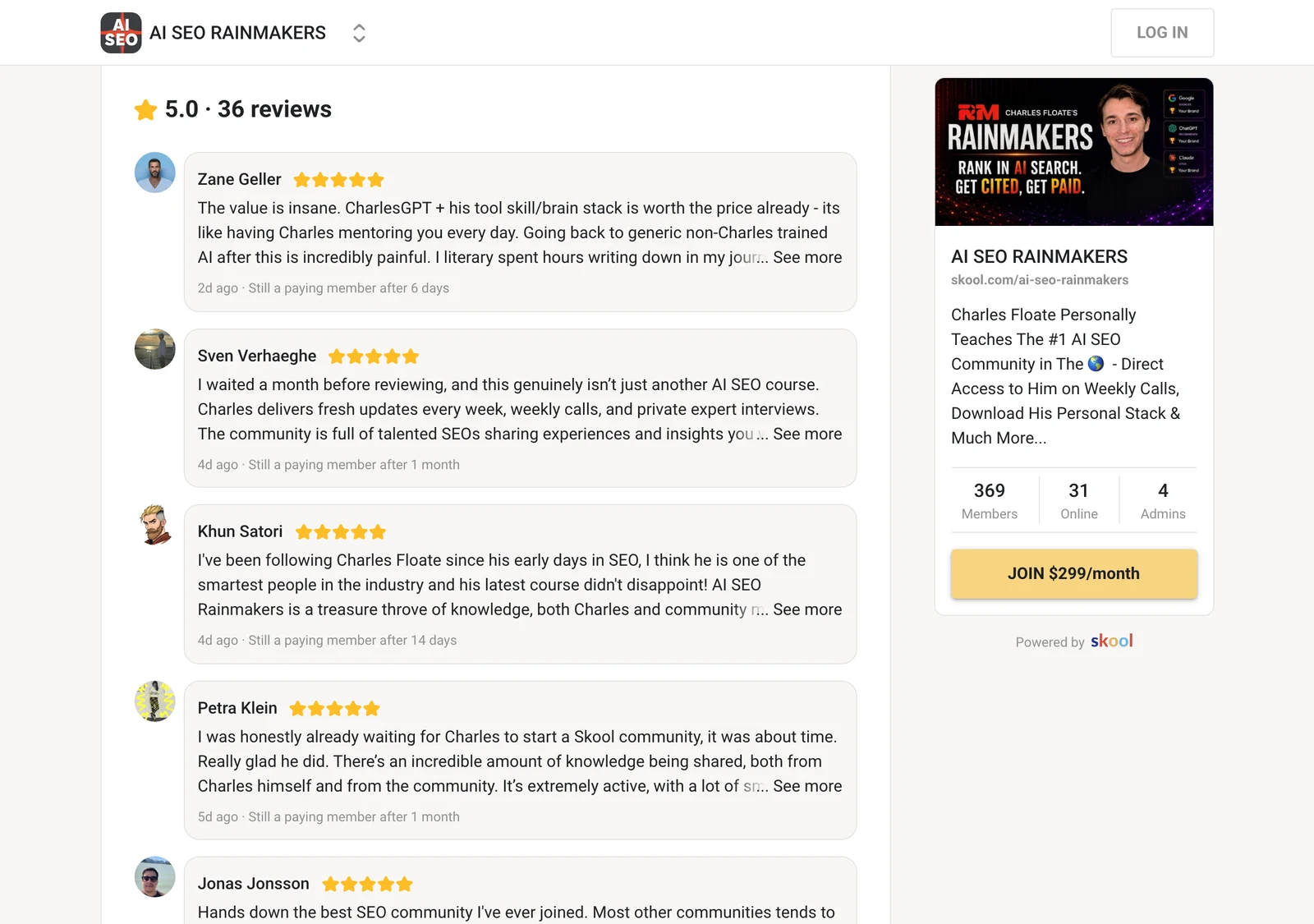
Public Skool reviews captured 20 September 2026.
Skool listed $299/month on 20 September 2026 and still did on 24 September, alongside 379 members. The page says the next 25 members lock that rate, after which it rises to $319 or more, so check the amount before subscribing. Its seven-day money-back offer also requires you to message before reaching Level 3. Read that condition before you start working through the community's participation levels.
Pros
Skool showed 5.0/5 from 36 reviews on 20 September (39 by 24 September). We expanded and read all 36 entries available on the first check. Sven Verhaeghe praised the weekly updates and calls after waiting a month to review. Zane Geller valued CharlesGPT and the tool stack. Petra Klein described an active community where members share tests and Charles answers questions himself. Taras Shynkarenko, who described himself as new to SEO, also reported finding value.
In a review updated 7 September 2026, Ray Okafor says he paid to join. He describes the Claude Skills Library, downloadable repositories, and Claude Code lessons, alongside direct access to Charles on live calls. The page discloses affiliate commissions; the classroom details are the reviewer's account.
My verdict: AI SEO Rainmakers is still quite new, and I find it an exciting community to be part of. What appeals to me is the combination of Charles's SEO and GEO experiments, an active group of experienced practitioners, and a Claude Code skill library that gives members something concrete to build with. There are several ways to take an idea further: examine the method, adapt a skill, or bring a question to the community.
The experiments are especially interesting to me. In AI search, I want to understand what someone changed, what they measured, and where their approach might apply to a different website. Having Charles and other experts available for that discussion adds value beyond the original lesson. I also like the practical direction of the skill library: a reusable workflow is a useful starting point for developing your own process. For an SEO who enjoys testing ideas and comparing notes with other practitioners, this is a community I'd recommend joining and participating in actively.
Reforge's course overview puts opportunity sizing, topical authority, and explaining SEO's return on investment at the center of the syllabus. Ethan Smith, CEO of Graphite, teaches it. The format is self-paced and on-demand, but the public page doesn't state a runtime or module count.
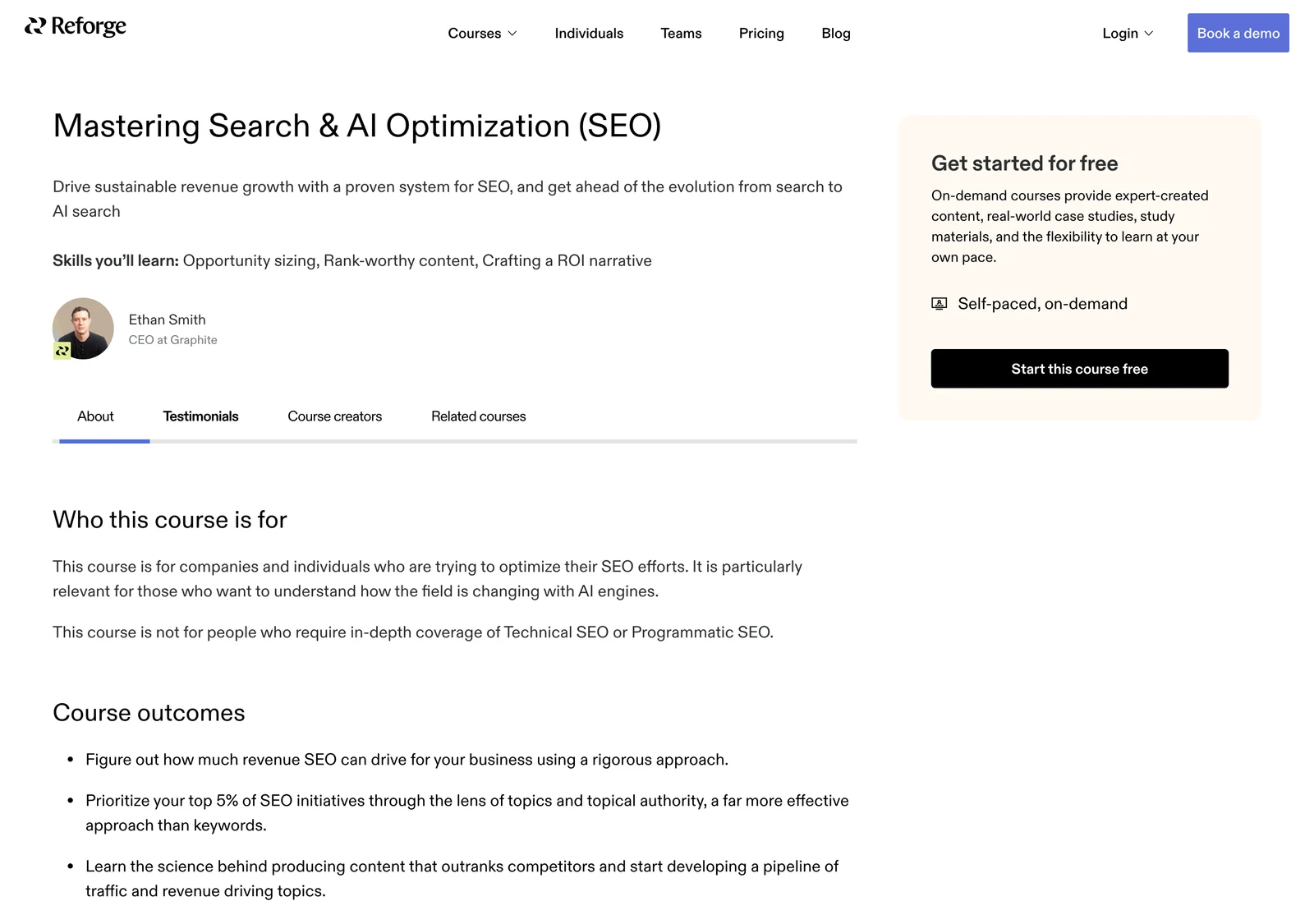
Public course overview captured 20 September 2026.
The individual membership price is $1,995 USD per year plus tax. That's access to Reforge's wider learning library, so I'd consider how many of its courses I'd actually use before paying.
Pros
Cons
We read all three testimonials on the course page. The Upstatement reviewer praised the topic-based approach; the Spatialized founder valued realistic expectations about SEO. The Talkiatry reviewer liked the introduction but wanted an advanced follow-up. These are provider-selected testimonials dated November 2023, so they don't establish the quality or freshness of today's AI-search material.
My verdict: I place Reforge in the strategy part of this shortlist. Having completed the course, I see its clearest relevance to decisions about where SEO deserves time and budget. From my perspective as a growth lead, opportunity sizing and the ability to explain a return on investment are useful skills. A team can have plenty of content ideas and still struggle to decide which ones deserve the next month of work.
That's why I'd consider it for an SEO manager, founder, or growth lead responsible for prioritization. The topical approach also gives you a way to discuss planning connected content beyond individual keyword targets. The purchase needs to make sense across the wider Reforge membership, though; I'd be cautious about buying a full year solely for this course. If your immediate need is to debug crawling or build a programmatic implementation, I'd choose training that explicitly covers that work.
SkillUp's AI SEO: Mastering Generative Engine Optimization course lists two modules, four hours of study, and four assignments. Rajesh Menon is a named instructor. Coursera labels it intermediate; the syllabus moves from entities and topical authority into content rewriting and GEO measurement.
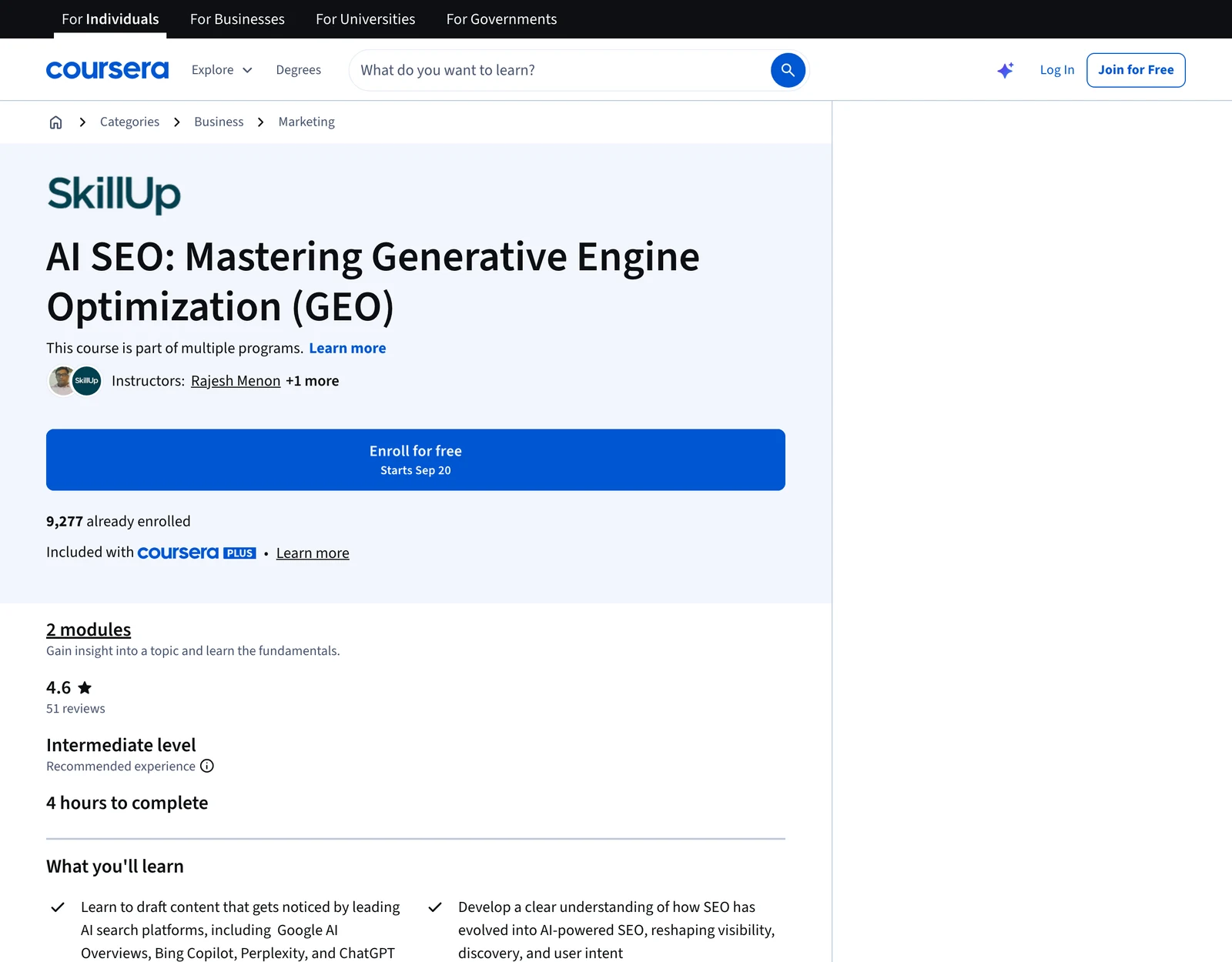
Public course overview captured 20 September 2026.
It's included with Coursera Plus. The page's enrollment FAQ says certificate access requires payment; available trials and prices depend on the enrollment offer. The free-enrollment button alone doesn't mean the certificate is free.
Pros
Cons
Coursera displayed 4.6/5 from 51 ratings, with 14 public written reviews. We read all 14. Jeevan praised the structure, Sharon liked the interactivity and repetition, and Buddy found the exercises helpful. Rhea's three-star review, dated 28 August 2026, criticized the AI-style delivery but still found the content understandable. That's her assessment of the presentation; we haven't independently verified how the lessons were produced.
My verdict: I see SkillUp's course as a manageable way to move from knowing the GEO terminology to practicing a few tasks. After completing it, the reason I'd recommend it is the combination of a short syllabus and exercises that ask you to work with content and measurement. That gives a learner a defined piece of work to finish, which can help when the broader subject feels open-ended.
I'd treat the hypothetical datasets as practice for interpreting evidence. The next step is to repeat a content exercise on a page you own, keep the original version, and record what changes in your observations. That is where you'll find questions a short course can't anticipate. I would also preview the presentation before paying, particularly given Rhea's comment about the delivery style. For someone with SEO basics who wants a contained GEO exercise, I think it's a reasonable option; deeper implementation will need further study.
The sticker price doesn't tell you what a year of learning costs. The table below divides each price by the learning time the provider publishes. Where a provider doesn't publish a runtime, I've left the calculation blank instead of estimating one.
| Option | Price checked 24 September 2026 | 12-month cost | Published learning time | Cost per published hour |
|---|---|---|---|---|
| HubSpot AEO Fundamentals | Free | $0 | 2 h 20 min across 7 lessons | $0 |
| iPullRank AI Search Manual | Free | $0 | 24 chapters plus an appendix; no runtime | $0 |
| SkillUp GEO course (Coursera) | Depends on the enrollment offer | Depends on the offer | 4 hours, 2 modules | Not calculable |
| Maven AEO Masterclass | $499 once | $499 | 2 hours (summary) or 3 hours (calendar) | $166–$250 per live hour |
| Reforge Mastering Search & AI Optimization | $1,995/year plus tax | $1,995 plus tax | Not published | Not calculable |
| AI SEO Rainmakers | $299/month | $3,588 if the rate holds | Ongoing, with weekly live calls | Not meaningful for a membership |
Cost per hour punishes live formats: an hour of an instructor answering your question isn't comparable to an hour of recorded video. So I'd read the table above next to the one below, which records what each option offers for the parts of the job that are hard to learn alone.
| Option | Hands-on work | Technical SEO | Measurement | Access to a person |
|---|---|---|---|---|
| HubSpot AEO Fundamentals | Lessons leading to a certification; no project | Content structure for rich results and AI Overviews | Search Console, GA4, and AEO tracking | None published |
| iPullRank AI Search Manual | Self-directed; appendix templates and prompt recipes | Search architecture and query fan-out chapters | Measurement, tracking, and attribution chapters | None |
| SkillUp GEO course (Coursera) | Four assignments, including content labs | Entities and topical authority | GEO measurement on hypothetical datasets | None published |
| Maven AEO Masterclass | Applying the lessons to your own brand in session | A technical AEO lesson | A measurement lesson | Two live sessions, with recordings |
| Reforge Mastering Search & AI Optimization | Opportunity sizing and an ROI case | Excluded by Reforge | Revenue estimation and prioritization | Page mixes live and self-paced wording |
| AI SEO Rainmakers | Claude Code skills, repositories, and site audits | Site audits and shared tests | Tests posted with their methodology | Weekly live Q&A with Charles Floate |
Three more courses rank for this search but sit outside my shortlist. The details below come from their public pages, checked on 24 September 2026, so they describe the offer rather than the teaching.
| Course | Price and format | Published length | What the page shows |
|---|---|---|---|
| Udemy: AI SEO Course 2026, Arun Nagarathanam | Paid; Udemy prices vary with promotions | 26 sections, 245 lectures, 14 h 49 min; updated July 2026 | 4.6/5 from 20,513 ratings and 120,367 students; the opening sections cover general SEO foundations, keywords, and on-page work |
| Semrush AI Visibility Essentials | Free, with a certificate | 21 videos, about 87 minutes | Several lessons walk through Semrush's own AI visibility toolkit; one is a conference promotion |
| Ahrefs Answer Engine Optimization course | Free, no sign-up | 12 lessons in 5 modules, 1 h 26 min | Taught by Sam Oh, Ahrefs' VP of Marketing; covers prompt research, citations, and tracking AI traffic |
The Udemy course ranked first for ai seo course in both of our search samples. Its URL slug and opening sections point to a general SEO course with AI material added. That doesn't make it a poor course, but I'd preview the AI-specific sections before relying on its overall rating. The two free vendor courses are quick to finish. Expect them to demonstrate their own tools.
Use Charles Floate's course roundup to find courses to investigate. It scores 19 options on a published 100-point rubric and puts AI SEO Rainmakers, which he runs, in a separate unscored box. He discloses that commercial interest at the top of the page, and I'd still keep it in mind when reading the recommendations.
His emphasis on instructor experience, freshness, and access to help is useful. His rubric deliberately leaves out certificates and star ratings, which suits a practitioner but not someone whose employer needs a credential. I would add a project-specific test: does the training teach the next decision you need to make? An excellent curriculum can still be the wrong purchase for your situation.
Our Google checks show how many formats share the label. We recorded the organic results for three US-English queries on 24 September 2026:
| Query | Training pages | Editorial roundups | Videos | Discussions | Other |
|---|---|---|---|---|---|
| ai seo course (9 organic results) | 4 | 2 | 2 | 1 | 0 |
| best ai seo course | 5 | 1 | 2 | 1 | 1 gated resource bundle |
| best ai seo course 2026 | 3 | 5 | 1 | 1 | 0 |
Charles Floate's roundup was the only editorial page in all three result sets. You can inspect the 24 September search-result sample and our earlier 20 September sample.
That's a handful of result pages, not a measure of teaching quality. I'd apply the same scrutiny to any vendor's recommendations, including advice published by an SEO platform like ours.
Check the work the syllabus asks you to do. AI-assisted SEO means using AI in research, analysis, and production; AEO and GEO training usually focus on visibility in generated answers. A course may cover either or both. Its title is less useful than its assignments.
AI SEO course guide: nine buying checks.
Ask for a sample assignment before enrolling. Look for the output you need: a content brief, an audit, an improved page, or a measurement plan. Then put the syllabus next to a page from your own website. Can you see how you'd use the lesson? Watching a demonstration is easy; repeating the work yourself is the test.
Look for crawling, indexing, internal links, and content accessibility. According to Google's AI features guidance, eligibility for AI Overviews and AI Mode builds on normal Search requirements; special AI files or special schema aren't required.
If those fundamentals are missing, work through an SEO audit walkthrough first. Use Search Console URL Inspection and a website crawl test to check a page you own. You'll have a more useful question for an instructor once you know where the page fails.
Ask the instructor for the source behind a claim. Is it in official documentation, or did they observe it in an experiment? If it's an experiment, ask what they changed and how they measured the result. I want to learn from experiments, but I also want to know when I'm being taught a hypothesis.
A course can teach you how to create an llms.txt file while still needing separate evidence for any claim about its effect. The same test applies to claims about schema, content formatting, and brand mentions.
Look for a baseline, consistent observations, and a connection to business outcomes. A useful course should make you more careful about interpreting results, especially when the answer an AI system gives can vary between runs.
According to Pew Research Center, traditional-result clicks occurred in 8% of visits with an AI summary versus 15% without one in its analysis of 900 US adults' March 2025 browsing. Pew reconstructed search results in April. This observational study isn't a current universal traffic forecast or a test of any course.
An after-only screenshot can't show an improvement. Save the page, search queries, prompts, dates, and existing performance before applying the lesson. Search Console, analytics, and a SERP rank check give you a starting point for organic search. For AI answers, save the actual responses as well as any counts you report.
A brand mention doesn't necessarily contain a link; a linked answer doesn't necessarily send a visitor. Record each stage separately, with a definition and denominator for every metric. Compare saved AI responses with referral reports and your lead records. Where you can't connect a visit to a lead, leave that gap visible.
Repeat the same prompts in the same engine and market, and record the observation dates. Changing the test can change the result. A spreadsheet alongside your keyword rank tracking is enough to start; keep AI-answer observations in their own columns. Log other site changes, too, so you don't credit the course for work that happened elsewhere.
Pay for a clear addition to what you can learn independently. That might be feedback, a structured project, access to an instructor, or help interpreting a difficult result. Record which one you're purchasing before comparing the fee.
"Lifetime access" can describe access to old recordings without promising future changes. Read the changelog and ask what was revised recently. Then check how questions are handled: who answers, where you submit them, and whether there's a response window. Get the support terms in writing and keep a copy.
Look for a review that names the course and explains when the person took it. Specific accounts of assignments and feedback tell you more than broad praise. A testimonial about an instructor's earlier program may say little about the current offer, especially if the format or support has changed.
There are two concrete examples in this shortlist. Maven displayed 4.6/5 from 42 ratings when checked; that is the platform's feedback summary, not an independently measured success rate. For AI SEO Rainmakers, the Skool comments describe the current membership. Keep them separate from testimonials about Charles Floate's earlier courses, and check how long each reviewer has been a member.
Include tuition, required subscriptions, recurring fees, and practice time in your budget. Ask which tools are mandatory and whether you can complete the assignments with tools you already use. A low entry fee can hide an expensive setup. Read the cancellation and refund conditions before checkout, especially for a membership you'll be billed for again.
Start with fit and measurement, checks 1–6. If the course can't help you do the work or assess the result, the support package won't make it a good purchase. Once those checks pass, use checks 7–9 to compare feedback, reviews, and the full cost.
Missing information on a sales page isn't proof that the teaching is poor; it is a reason to ask. Send the provider the two or three questions that could change your decision. Their answers should make the choice easier.
If you've read this far and still want a starting point, match your situation to a row. The last column is the gap I'd expect you to fill next, based on my experience with each option.
| If you are… | Budget | Start with | Then add |
|---|---|---|---|
| New to AI search, with no training budget | $0 | HubSpot AEO Fundamentals | The iPullRank chapter that matches your problem |
| An experienced SEO who learns by reading | $0 | iPullRank AI Search Manual | A live class or community for feedback |
| Comfortable with SEO basics and wanting GEO exercises | Coursera offer price | SkillUp GEO course | The same exercise, repeated on a page you own |
| Holding a real project and wanting scheduled teaching | $499 | Maven AEO Masterclass | A baseline and questions prepared before the cohort |
| Deciding where the search budget goes | $1,995/year plus tax | Reforge Mastering Search & AI Optimization | Technical SEO training, which Reforge excludes |
| A practitioner with campaign questions most weeks | $299/month | AI SEO Rainmakers | Your own test log, so you can compare results |
Use a small project to turn instruction into a visible work sample. The following schedule is a suggested practice plan, not a promise that rankings or AI visibility will change within a month.
Keep the result to a page of notes another person can question. If you can't explain why you made a change, take that question back to the lesson.
My shortlist includes HubSpot for foundations, iPullRank for reading, Maven for live teaching, and AI SEO Rainmakers for continuing discussion. Reforge suits search strategy and ROI planning; SkillUp's Coursera course suits short GEO practice. Choose based on the help your project needs. I haven't compared learning outcomes under controlled conditions, so I wouldn't name one winner for everyone.
I'd start with HubSpot AEO Fundamentals if you want a free, structured introduction. Apply a lesson to your own website before buying more training. If crawling, indexing, and search intent are new to you, study those alongside the course. SkillUp labels its Coursera GEO course intermediate, so it wouldn't be my first choice for someone starting SEO from scratch.
On my shortlist, checked 24 September 2026, prices run from free for HubSpot and the iPullRank manual to $499 for Maven's live cohort and $1,995 a year plus tax for Reforge. AI SEO Rainmakers costs $299 a month, or $3,588 over 12 months if the rate holds. SkillUp's Coursera certificate price depends on the enrollment offer. Add any required tool subscriptions and your practice time before comparing.
Yes. You can use AI to help classify queries, draft briefs, analyze exports, and generate hypotheses. You still need to verify facts and inspect the work. Google's generative AI guidance describes research and content structure as useful applications, while warning against generating pages at scale without adding value. Choose training that includes the review step and lets you practice on real inputs.
ChatGPT can assist with SEO tasks, including reviewing text and analyzing data you provide. It still needs reliable inputs and someone who can check the result. OpenAI explains its accuracy limits, including invented facts and citations. For a course exercise, give it a small query export, ask for proposed groups, and check each group yourself before using it in a content plan.
For a free starting point, I'd try ChatGPT on a small task you can verify. Its free plan includes tools for web search, file uploads, and data analysis, with usage limits. That makes it an accessible practice option, but I wouldn't call it the best for every SEO job. Judge it by the useful work left after you've checked and corrected its output.
You'll see AI SEO, answer engine optimization (AEO), and generative engine optimization (GEO). Providers use these labels with overlapping meanings. Read the syllabus to distinguish training about using AI to do SEO from training about earning visibility in AI answers. A course can cover both, but a title doesn't tell you how deeply it addresses either.
Start with writing clear task instructions, preparing data, and checking the output against its source. Then practice grouping queries, editing content, and interpreting performance changes. I'd look for assignments that make you explain a rejected AI suggestion as well as an accepted one. You still need enough SEO knowledge to recognize when a plausible answer could lead to the wrong change.
Start with Google's official guidance and a free course such as HubSpot AEO Fundamentals. Apply each topic to a page you own, and use the AI Search Manual when you need a fuller explanation. The first-month plan above gives you a way to organize that practice.
A certificate can document study and help a team set a common training requirement. It doesn't demonstrate a business result or cause search engines to trust your website. I'd present it alongside an audit or a record of changes you've made. Ask employers or clients what evidence they value.
Evaluate the individual course. Check the current syllabus, preview a recent lesson, and read reviews that address the AI-specific sections. A long-running general SEO course may have ratings collected before its newer material existed. That doesn't make it a bad course, but the overall rating won't answer whether the current AI lessons meet your needs.
No. A course title containing "Google" doesn't establish that Google teaches or endorses it. Verify the provider and any affiliation directly. Google's documentation says that meeting Search requirements doesn't guarantee crawling, indexing, or serving. Treat training as a way to improve your decisions, with outcomes measured separately after implementation.
AI SEO Rainmakers is the training community led by Charles Floate. His URL discussed here is a course roundup that also promotes the membership. Check the product named at checkout, what training it includes, and whether the price is recurring. Reviews of older courses shouldn't be treated as direct evidence about the current membership.
I personally enrolled in and completed all six shortlisted courses during the 12 months leading up to this review. The three other ranking courses are described from their public pages only. For iPullRank, I worked through the AI Search Manual. For AI SEO Rainmakers, completion means the training available when I took it; the community continues to add material. My experience covers the versions I completed, while upcoming cohort dates in the comparison describe enrollment options for readers.
We checked the linked provider pages on 20 September 2026 and rechecked prices, schedules, and review counts on 24 September 2026. The screenshots show their public pages as of 20 September; we didn't capture private lesson dashboards. Prices and schedules can change.
These are the learner accounts we read, and what each one can and can't tell you:
| Source | What we read | Caveat |
|---|---|---|
| HubSpot community thread | The full Reddit discussion | The original poster disclosed HubSpot training work |
| iPullRank launch post | Visible LinkedIn comments | Peer reactions, not course ratings |
| Maven alumni reviews | Five visible reviews; 4.6/5 from 42 ratings | Platform summary; June 2026 cohort |
| AI SEO Rainmakers on Skool | All 36 entries on 20 September | One entry had no written comment |
| Ray Okafor's review | The full review, updated 7 September 2026 | Discloses affiliate commissions |
| Reforge course page | All three testimonials | Provider-selected; dated November 2023 |
| SkillUp on Coursera | All 14 written reviews | The 51-rating aggregate isn't 51 written accounts |
We didn't independently verify the reviewers' purchases or reproduce their results. Pros and cons combine my course experience with documented offer details. Other learners' experiences are attributed to the people who reported them.
Our search samples record the organic results for US-English Google queries, with result formats classified manually: one query on 20 September 2026 and three on 24 September 2026. On 24 September, ai seo course returned nine organic results and the other two queries returned ten each. The samples exclude ads and other search modules and aren't representative of every reader's results. The downloadable CSVs preserve the positions, URLs, market, query, and classifications.
We also checked Google People Also Ask through Serper.dev for "ai seo course," "best ai seo course," and "ai seo course free" on 20 September 2026, using US-English settings. Our People Also Ask sample records the questions and which we used. The beginner question comes from related searches; certification and provider-specific questions are editorial additions. These results help identify questions, not estimate search volume.
The SEOmator census cited above requested root-path llms.txt files from a Cloudflare Radar top-100,000-domain list on 13 September 2026. Nonresponses explain the difference between the full-list and responder percentages. It measures file presence, not the effect of a file on rankings or citations. Pew's study supplies separate, dated evidence about click behavior; neither dataset measures course effectiveness.
Learn how user experience (UX) influences SEO rankings, with key statistics and actionable best practices to improve site performance and engagement.

We checked the web's top 100,000 domains for llms.txt. Only 8.6% publish one, and nearly a third of those were generated automatically by the platform.

ClaudeBot cooled from 22.4% to 19.2% of AI-bot hits across the sites we track in July 2026 as Meta rebounded to 12.7%. Our monthly AI crawler report.


