


· 21 min read
30+ AI SEO Statistics for 2026: Data on AI Overviews, ChatGPT & GEO
Cloudflare Radar: Perplexity now crawls 885 pages per visitor it sends back and Anthropic 823 - down by half. Plus SEOmator's own panel data and 30+ AI SEO statistics.
50+ ChatGPT prompts for keyword research, content optimization and competitor analysis — grouped by the job each one actually does well, with the outputs you need to verify before acting on them.

Charles Duncan · Co-founder & CTO, SEOmator
Leads the engineering behind SEOmator's crawler, audit engine and rank tracking

SEO prompts for ChatGPT are structured instructions that guide the AI to generate keyword-rich content, meta descriptions, and optimization strategies for better search rankings. In 2026, these prompts have become essential for content creators seeking to combine human creativity with AI efficiency. The right prompts can help you research keywords, cluster topics, analyze competitors, and create NLP-friendly content that resonates with both search engines and readers.
A caveat I want to state up front, because most prompt roundups skip it: a prompt does not move a ranking. It drafts, clusters, summarises and reformats — the work that used to eat the first two hours of the day. I build the crawler and audit engine behind SEOmator, so I judge ChatGPT the way I judge any system that emits data: it's fast, but it's blind to what our crawler actually fetches from a live SERP. What the model produces still has to be checked against real data, because it will state a search volume it cannot know and cite a competitor page it has not read. Every prompt below is grouped by the job it genuinely does well, and we flag the ones where the output needs verifying before you act on it. For where AI-assisted work fits in the wider picture, see our AI SEO statistics reference and our comparison of AI-powered and traditional SEO methods.
Seed keywords form the foundation of any SEO campaign. They define your niche, identify competitors, and guide content strategy. ChatGPT excels at brainstorming and expanding seed keyword lists when given the right prompts.
"I offer [Your Product/Service, including specific features and unique selling points]. Considering these details, what are comprehensive seed keywords that encapsulate the essence and benefits of my offering? Please provide a list of keywords that reflect both the general category and the unique aspects of my product/service."
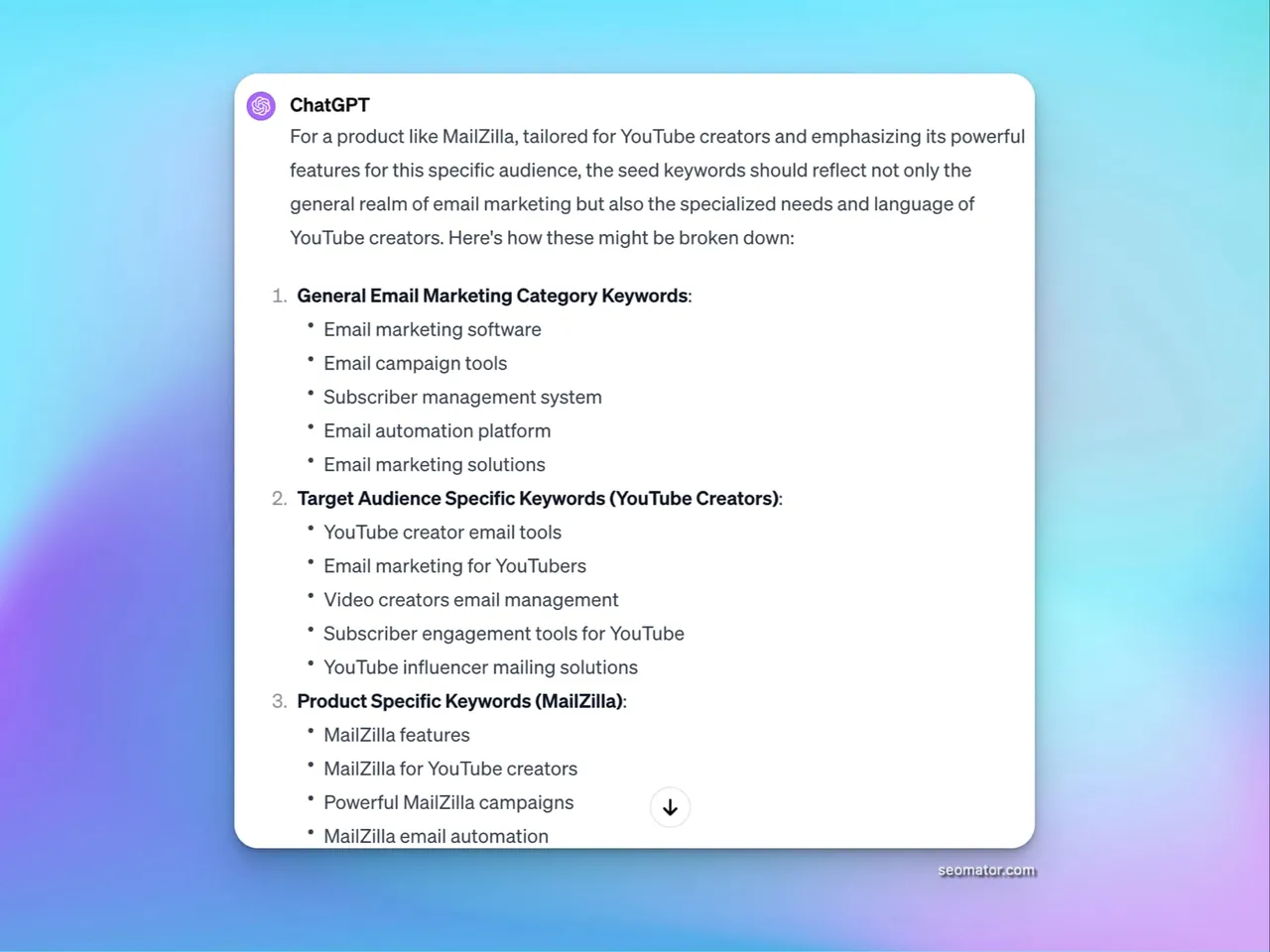
"Here are my main competitors [list them with brief descriptions of their offerings]. Analyzing their content and market position, what seed keywords are they likely targeting? Please suggest a range of potential seed keywords derived from both direct and indirect competitors, focusing on those that capture similar customer intents and market segments."
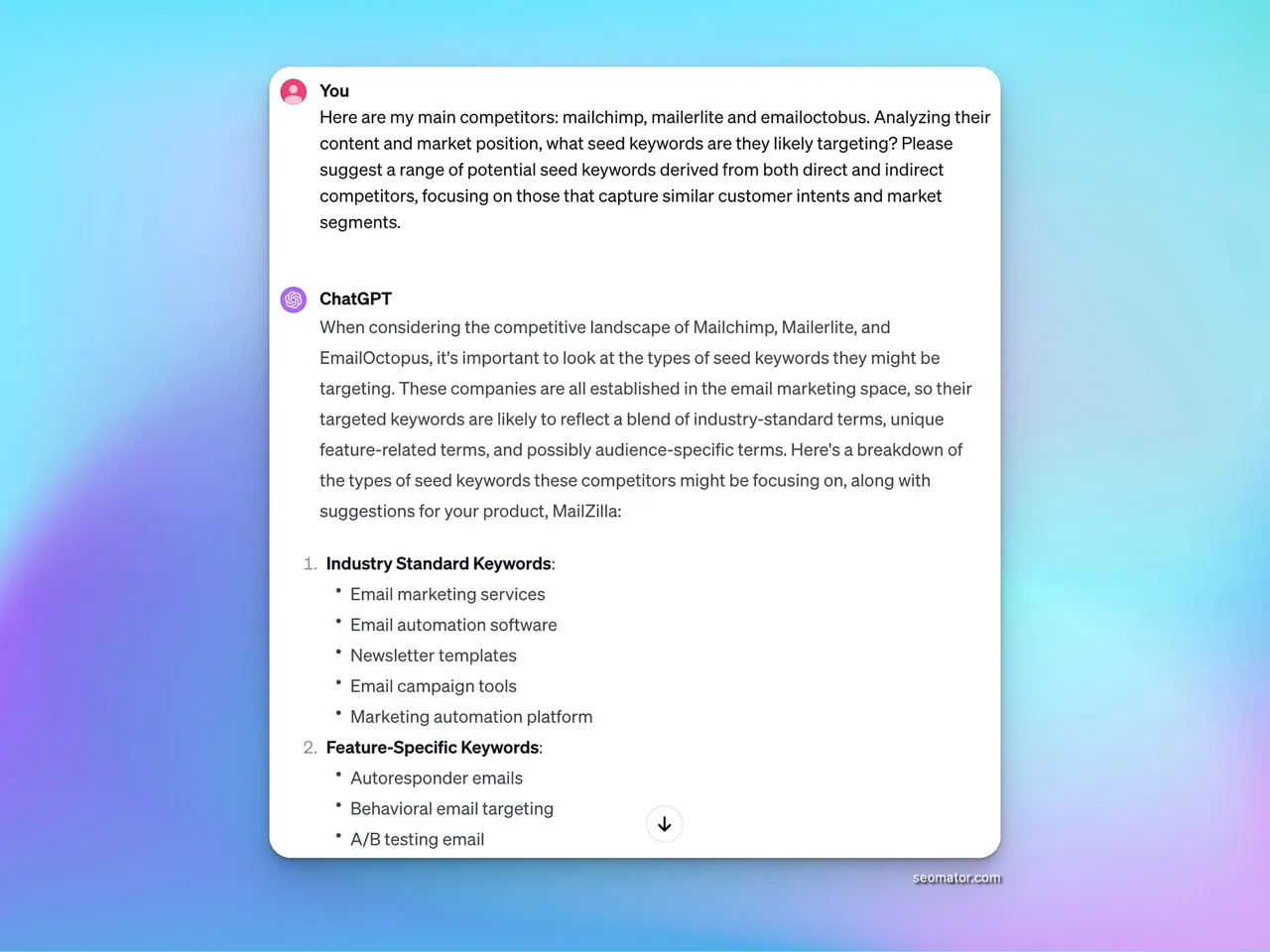
"My product/service solves these problems or fulfills these needs: [list problems/needs]. For each listed item, could you suggest potential seed keywords that a customer might use when searching for solutions to these specific issues? Please consider both broad and long-tail keywords that could capture various stages of customer awareness and decision-making."
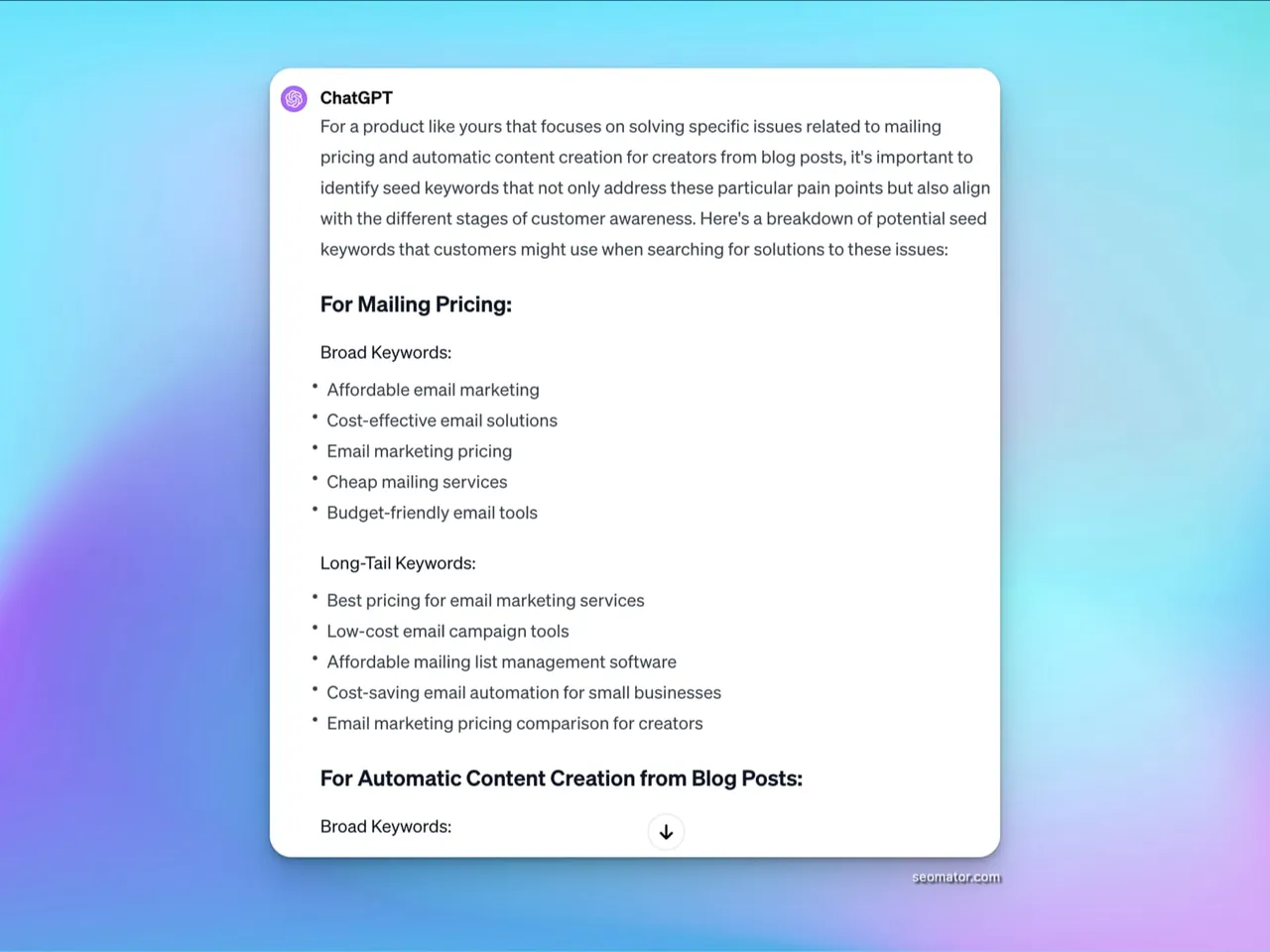
"My niche is defined as [specific niche description]. Given this niche's characteristics and target audience, what are some initial broad seed keywords, and how can we refine these into more targeted, niche-specific keywords? Please provide a list of seed keywords along with brief explanations of their relevance to my niche."
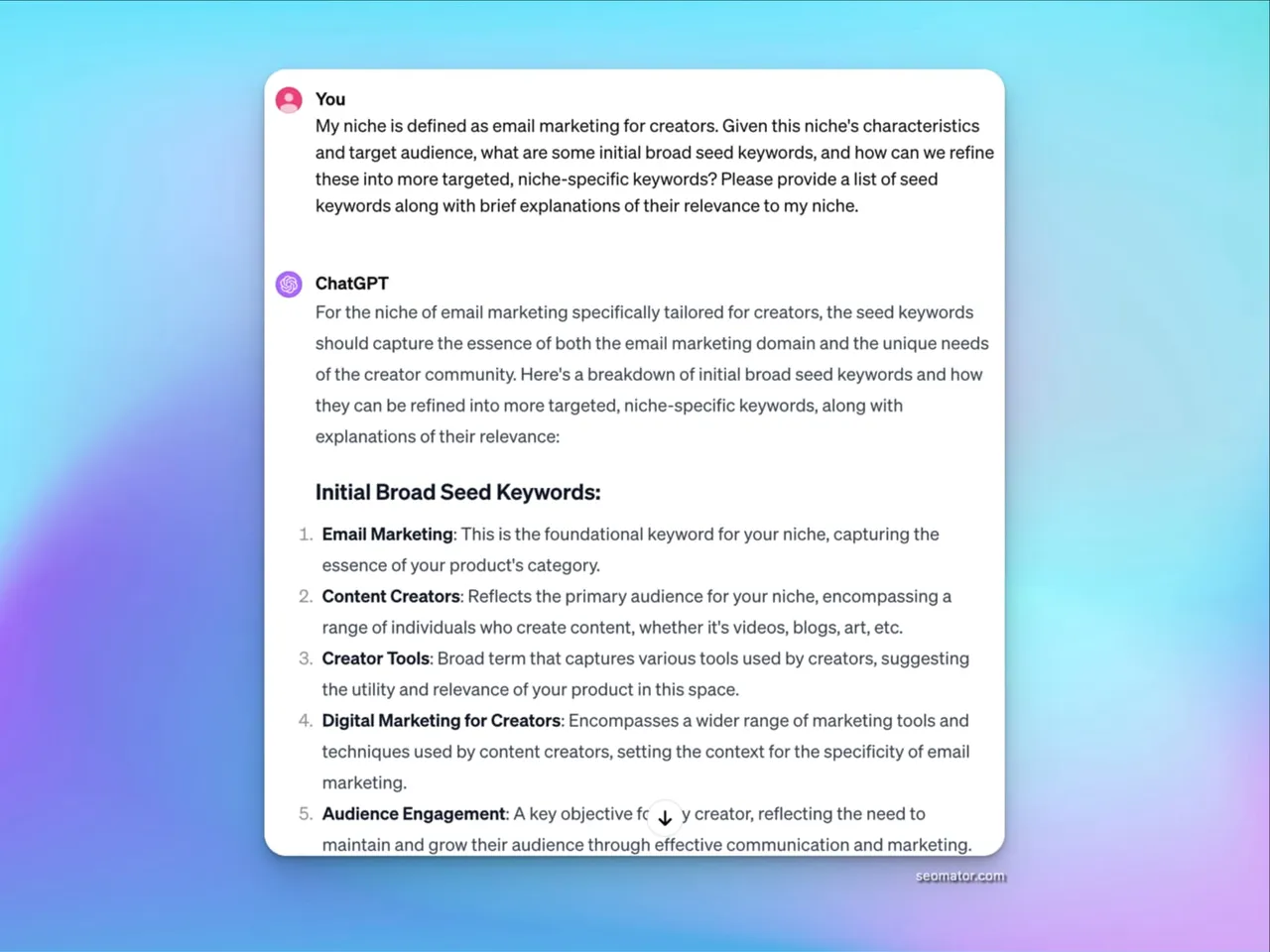
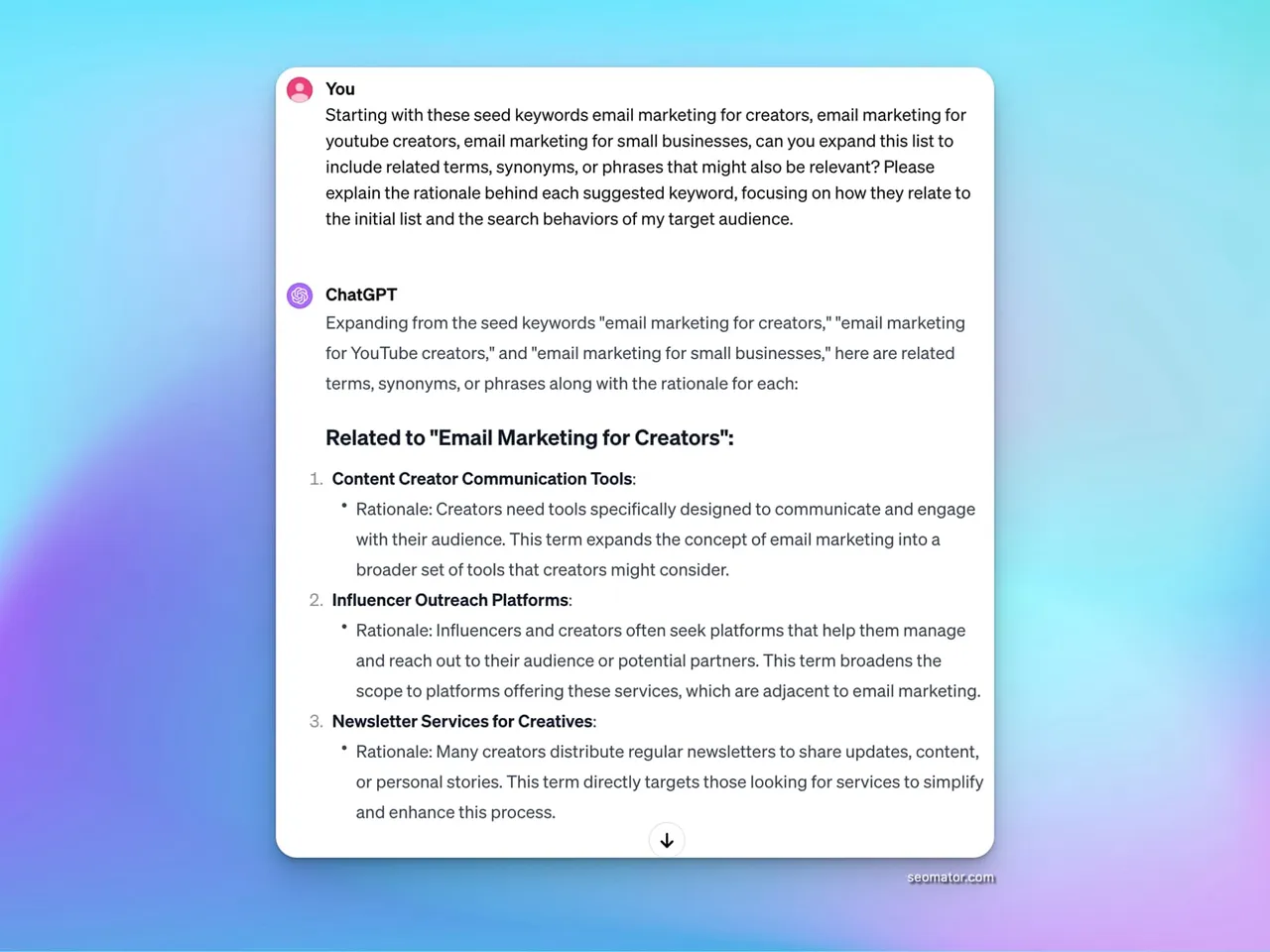
"Starting with these seed keywords [list any initial keywords], can you expand this list to include related terms, synonyms, or phrases that might also be relevant? Please explain the rationale behind each suggested keyword, focusing on how they relate to the initial list and the search behaviors of my target audience."
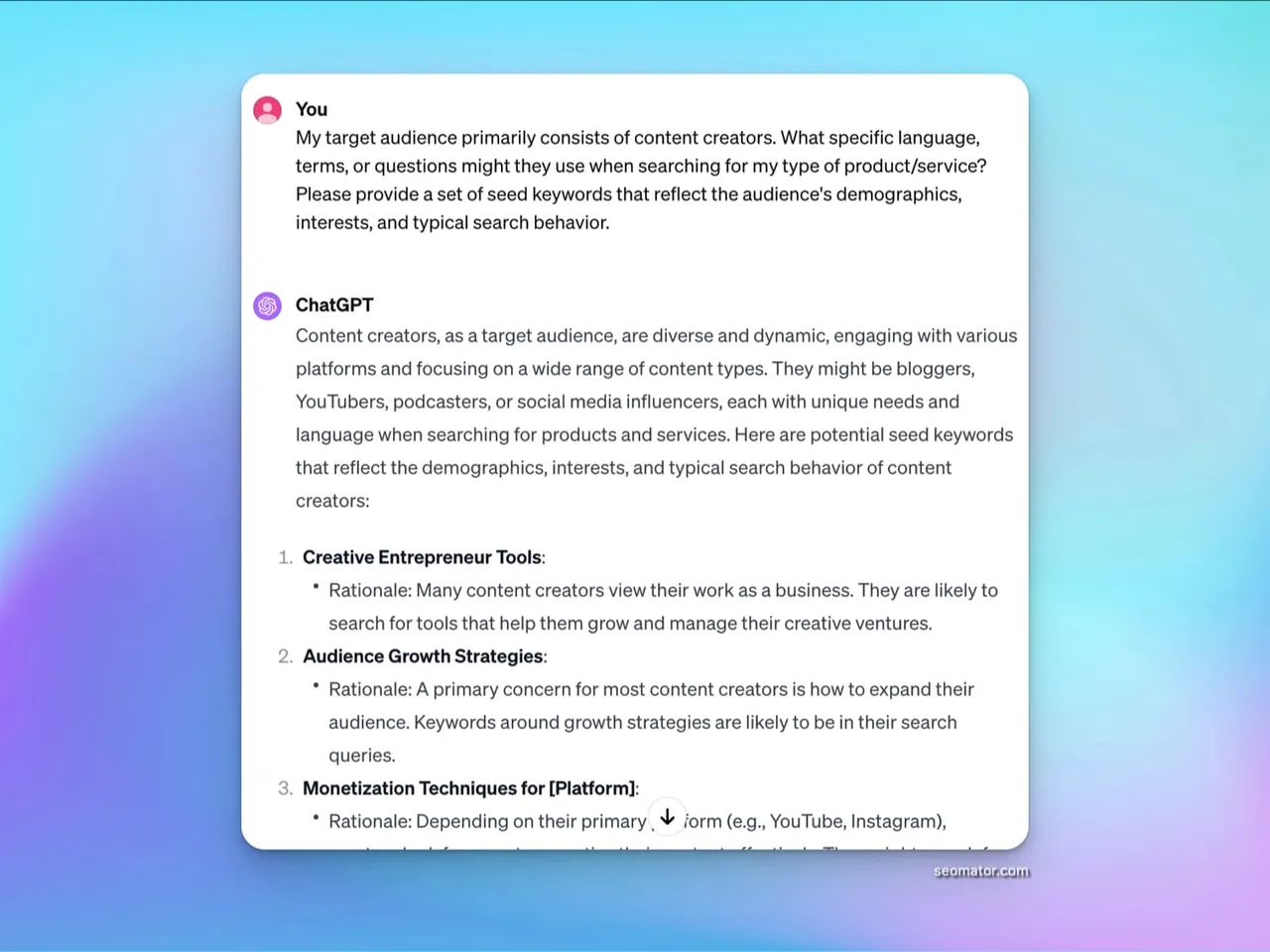
"My target audience primarily consists of [define audience]. What specific language, terms, or questions might they use when searching for my type of product/service? Please provide a set of seed keywords that reflect the audience's demographics, interests, and typical search behavior."
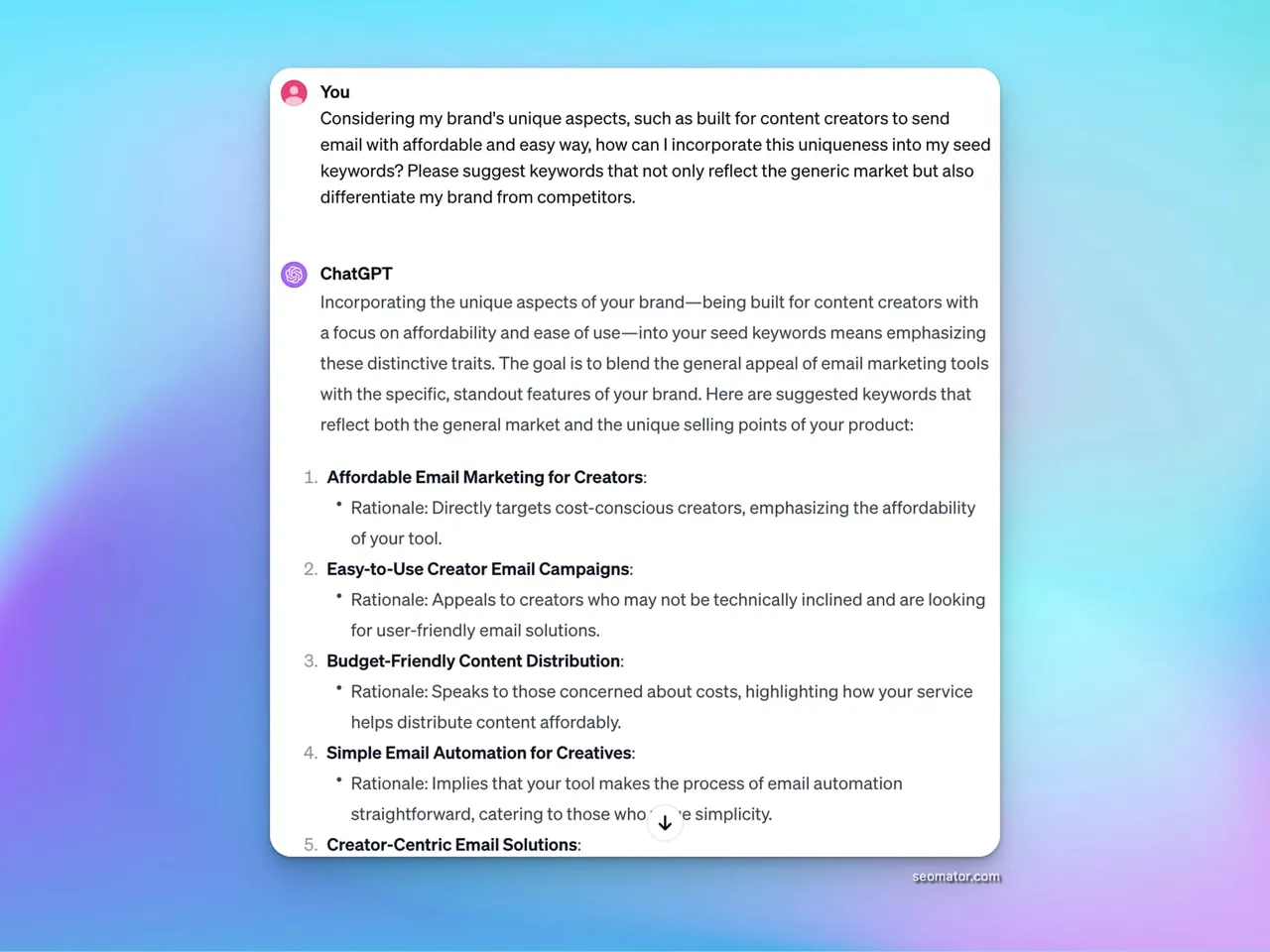
"Considering my brand's unique aspects, such as [unique selling propositions, brand story, or features], how can I incorporate this uniqueness into my seed keywords? Please suggest keywords that not only reflect the generic market but also differentiate my brand from competitors."
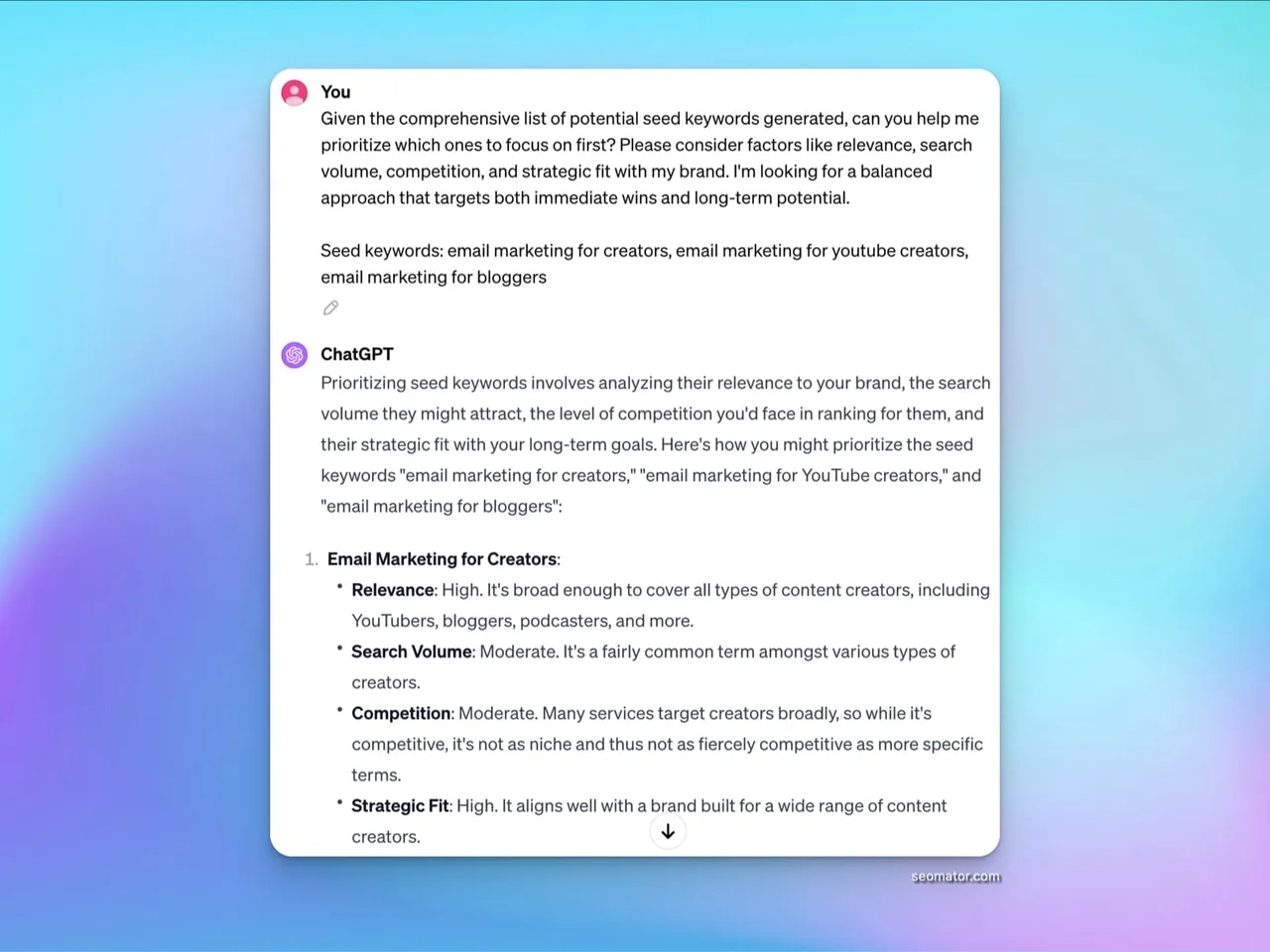
"Given the comprehensive list of potential seed keywords generated, can you help me prioritize which ones to focus on first? Please consider factors like relevance, search volume, competition, and strategic fit with my brand. I'm looking for a balanced approach that targets both immediate wins and long-term potential."
Long-tail keywords are more specific phrases that typically have lower search volume but higher conversion rates. According to Ahrefs research, 92% of all keywords get 10 or fewer searches per month, making long-tail targeting essential for most websites.
The reason long-tail works is mechanical rather than magical: a query with six words tells you what the searcher has already decided, and a query with two does not. That is also why ChatGPT is genuinely good at this particular job — expanding a seed term into the specific phrasings people actually type is a language problem, not a data problem. Just don't let it invent the search volumes; it will, confidently. The split I draw is simple: take the phrasings from the model and the numbers from our keyword research tool.
"I am looking to target [Target Audience] interested in [Product/Service Name]. Can you generate a list of detailed long-tail keywords that focus on the unique features and benefits of [Product/Service Name], considering factors like age, location, and specific interests of the audience?"
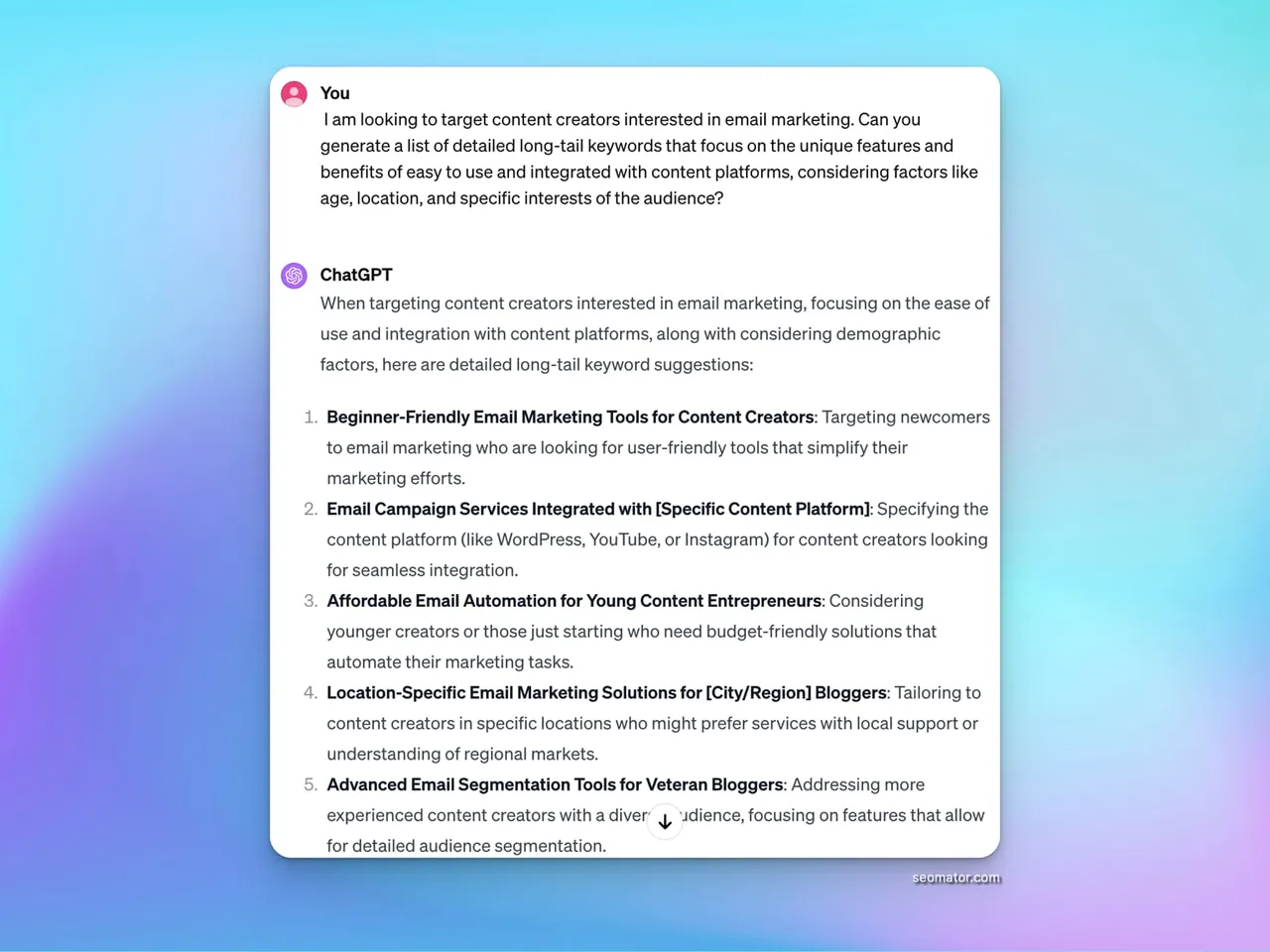
"Identify long-tail keywords for individuals facing [Specific Problem or Need]. The keywords should reflect various aspects of the problem, potential solutions, and the emotional state or goals of the user, such as seeking convenience, affordability, or quick results."
"Provide a comprehensive list of long-tail keywords for [Industry/Service] specifically in [Location/City/Region]. Include keywords that consider local landmarks, regional slang, and specific needs or preferences of residents in that area."
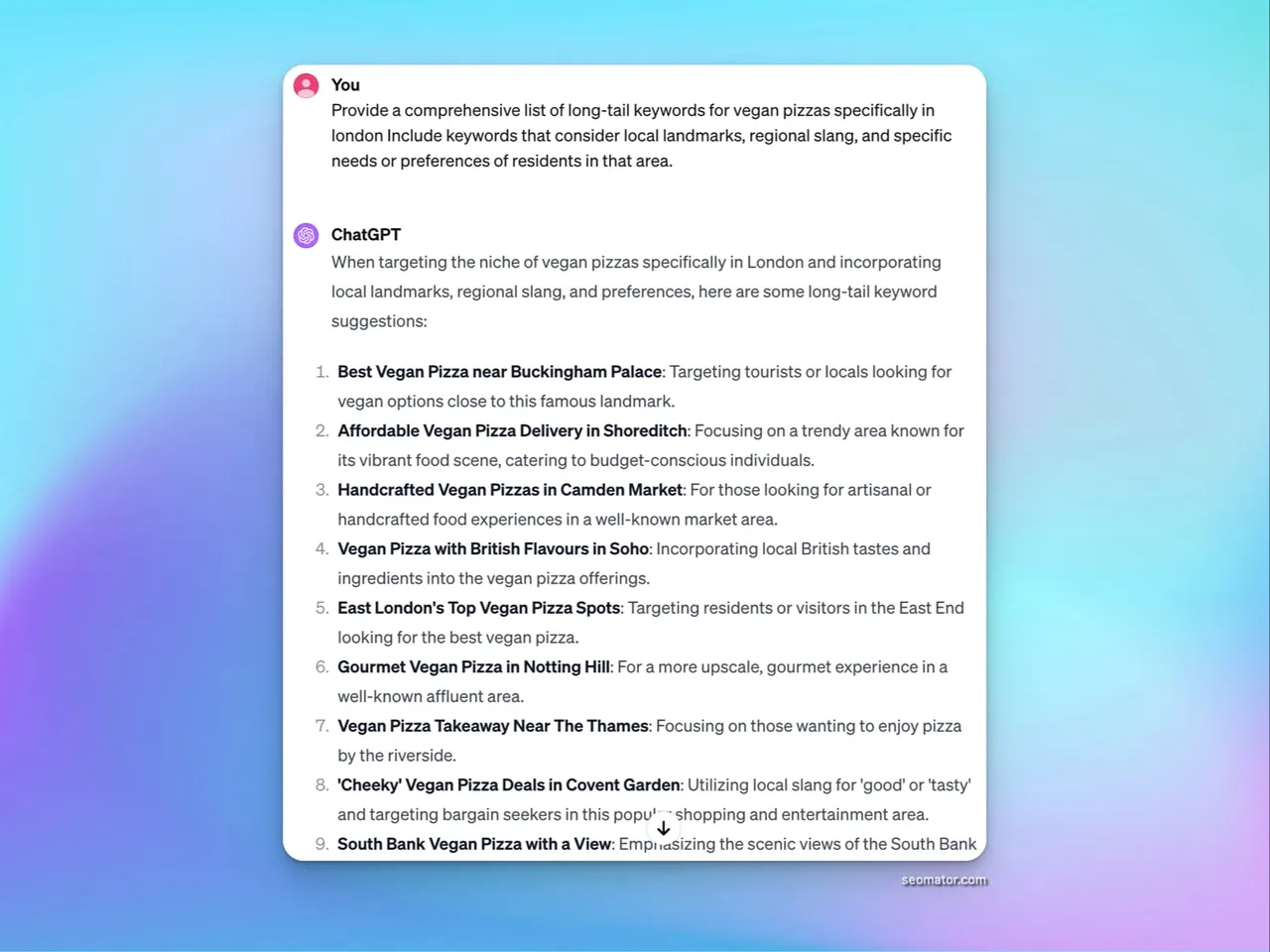
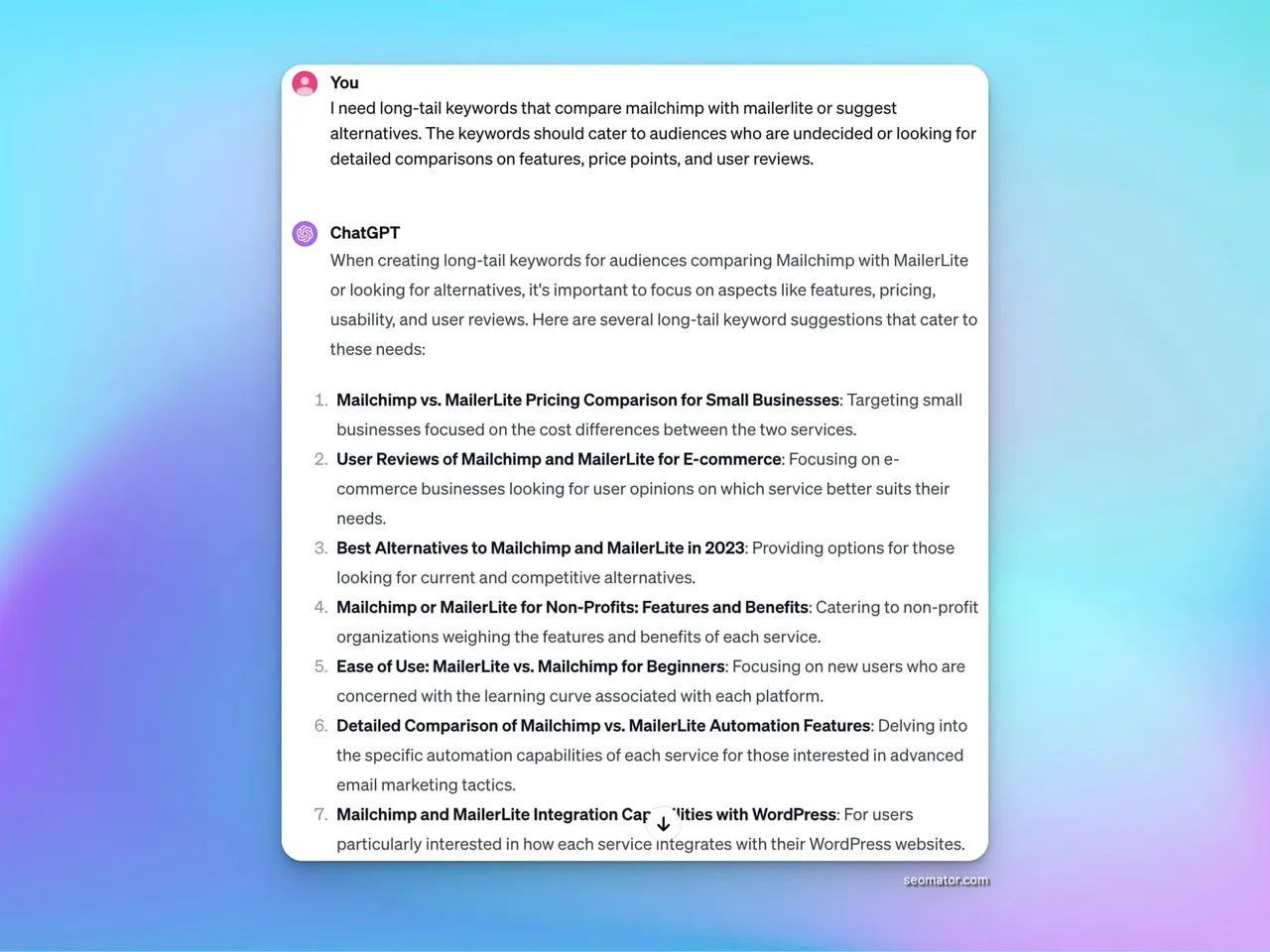
"I need long-tail keywords that compare [Product/Service A] with [Product/Service B] or suggest alternatives. The keywords should cater to audiences who are undecided or looking for detailed comparisons on features, price points, and user reviews."
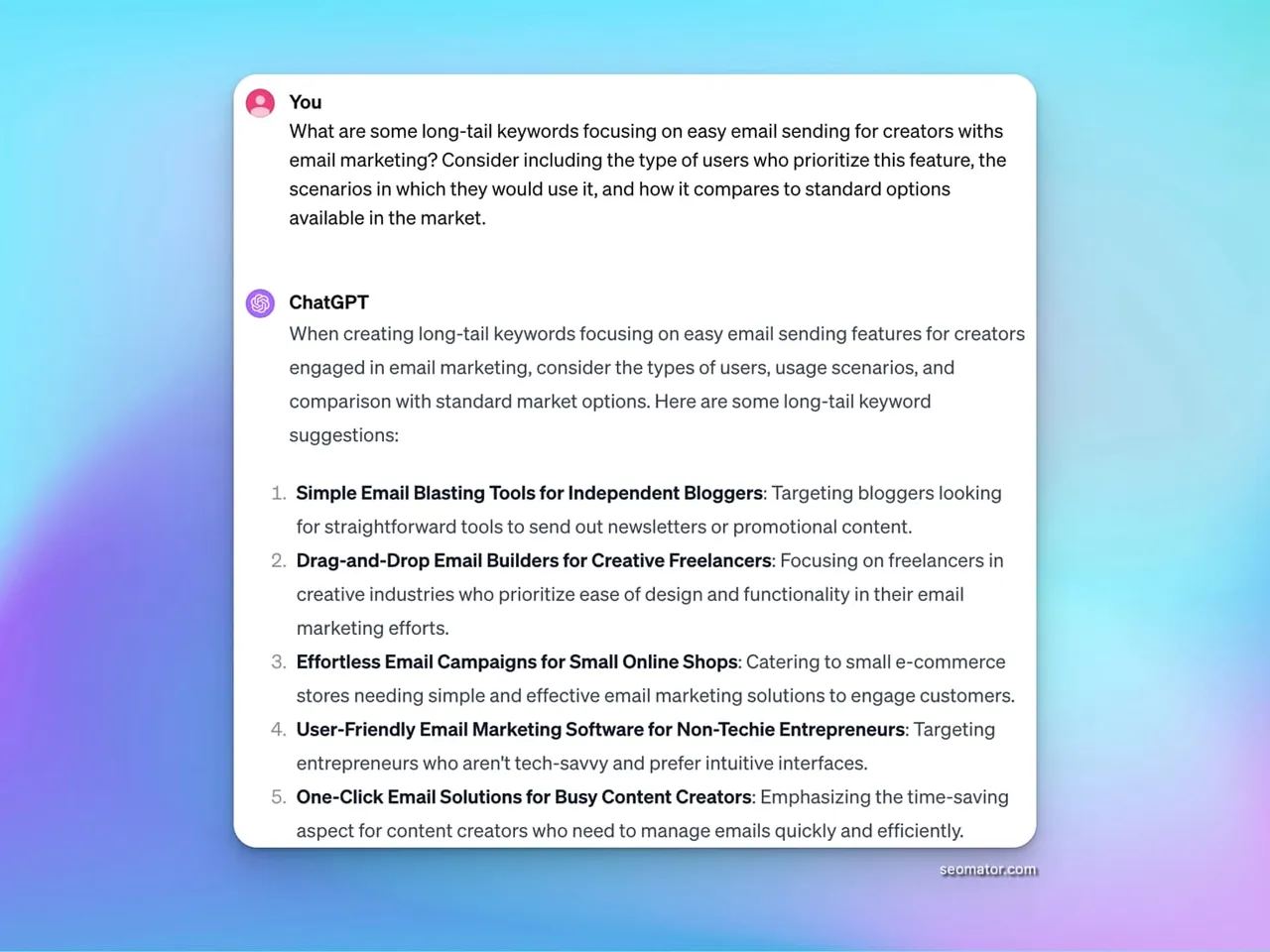
"What are some long-tail keywords focusing on [Specific Feature] of [Product/Service]? Consider including the type of users who prioritize this feature, the scenarios in which they would use it, and how it compares to standard options available in the market."
Keyword clustering groups related keywords to create comprehensive content that targets multiple search queries. This approach improves content relevance and increases chances of ranking for related terms.
The benefits of keyword clustering include:
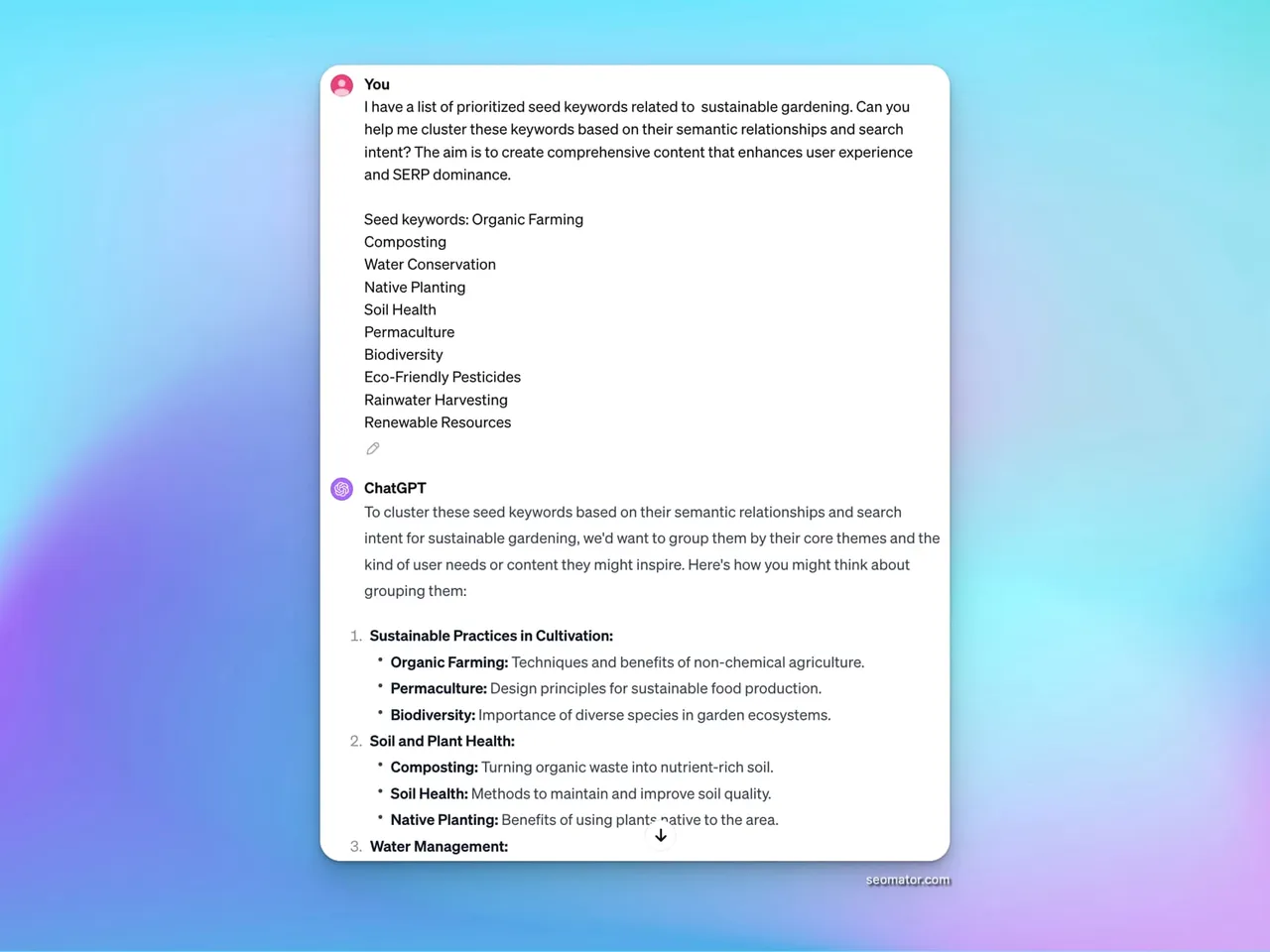
"I have a list of prioritized seed keywords related to [Your Topic]. Can you help me cluster these keywords based on their semantic relationships and search intent? The aim is to create comprehensive content that enhances user experience and SERP dominance."
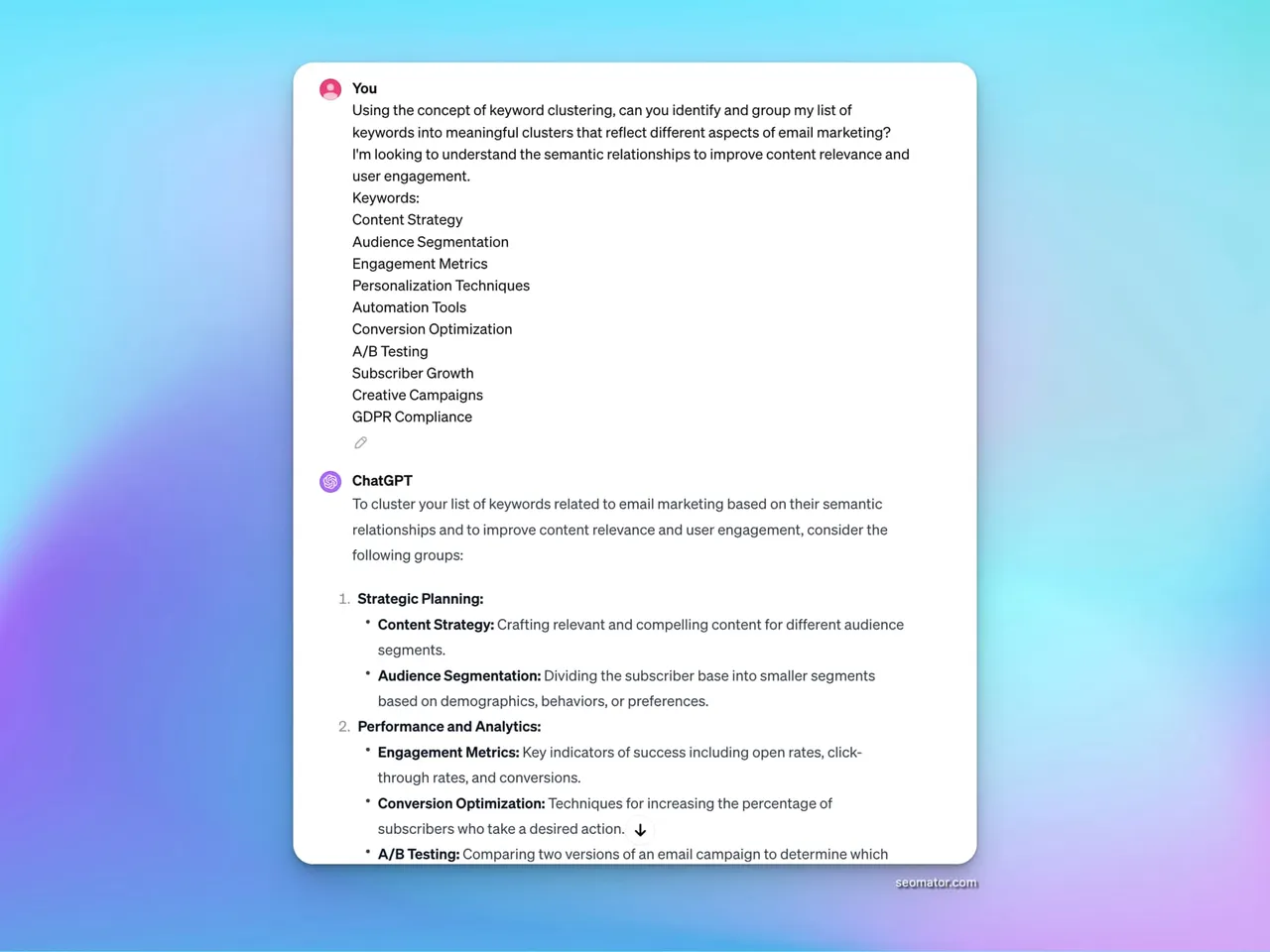
"Using the concept of keyword clustering, can you identify and group my list of keywords into meaningful clusters that reflect different aspects of [Your Topic]? I'm looking to understand the semantic relationships to improve content relevance and user engagement."
"With these keyword clusters for [Your Topic], what are some content topics or article ideas that could effectively encompass these keywords? I'm aiming to create well-structured content that addresses multiple user intents and increases engagement."
"Given these clusters of related keywords, how can I develop a content strategy that targets these clusters to increase my chances of SERP dominance? I'm looking for content structures or types that are particularly effective for clustered keyword targeting."
"I want to create content that is highly relevant and engaging by targeting a cluster of related keywords. Can you suggest content formats and angles that would cover these clusters comprehensively, keeping in mind the goal of reducing bounce rates and enhancing user experience?"
"Can you analyze the keyword clusters used by top-ranking content in my niche and suggest how I can structure my own clusters to compete effectively? I'm interested in understanding the competitive landscape and how to position my clusters for better ranking."
"For a niche segment within [Your Topic], how can I cluster long-tail keywords to create targeted content that addresses specific user queries and interests? I'm looking for clusters that cater to a more focused audience."
Understanding competitor strategies reveals opportunities to outperform them. ChatGPT assists with competitor analysis by summarizing strategies and identifying content gaps.
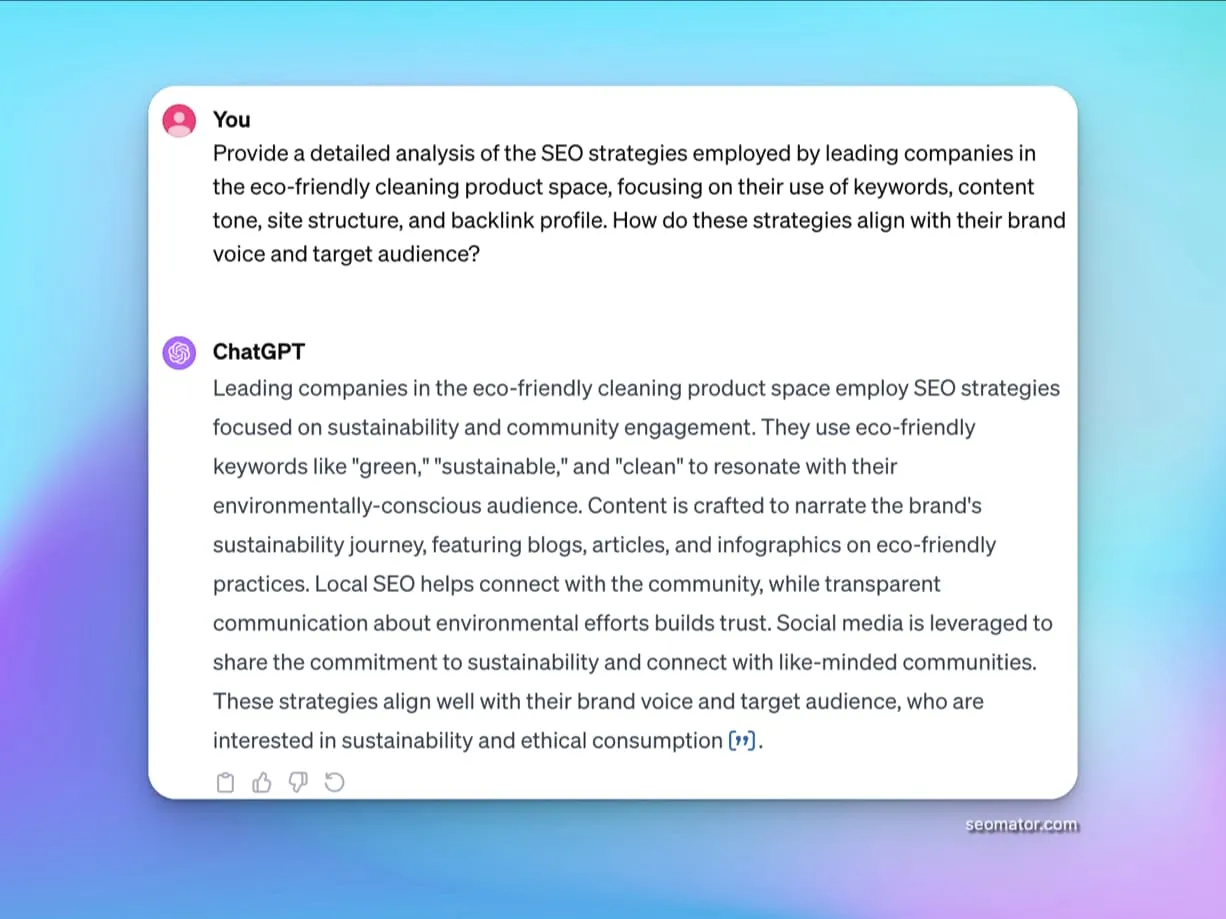
"Provide a detailed analysis of the SEO strategies employed by leading companies in the [your industry] space, focusing on their use of keywords, content tone, site structure, and backlink profile. How do these strategies align with their brand voice and target audience?"
"Examine the top-ranking websites in the [your industry] industry, noting the specifics of their on-page and off-page SEO tactics, including keyword optimization, content quality, user engagement strategies, and technical SEO elements. How do these tactics contribute to their high rankings?"
"Investigate and report on the most successful content formats among [your niche] competitors, analyzing how these formats are optimized for search engines, the tone and style adopted, and the type of user engagement they are designed to generate."
On-page SEO involves optimizing individual page elements like title tags, meta descriptions, and headers. ChatGPT can help craft these elements efficiently.
Well-crafted URLs help users and search engines understand page content. Use these prompts:
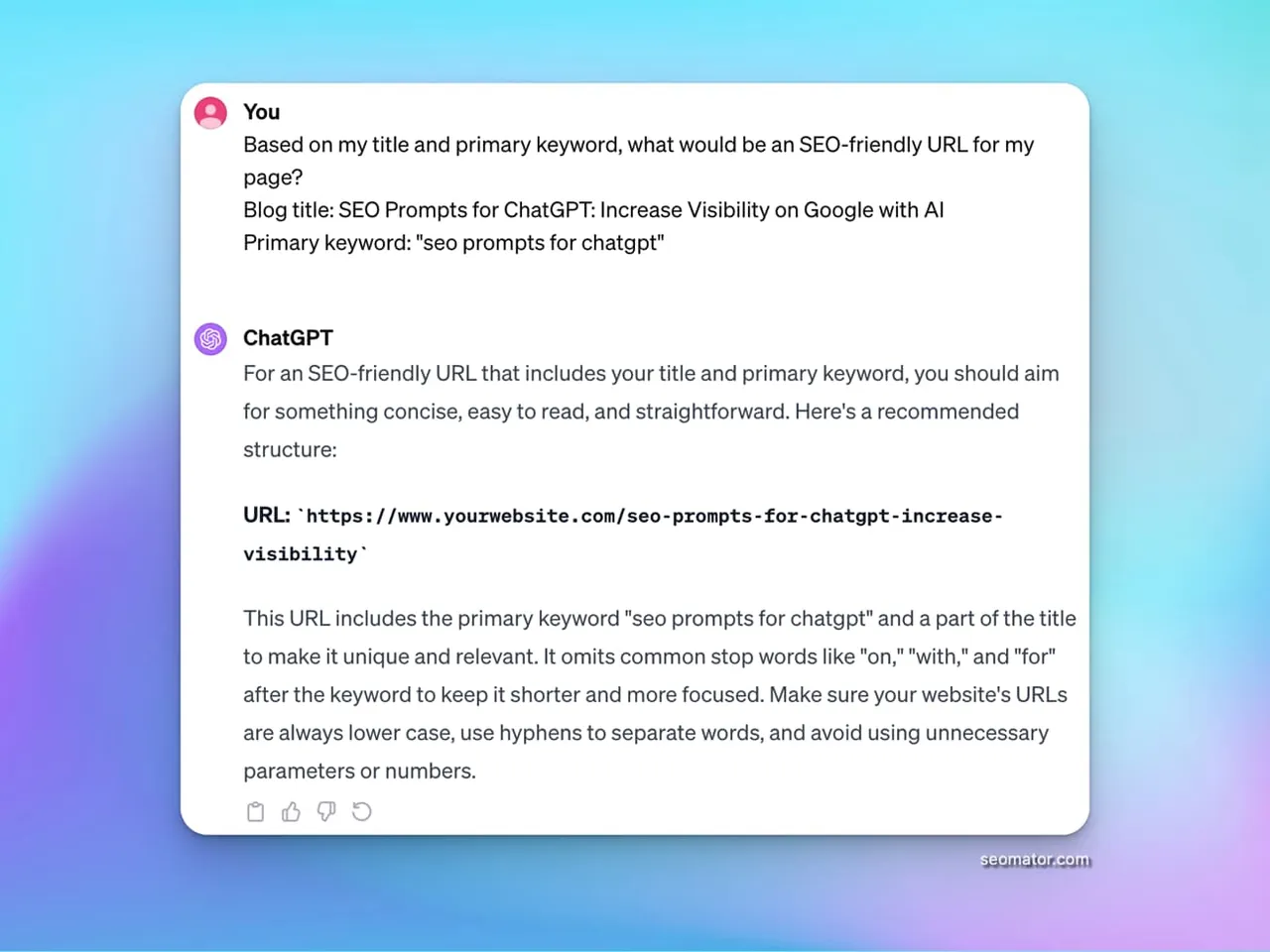
AI suggestions aren't always perfect. For this post, we chose "seo-prompts" over the AI's longer suggestion.
Header tags (H1, H2, H3) provide structure and context. Use these prompts:
Calls to Action guide users toward conversions. Try these prompts:
The title tag is one of the most important on-page SEO factors. According to Backlinko's analysis of 11.8 million Google results, title tag optimization correlates strongly with first-page rankings.
Meta descriptions don't directly impact rankings but affect click-through rates. Use these prompts:
If you need quick meta descriptions, try the SEOmator AI meta description generator to preview SERP results for free.
"LSI keywords" is one of SEO's most stubborn myths. Google's John Mueller has said flatly that there is no such thing as LSI keywords — Latent Semantic Indexing is 1980s technology Google never used. What actually helps is covering the related terms, entities and questions around your topic so the page reads as genuinely on-subject to modern systems like BERT and to AI answer engines. From where I sit — building the indexing side of our platform — a page earns relevance by covering the entities a topic implies, not by echoing a keyword. The prompts still work; just aim them at semantic coverage rather than a made-up index:
Natural Language Processing (NLP) allows search engines to understand context and intent behind queries. Creating NLP-optimized content improves search visibility.
Modern search engines use NLP to deliver accurate, relevant results — and the same parsing now powers AI answer engines. ChatGPT, Perplexity and Google's AI Overviews read passages and entities to decide what to quote, so structured, semantically complete content is easier for them to surface in an AI answer. When I trace how our crawler renders a page and hands it to indexing, the pattern is consistent: clean structure and self-contained passages get picked up; content buried in scripts or vague prose gets skipped. Content creators should focus on:
To create content that resonates with NLP algorithms:
As SEO evolves, prompts must become more sophisticated. Here are advanced prompts for various SEO tasks:
SEO prompts still speed up the work — research, drafting, clustering — but in 2026 the destination has moved. A large share of searches now end inside an AI answer instead of a blue-link click: AI Overviews appear on roughly half of Google searches (about 48% of tracked queries by early 2026), and ChatGPT itself passed 800 million weekly users in October 2025. ChatGPT is a search surface now, not only a drafting assistant.
That changes how you should aim these prompts in two ways:
ChatGPT has transformed SEO workflows by providing scalable content solutions, insightful keyword research, and improved content relevance. Its ability to understand and generate human-like text makes it invaluable for optimization tasks.
We've developed a custom SEOmator GPT that provides real-time keyword volume and analyzes SERPs. ChatGPT Plus users can access it directly. If you don't have ChatGPT Plus, use our free SEO AI Assistant instead.
Whatever a prompt hands you — a keyword list, a title, an outline — I treat it as a draft, not a decision, and I'd tell any engineer or SEO on my team to do the same. Run the page through a free SEO audit and confirm real search demand and difficulty in a keyword tool before you build around anything the model produced.
Experiment with the prompts in this guide and tailor them to your specific needs. SEO constantly evolves, and those willing to innovate and adapt will see the best results. If you want structured practice beyond prompts, see our guide to choosing an AI SEO course.
SEO prompts for ChatGPT are structured instructions that guide the AI to generate useful SEO content, strategies, or keyword suggestions. These prompts help optimize website content for better search engine visibility by producing material aligned with target keywords and user search intent.
ChatGPT assists with generating keyword-rich content, suggesting meta descriptions, creating title tags, and helping with technical SEO aspects. By producing content aligned with user searches, it improves site relevance and authority on Google.
While ChatGPT provides valuable suggestions and brainstorming assistance, effective SEO strategies require combining AI insights with human expertise. Use it as a tool to augment strategy development rather than replace strategic thinking.
No tool guarantees protection from algorithm changes. However, prompts aimed at generating high-quality, relevant content generally perform well regardless of updates. Focus on creating valuable, user-centric content rather than gaming algorithms.
Indirectly, yes. Prompts don't place you in an AI Overview, but they help you produce the clear, self-contained, well-structured answers that AI engines prefer to quote. Ask ChatGPT for concise 40–60 word answers under each heading, then confirm which of your target queries actually trigger AI Overviews — and who they cite — with live SERP data rather than the model's guesses.
More specific prompts produce more tailored, effective output. Provide clear context, goals, and relevant details about your target audience, products, or services to guide the AI effectively.
Yes. Use prompts related to local landmarks, regional language, or community events to create localized, relevant content for specific geographic areas.
ChatGPT generates responses based on learned patterns from its training data. While it aims for unique content, always check for plagiarism and ensure output matches your brand voice and objectives.
ChatGPT may not have the latest information or understand nuanced SEO trends. It doesn't replace human creativity, critical thinking, or up-to-date industry knowledge. Use it as a complement to your SEO efforts rather than a standalone solution.
Regularly review and update content to ensure accuracy and alignment with current SEO best practices. Update frequency depends on your industry's pace of change, algorithm updates, and shifts in user behavior.
Who wrote it, what changed and how to tell us about a mistake.

Charles Duncan
Co-founder & CTO, SEOmator
Leads the engineering behind SEOmator's crawler, audit engine and rank tracking
Charles Duncan is co-founder and CTO of SEOmator, where he leads the engineering behind the platform's site crawler, audit engine, and rank-tracking infrastructure. He writes about the technical foundations of SEO — how search engines and AI answer engines crawl, render, and index the modern web — and what that means for the people building sites on it.
Charles retires from SEOmator at the end of October 2026.
Published · Updated
Spot a mistake or a number that has gone stale? Tell us. We correct it and log the change in the History above. Report an error →
· 21 min read
Cloudflare Radar: Perplexity now crawls 885 pages per visitor it sends back and Anthropic 823 - down by half. Plus SEOmator's own panel data and 30+ AI SEO statistics.

· 35 min read
I completed six AI SEO courses in the past year. Here's the order I'd take them in, who each one suits, and what they cost, from free to $319 a month.

· 14 min read
We checked the web's top 100,000 domains for llms.txt. Only 8.6% publish one, and nearly a third of those were generated automatically by the platform.


