 TechnologyChecker.io·B2B SaaS · Technology Intelligence
How TechnologyChecker.io Won Its Category Terms on a One-Year-Old Domain
On a domain registered in August 2025, TechnologyChecker.io reached Domain Rating 68, 1,311 referring domains and 28,688 monthly sessions — holding the top three for the terms that name its own category. Strategy by SEOmator's team, execution by its agent. Every figure here is dated and sourced.
Key results
- Referring domains, up from 67 in March 2026 (Ahrefs, 10 Oct 2026)
- 1,311
- Sessions from google.com in September 2026 (TinyAnalytics)
- 15,110
- Sessions from AI assistants in September 2026 (TinyAnalytics)
- 995
TechnologyChecker.io is a paying SEOmator client.
Category terms on Google
Ahrefs · US · 10 Oct 2026
| Keyword | Position | Volume |
|---|---|---|
| website technology checker | 2 | 900 |
| companies that use salesforce | 1 | 350 |
| workday customers | 1 | 300 |
| technology lookup | 2 | 200 |
| tech stack lookup | 2 | 200 |
| website technology lookup | 2 | 100 |
240 of its 758 ranking keywords sit in Google's top 3.
The challenge
TechnologyChecker.io launched in 2025 with a genuinely large dataset — full-stack technology detection across 29.9 million live business domains, plus two decades of historical adoption data rebuilt by re-analyzing public web archives year by year — and almost no search footprint to match it.
The shape of the problem was specific rather than generic. The product implies tens of thousands of potential landing pages, one per tracked technology. That is exactly the situation where programmatic SEO either compounds or collapses: at that scale, thin near-duplicate pages don't merely fail to rank, they pull down the templates that would otherwise have worked. Meanwhile a growing share of the research questions the site answers — what is Paddle, which companies use Workday — were being resolved inside AI assistants that never sent a click at all.
So there were two questions to answer at once. Which templates deserve to scale? And is any of this legible to the engines that now sit between the query and the site?
How the work was split
The engagement has run in two layers for roughly seven months.
Strategy, set by SEOmator's team. People, not software, decided the shape of the site before the content existed: the URL structure for a catalogue that would eventually run to tens of thousands of pages, and which terms each template should target. At that scale those two decisions are most of the outcome — they determine whether the pages compound or cannibalize each other.
Execution, run by SEOmator's agent. The agent produced content against that plan and ran the SEO and GEO audits across the site — checking not only the usual technical surface, but whether AI crawlers could reach, parse, and cite the pages, and whether the answers were structured tightly enough to be quoted rather than merely read.
Link acquisition followed the content plan rather than running beside it as a separate campaign. TechnologyChecker built the product and the underlying dataset.
The results
The domain was registered on 20 August 2025. Everything below was measured about fourteen months later, which makes this a young domain's result rather than a mature site coasting on accumulated authority.
It ranks for the terms that name its category
Category terms are the hardest ones for a new domain to take, because they are precisely what incumbents defend. TechnologyChecker ranks first or second on US Google for six of its own; the window at the top of this page lists each with its position and monthly volume.
Across the whole site that is 758 organic keywords, 240 of them in positions 1–3, at Domain Rating 68 — from 67 referring domains in March 2026 to 1,311 in October.
Links and organic traffic
Ahrefs · subdomains
- Referring domains
- ×19.6
- 67Mar 2026
- Oct 20261,311
- Est. organic traffic
- ×17.7
- 290/moMar 2026
- Oct 20265,119/mo
Not every number went up between the September and October checks. The top-three count fell from 258 to 240 while the total barely moved (769 to 758). Two terms this story used to lead with slipped: chargebee alternatives went from first to 26th, and companies that use workday no longer appears in Ahrefs' sample, though the Workday page still ranks first for workday customers and companies using workday. Referring domains have levelled off too: Ahrefs' monthly history reads 1,347 on 1 September and 1,309 on 1 October.
On the GEO side, Ahrefs counts 2,242 citations of the domain in AI answers on 10 October, spread across 287 pages. On 6 September the same count read 2,526 citations across 236 pages: more of the site gets cited, each page a little less often. Perplexity cites it most (627), then Google's AI Mode (289), Copilot (244) and Google's AI Overviews (200).
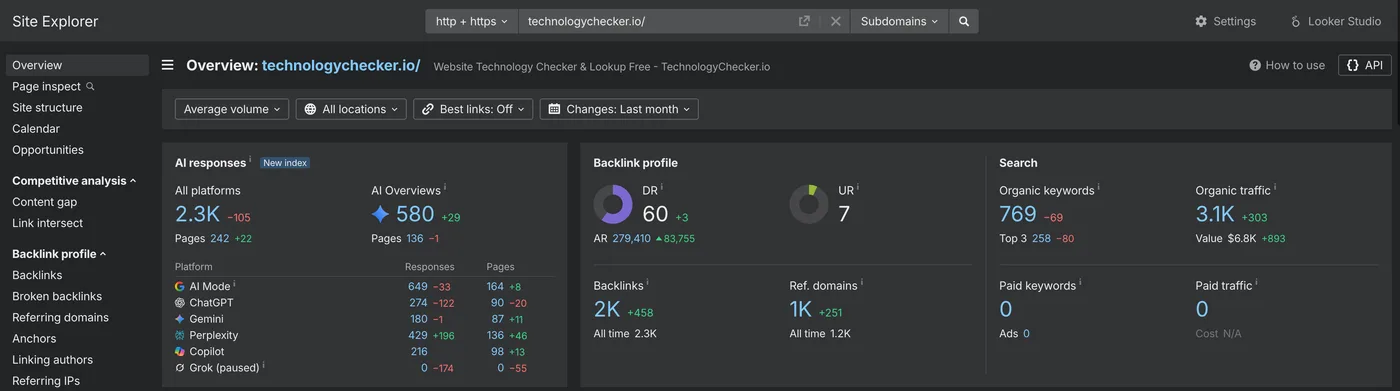
Ahrefs Site Explorer, subdomains mode, captured 6 September 2026. It shows that day's figures (Domain Rating 60, 769 keywords); the October figures above come from Ahrefs' data, pulled on 10 October 2026.
Where the traffic comes from
Measured traffic for September 2026, the second complete calendar month on the analytics property:
Sessions by channel
TinyAnalytics · Sep 2026
| Channel | Sessions | Share |
|---|---|---|
| 15,110 | 52.7% | |
| Direct | 7,815 | 27.2% |
| Bing | 2,499 | 8.7% |
| AI assistants | 995 | 3.5% |
| DuckDuckGo | 702 | 2.4% |
| Total | 28,688 |
AI assistants, by assistant
995
- ChatGPT594
- Gemini269
- Claude76
- Perplexity54
- Other2
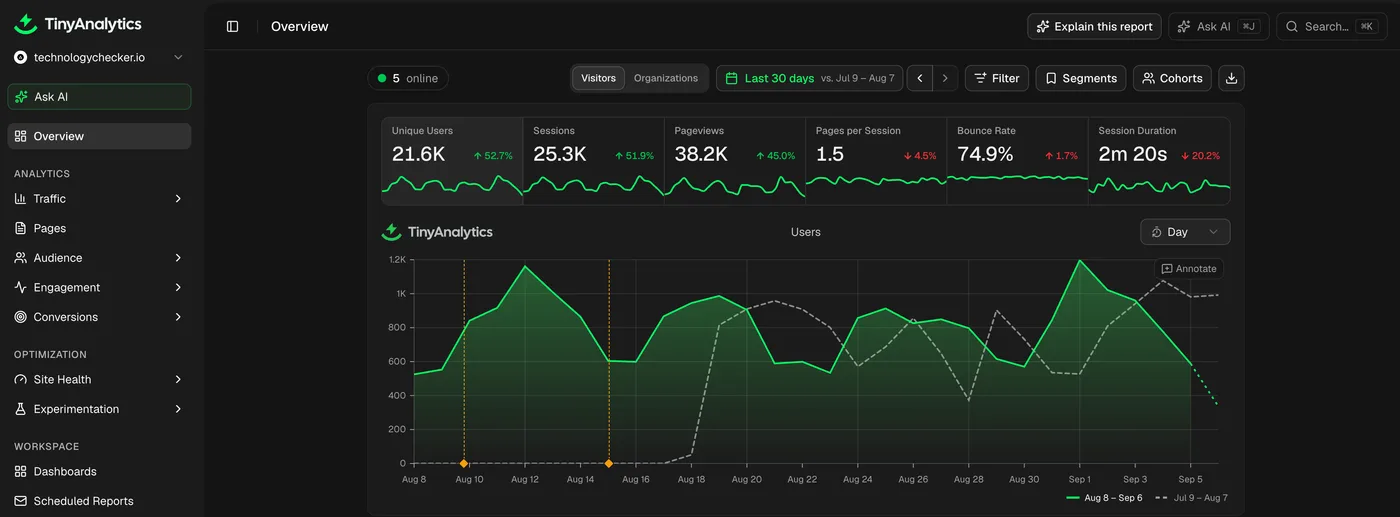
TinyAnalytics, technologychecker.io property, captured 6 September 2026. This view is the rolling 30 days (8 August – 6 September) and reads 25.3K sessions; the window above is the September calendar month, which is why the totals differ.
September is the first month that can be set against a complete month before it. Sessions rose 8.3% on August (26,498 to 28,688), in a month one day shorter. Organic search rose 13.1% (16,805 to 19,007) and google.com 13.3% (13,334 to 15,110).
The AI figure is worth isolating, because it is the part most sites cannot see at all. Across September 2026, AI assistants sent 995 sessions: ChatGPT 594, Gemini 269, Claude 76, Perplexity 54. That is 3.5% of all traffic arriving from surfaces that did not meaningfully exist as referrers three years ago. The total barely moved from August's 979, but the mix did: ChatGPT and Gemini grew (from 534 and 202) while Claude and Perplexity fell (from 164 and 72).
How these numbers were measured
Every figure above is reproducible, and the two sources deliberately disagree.
Traffic comes from TinyAnalytics on the technologychecker.io property, for the calendar months of August and September 2026. That property began collecting on 19 July 2026, so August is the first complete month and July is left out of every comparison: it covers 13 days, and setting it beside a full month would overstate growth by roughly the ratio of the two windows. The August figures were pulled again on 10 October 2026 and match what this story first published.
Links, keywords, and rankings come from Ahrefs Site Explorer in subdomains
mode, checked 10 October 2026; the rankings window shows US results. Anyone with
an Ahrefs seat can pull the same rows. Ahrefs revises its history as it recrawls:
its monthly series now reads 1,347 referring domains on 1 September, above the
1,019 live count this story quoted on 6 September. Every figure here is the live
count on the day it was checked. The domain age is from the public whois
record: technologychecker.io was created 2025-08-20.
AI citations come from Ahrefs' count of AI answers that cite the domain, pulled for 6 September and 10 October so the two are compared like for like. The screenshot's "580 AI Overview responses" is a figure from the Ahrefs interface that its data doesn't reproduce, so it isn't compared with anything.
Both screenshots are unretouched captures taken on 6 September 2026, kept at full width so the target domain and the date range stay legible in frame; the Ahrefs capture drops only its top navigation row, which carries the account label. Dashboards behind a login can only be captured by hand, so these were — neither has been cropped in a way that changes a number. They show that day's figures, not October's.
The two sources do not agree, and that is expected. Ahrefs estimates 5,119 organic visits per month; TinyAnalytics recorded 19,007 organic-search sessions in September. Third-party tools model traffic from a sample of tracked keywords and assumed click-through rates, while analytics counts sessions that actually happened. Neither is wrong — they measure different things. Both are published here rather than only the flattering one, so that a reader who checks the public tool and finds a smaller number knows why.
The outcome
The arc since March is the ordinary one when the diagnosis is right: a link profile that grew roughly twentyfold, a template that earned the right to scale, and a top-three keyword set large enough to carry compounding traffic. The October check also shows what is still open: two lost terms to win back and a link count that has stopped climbing.
The less ordinary part is the 995. TechnologyChecker can now see how much of its demand is being intermediated by AI assistants, split by assistant, month over month — which turns GEO from an article-writing exercise into a number the team can manage against.
Become our next story
Put SEOmator to work on your AI search visibility and see results like these.