


· 16 min read
What is SEO? How it works, tested on 20 real sites
We ran a 251-rule audit on 20 well-known homepages: none scored 100 and the median site failed 13 rules. Learn what SEO is, how it works, and audit yours.
We ran all 41 Google search operators against live Google in July 2026. Only 12 still apply the filter they promise. Here's the tested cheat sheet.

Isabella Edwards · Technical SEO Content Manager, SEOmator
Leads technical SEO content at SEOmator: audits, Core Web Vitals and on-page fixes

How we know this
Full method ↓ Written up by Isabella Edwards
Google search operators are commands you type into the search bar to filter what comes back. We ran all 41 against live Google in July 2026: only 12 still apply the filter they promise, 10 are dead, 13 just trigger an answer panel, and 6 our test couldn't settle. Every status below is dated, because operators change.
So let me introduce you to “Google Search Operators” properly — and to the habit behind this post. The first thing I do with any cheat sheet is re-run every command against live Google, because in the audits I run I keep hitting operators that stopped working years ago. Before you copy a single query from any list — including the one we published here in 2023 — you should know which of these commands Google still honours. Most cheat sheets, this one included, have been teaching operators that Google killed years ago.
Google Search Operators are a set of unique symbols or commands – not unlike a secret code – that you can type into the Google Search bar to get more specific results. These special commands help modify the search algorithm to better tune into the information that you're seeking.
Armed with our Google Search Operators cheat sheet, you won't need to trawl through countless websites to find nuggets of the information you need, rather you'll know exactly how and where to find them.
Here's the trap, though. When Google doesn't recognise an operator, it doesn't throw an error. It silently drops the prefix and runs a plain text search on the remaining words. Results come back, they look plausible, and nothing was filtered. That's how a dead operator sits in a cheat sheet for a decade — Google's own refine web searches documentation lists a fraction of what circulates on SEO blogs.
Every row below was run against live Google (US/English, desktop) on 13 July 2026 with our SERP scraper, each paired with a control query. Statuses:
| Operator | What it's supposed to do | Example | Status (July 2026) |
|---|---|---|---|
| Quotation Marks | Used to search for an exact phrase or sequence of words | "digital marketing strategies" | ✅ Works |
| Minus Sign (-) | Excludes specific words or phrases from search results | SEO techniques -backlinks | ✅ Works |
| Site: | Restricts search results to a specific site or domain | site:nytimes.com COVID-19 | ✅ Works |
| Filetype: | Filters results by specific file type | digital marketing trends filetype:pdf | ✅ Works |
| Intitle: | Searches for terms in the title of web pages | intitle:"SEO techniques" | ✅ Works |
| Intext: | Searches for terms in the body of web pages | intext:"SEO best practices" | ✅ Works |
| Allintext: | Searches for all terms in the body of web pages | allintext:seo audit checklist | ✅ Works |
| Inanchor: | Searches the anchor text of links pointing at a page | inanchor:"seo tools" | ✅ Works |
| AROUND(X) | Searches for words within X words of each other | SEO AROUND(3) Strategies | ✅ Works |
| Double Dots (..) | Used for number range searches | Samsung phone $300..$500 | ✅ Works |
| Before: | Returns pages published before a date | seo news before:2020-01-01 | ✅ Works |
| After: | Returns pages published after a date | seo news after:2026-06-01 | ✅ Works |
| Cache: | Shows the cached version of a web page | cache:google.com | ❌ Dead — 0 results |
| Link: | Finds pages that link to the specified URL | link:seomator.com | ❌ Dead — returns the domain's own pages |
| Info: | Displays some information that Google has about a web page | info:huffpost.com | ❌ Dead — returns a plain brand search |
| Related: | Displays sites similar to the specified web page | related:amazon.com | ❌ Dead — returns the target itself |
| Author: | Searches for content by a specific author | author:"John Doe" | ❌ Dead — 0 results |
| Patent: | Searches for patents | patent:5123123 | ❌ Dead — 0 results |
| ~ | Used to include synonyms or similar terms in a search | ~automobile tips | ❌ Dead — ignored |
| Daterange: | Searches within a specific date range | daterange:2455000-2455100 | ❌ Dead — ignored |
| Phonebook: | Finds phone numbers | phonebook:"John Doe" | ❌ Dead — ignored |
| Plus Sign (+) | Forced a term to be included in results | +seo tools | ❌ Dead — ignored |
| Weather: | Shows weather conditions and forecasts for a location | weather: Prague | ℹ️ Instant answer |
| Stocks: | Shows stock information | stocks:google | ℹ️ Instant answer |
| Movie: | Find information about movies | movie: "Parasite" | ℹ️ Instant answer |
| Define: | Provides definitions of terms | define:marketing | ℹ️ Instant answer — no panel in our test |
| Time: | Shows current time in various locations | time:London | ℹ️ Instant answer — no panel in our test |
| Map: | Shows maps related to the search query | map:New york | ℹ️ Instant answer — no panel in our test |
| Currency: | Converts one currency to another | currency: USD to EUR | ℹ️ Instant answer — no panel in our test |
| Area code: | Searches for the area code of a location | area code:347 | ℹ️ Instant answer — no panel in our test |
| Music: | Find music information | music: Beatles | ℹ️ Instant answer — no panel in our test |
| Book: | Find information about books | book:content strategy | ℹ️ Instant answer — no panel in our test |
| Safesearch: | Filters out explicit content from search results | safesearch:breast cancer | ℹ️ An account setting, not an operator |
| Clinical trials: | Finds information on clinical trials | Clinical trials: Alzheimer's disease | ℹ️ Instant answer — no panel in our test |
| City1 City2 | Searches for pages containing both cities | New York Los Angeles | ℹ️ Instant answer — no panel in our test |
| OR | Matches either term (the vertical-bar shorthand does the same) | seo OR sem tools | ⚠️ Unclear |
| Asterisk (*) | Acts as a wildcard to represent any word or phrase in a search | most important SEO * technique | ⚠️ Unclear |
| Inurl: | Searches for terms in the URL of web pages | inurl:blog ecommerce trends | ⚠️ Relaxed |
| Allinurl: | Searches for all terms in the URL of web pages | allinurl:SEO trends | ⚠️ Relaxed |
| Allintitle: | Searches for all terms in the title of web pages | allintitle:backlink tracking | ⚠️ Relaxed |
| Ext: | Alias for filetype: — filters by file extension | digital marketing trends ext:pdf | ⚠️ Relaxed |
These 12 passed the check: we didn't just confirm that results came back, we confirmed the constraint was applied to them. I've grouped them the way I actually reach for them in an audit.
1. "" (Quotation Marks): Using quotation marks is a simple way to specify an exact phrase match in your Google search. Your search results will include pages with the same words as in the quote.
Example: "digital marketing strategies" will show results where these three words appear together in that same order.
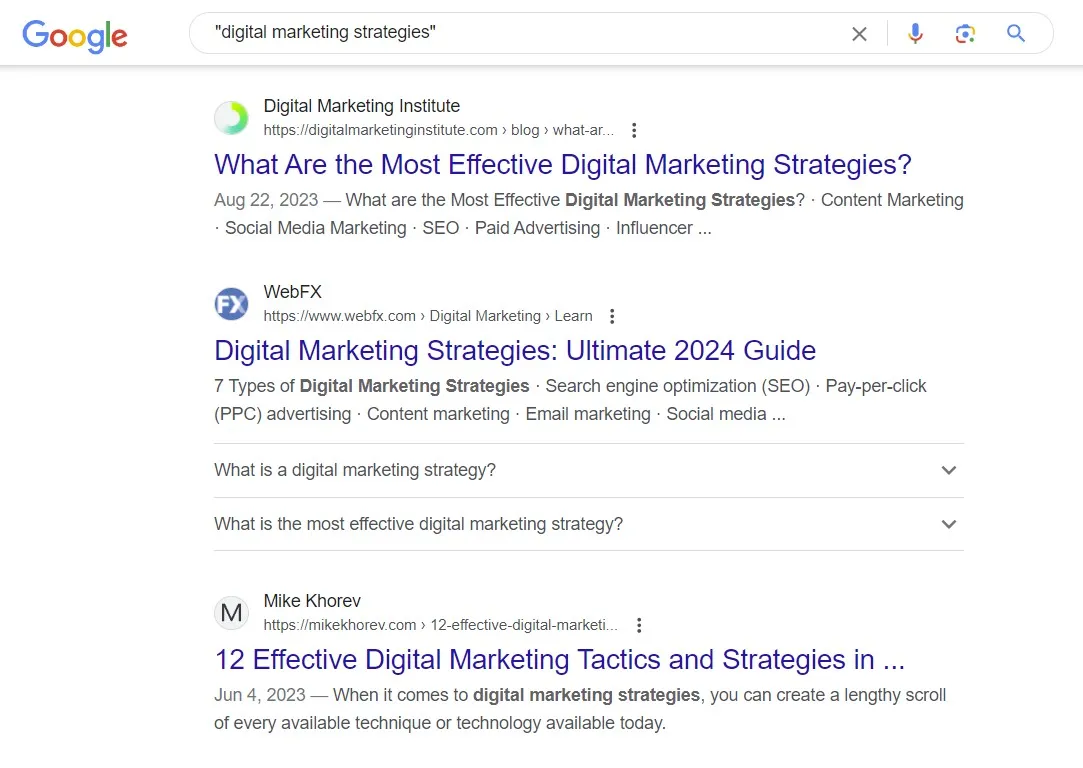
Nine of nine results carried the exact phrase in our July 2026 run. It also replaced the retired + sign: if you need Google to stop swapping a word for a synonym, quote it.
2. (Minus Sign): The minus operator helps exclude a specific word from your search results. Place it directly in front of the word (without any space) that you're trying not to include in search results.
Example: SEO techniques -backlinks will give you information about SEO techniques, but will omit pages that contain the word “backlinks”.
We checked the result bodies: 0 of 8 still mentioned the excluded word. Longer walkthrough: how to exclude a word from Google search.
3. Site: This little operator can be a treasure trove for SEO experts and digital marketers. Use it to search within a specific website.
Example: site:nytimes.com COVID-19 will yield all relevant articles about COVID-19 from The New York Times.
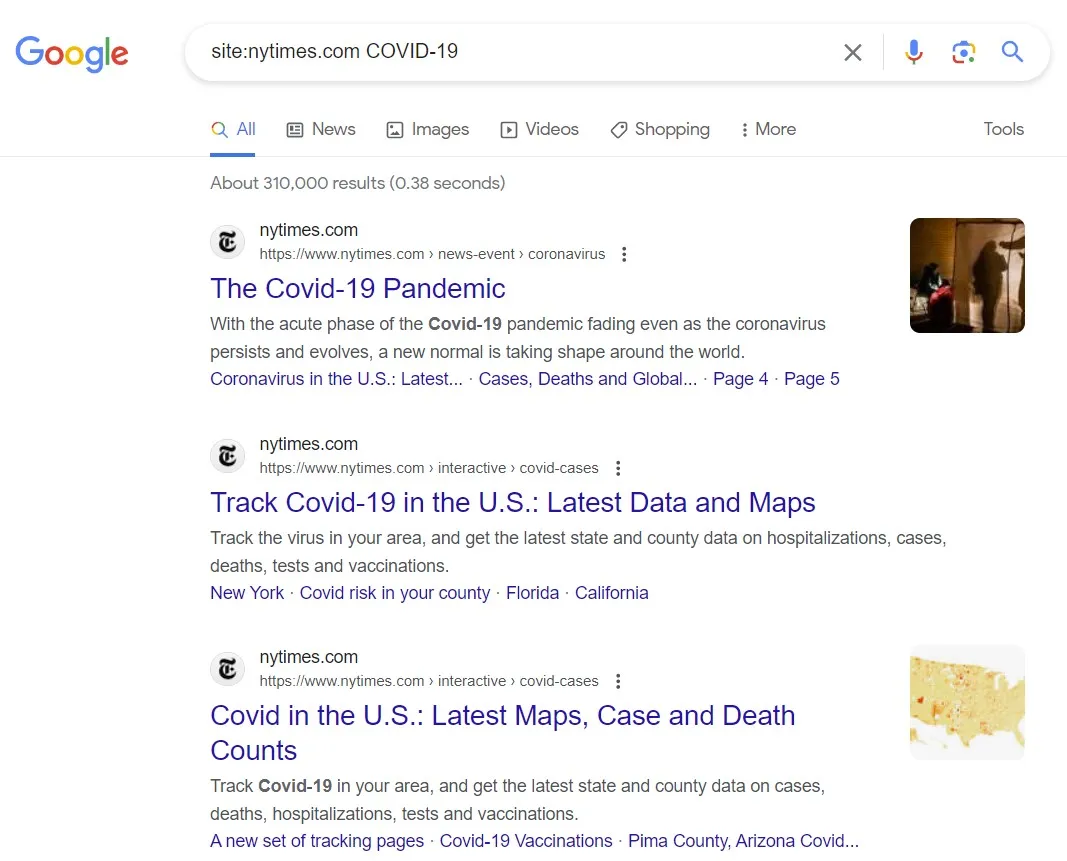
When we ran site:nytimes.com climate, 10 of 10 results were on nytimes.com. The filter is real and it's strict.
4. Filetype: An extremely helpful operator when looking for specific types of files such as pdfs, ppt, xls, doc, etc.
Example: digital marketing trends filetype:pdf will give you pdfs on the mentioned topic.
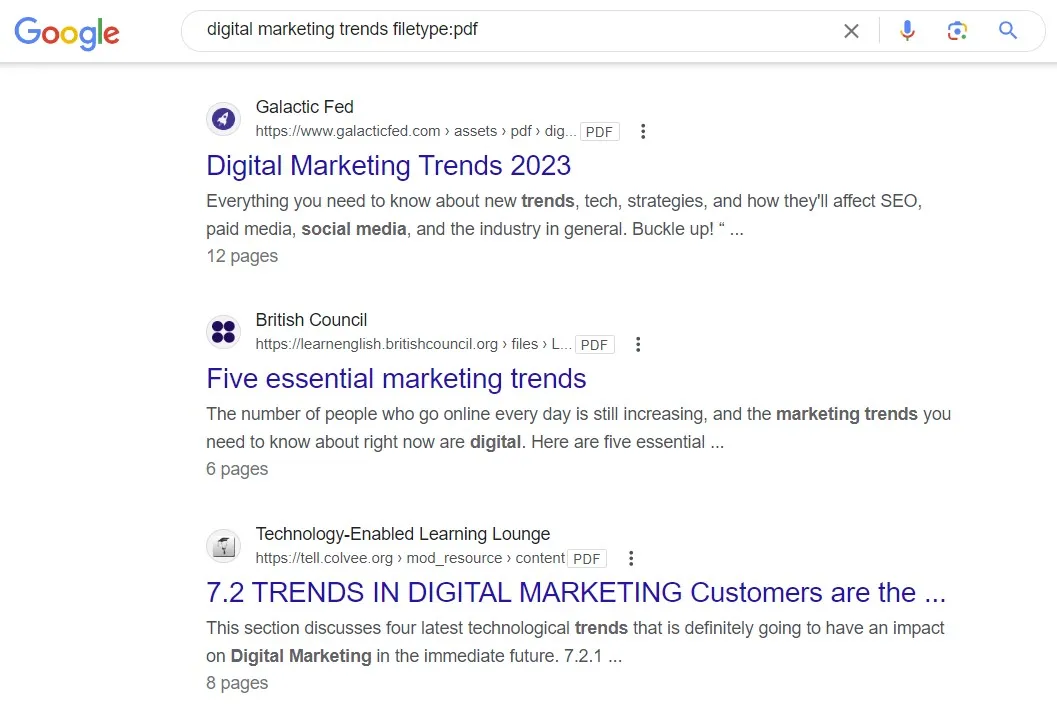
Nine of nine results were PDFs; the control returned zero. Its supposed twin ext: behaved less strictly (6 of 9) — see the unsettled list below.
5. Before: and After: Neither was in this cheat sheet's original list, and both should have been. Each takes a YYYY-MM-DD date, and both filter.
Example: seo news before:2020-01-01 returns pre-2020 coverage; after:2026-06-01 does the reverse.
These are the modern replacement for daterange:, the Julian-date operator half the internet still lists.
6. Intitle: This operator searches for a specific text within the title of a web page.
Example: intitle:SEO techniques will yield pages that have 'SEO techniques' in the title.
Quote the phrase (intitle:"seo techniques") and 10 of 10 returned titles contained it, against 67% in the control.
7. Intext: Use this operator to search for specific text within the body of a web page.
Example: intext:"SEO best practices" will return pages where the specified phrase is in the text of the page.
8. Allintext: Same idea, stricter — every term must appear in the body copy. allintext:seo audit checklist diverged sharply from a plain search for the same words.
9. Inanchor: The term must appear in the anchor text of links pointing at the page. inanchor:"seo tools" returned zero overlap with the control, the strongest signal in our whole test that an operator is doing real work. It's the closest thing Google still gives you to a link-flavoured query. When I want a fast read on how the web anchors a topic before I open a full backlink tool, this is the one native operator I still reach for.
10. .. (Double Dots): Use this operator to specify a range of numbers. For example, it can be quite helpful when searching for products within a certain price range.
Example: Samsung phone $300..$500 will return results for Samsung phones within this price range.
Only 22% of results overlapped with the control, so the range is being applied.
11. AROUND(X): This operator is surprisingly useful but often overlooked. If you want to find two words or phrases within close proximity to each other, AROUND(X) comes in handy. X here is the maximum number of words that can separate the two phrases.
Example: SEO AROUND(3) Strategies will return results where 'SEO' and 'Strategies' are at most three words apart.
Zero overlap with the control. Still alive, still overlooked.
Ten of the 41 are dead, in one of two ways. Six return nothing, or the opposite of what they promise. Four are silently ignored — Google drops the prefix and searches the leftover words as plain text. The second flavour is the more dangerous one, because you get a page of results that looks like it worked. In the audits I run, the silent failures are the ones that bite — I still see people treat link: output as a backlink list when it's only ever a plain search for their own domain. Each entry below quotes what this cheat sheet told you before today, then what actually happens now.
Cache: This operator is used to show the most recent cache of a particular website. Example: cache:google.com will return Google's recent cache.
It doesn't. cache:google.com returned zero organic results in our July 2026 test. Not "fewer results". Zero. Google stripped the cached-page link from the SERP in February 2024 and disabled the operator itself that September — a wind-down Search Engine Land tracked from the first announcement to the final removal. Google now links to the Internet Archive from some results instead.
Use instead: the Wayback Machine for historical snapshots, or your own crawler for a rendered copy of what a page serves today. If you wanted cache: to confirm Google had seen a page, that's an indexation question — use site:yourdomain.com/exact-path/, then read crawled – currently not indexed if it's missing.
Link: This operator will search for sites that link to the specified site URL. Example: link:seomator.com This will find all web pages that link back to SEOmator.
Run link:seomator.com and Google gives you results — that's the whole problem. It gives you seomator.com's own pages, having stripped the prefix and searched the domain name as text. Google publicly killed link: back in 2017.
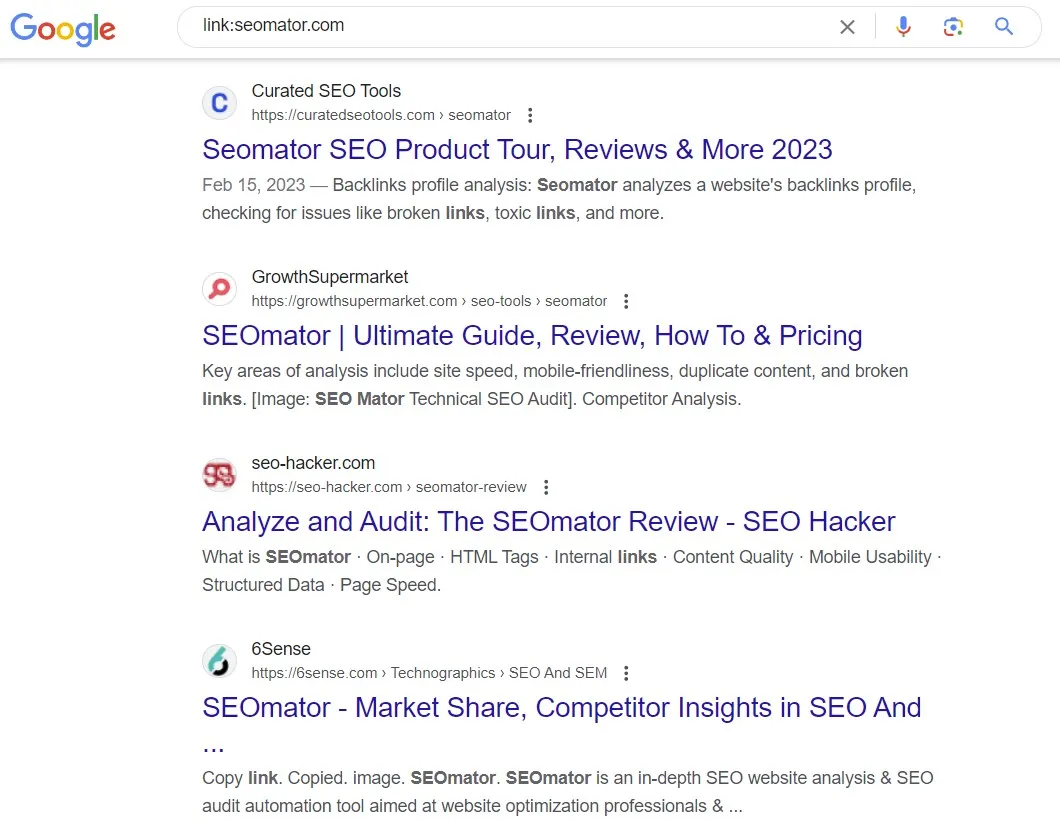 The
The link: query this cheat sheet has been showing since 2023. Run it today and Google hands back the domain's own pages, not its backlinks.
Use instead: a real backlink index. Our backlink checker returns referring domains, anchors and the follow/nofollow split — which is what people were always trying to get out of link:. For "how is this topic linked to?", inanchor: is the surviving native option.
Info: Find information about a particular page. Example: info:huffpost.com
Related: This operator searches for sites that are similar to the site URL you provide. Example: related:amazon.com will yield online shopping sites similar to Amazon.
info:huffpost.com returns a plain brand search — a few huffpost.com pages, plus Wikipedia and X. The operator was removed in 2019.
related: fails more obviously. related:amazon.com returned amazon.com itself in 6 of the 8 results. A working related: never returns the site you asked about; returning the ones you didn't ask about is the entire point.
Use instead: work from the SERP — the pages ranking for your money keywords are your competitors. Use a SERP rank checker to see which domains appear for each target keyword, then compare the recurring competitors.
Author: Searches for content by a specific author. Example: author: John Doe will help you to find books or any kind of documents written by John Doe.
Patent: If you're an inventor or just curious, the patent: operator allows you to search for specific patents. Type patent: followed by the patent number to find it. Example: patent:5123123 will display information about this particular patent.
Both returned zero organic results in our test. author: is a legacy Groups/News operator that no longer functions. For patents, go to Google Patents directly.
~: Use this operator to include synonyms of a specific word in your search. Example: ~automobile tips
Daterange: This operator will show results within a range of dates that you specify. However, you should enter the date format according to the Julian date format which requires the year followed by the number of days since the beginning of the year. Example: helpful content update daterange:22244-2233.
Phonebook: Find phone numbers tied to a specific name. Example: phonebook: "John Doe"
Google doesn't reject any of these. It runs them as plain text. The tilde has done nothing since Google dropped synonym search in 2013 — it's now literally just a character in your query. daterange: no longer filters by Julian date; use before: and after:, which we confirmed still work. phonebook: was retired years ago. And the + sign stopped forcing exact terms in 2011, when Google+ claimed the symbol; quotation marks took over that job.
Thirteen of the 41 entries were never search operators at all. They're instant-answer triggers: they don't filter the index, they ask Google to draw a panel above the results. Listing them next to site: inflates an operator count without helping anyone.
Three still fired a panel for us in July 2026:
Weather: Shows weather conditions and forecasts for a location. Example: weather: Prague ✅
Stocks: Use this operator to get stock information for a particular company. Example: stocks:google ✅
Movie: Use this to search for movie reviews, showtimes, and other related information. Example: movie: "Parasite" ✅
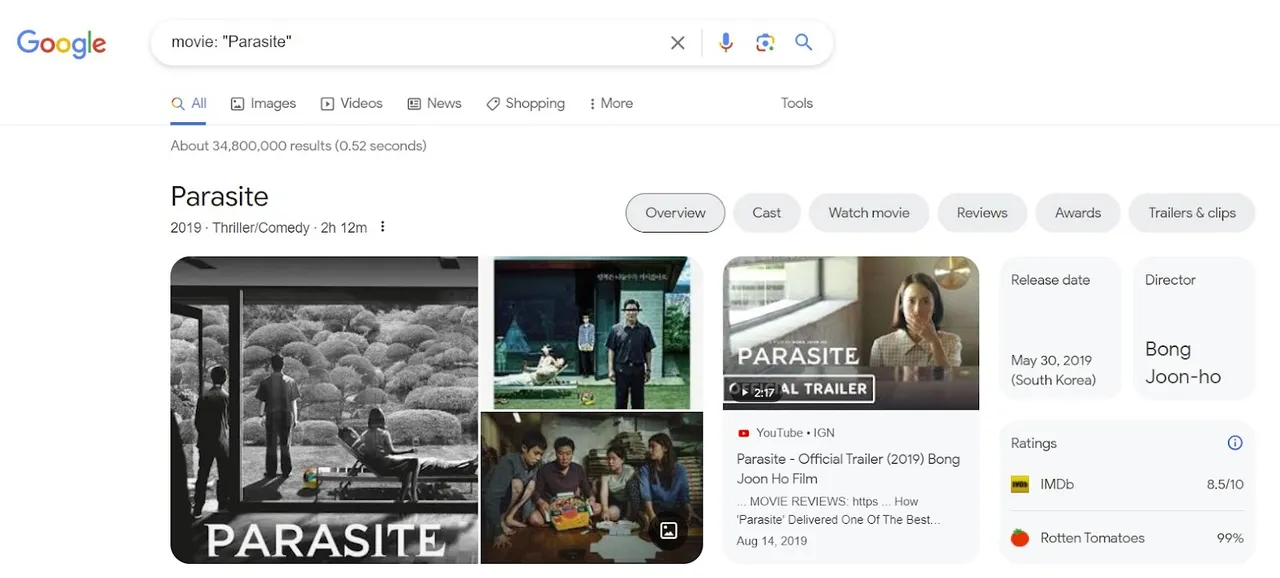
The other ten produced no panel at all — just a normal web search:
Time: Use this to find the current time in a specific location. Example: time:London
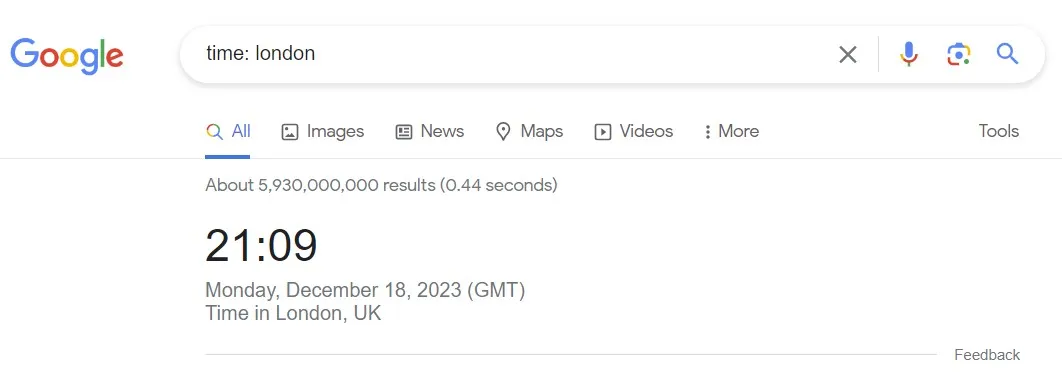
time:London as it appeared when this post was first published. In our July 2026 test, the prefix produced no answer panel.
Map: If you want quick geographical information about a place, using the map: operator can be beneficial. Example: map:New york will show the map of New York.
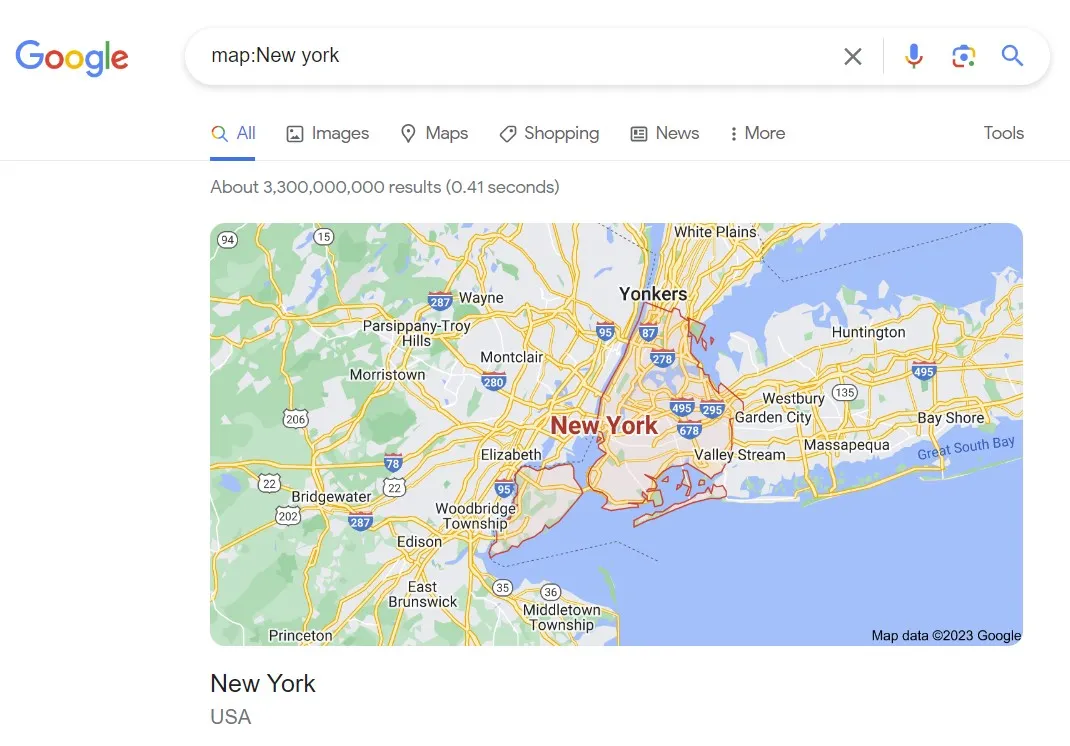 Same story: the map panel didn't fire, and Google returned plain web results.
Currency: Convert between two currencies. Example: currency: USD to EUR
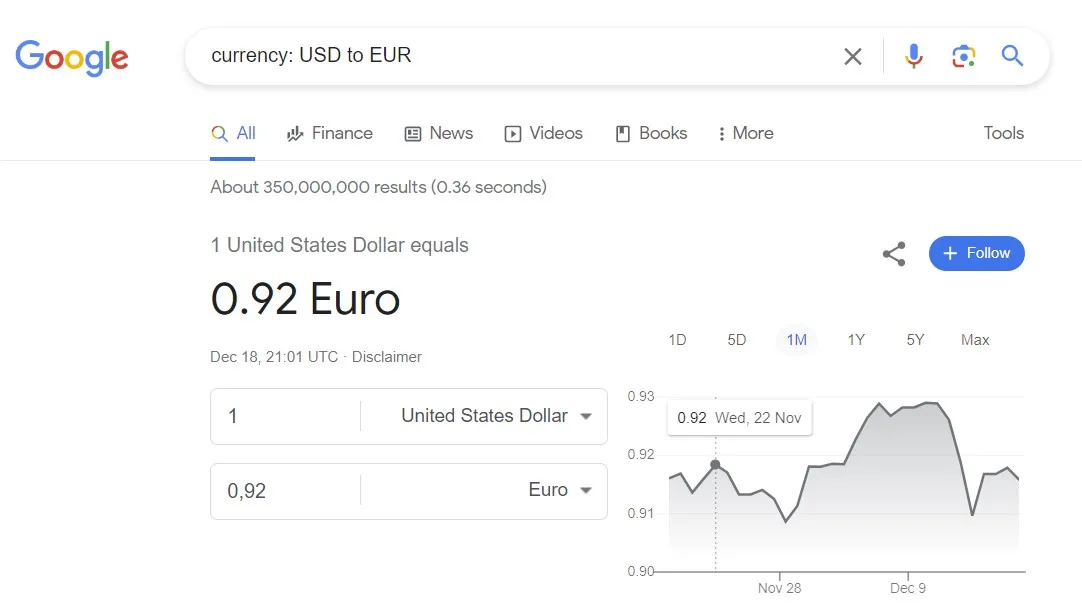 Our
Our currency:USD to EUR run came back 90% identical to a plain search for "USD to EUR" — Google is dropping the prefix. Typing 100 USD to EUR still works fine. The word "currency:" adds nothing.
Clinical trials: This is a niche function for health researchers and medical professionals. Example: Clinical trials: Alzheimer's disease will bring up all clinical trials related to Alzheimer's disease.
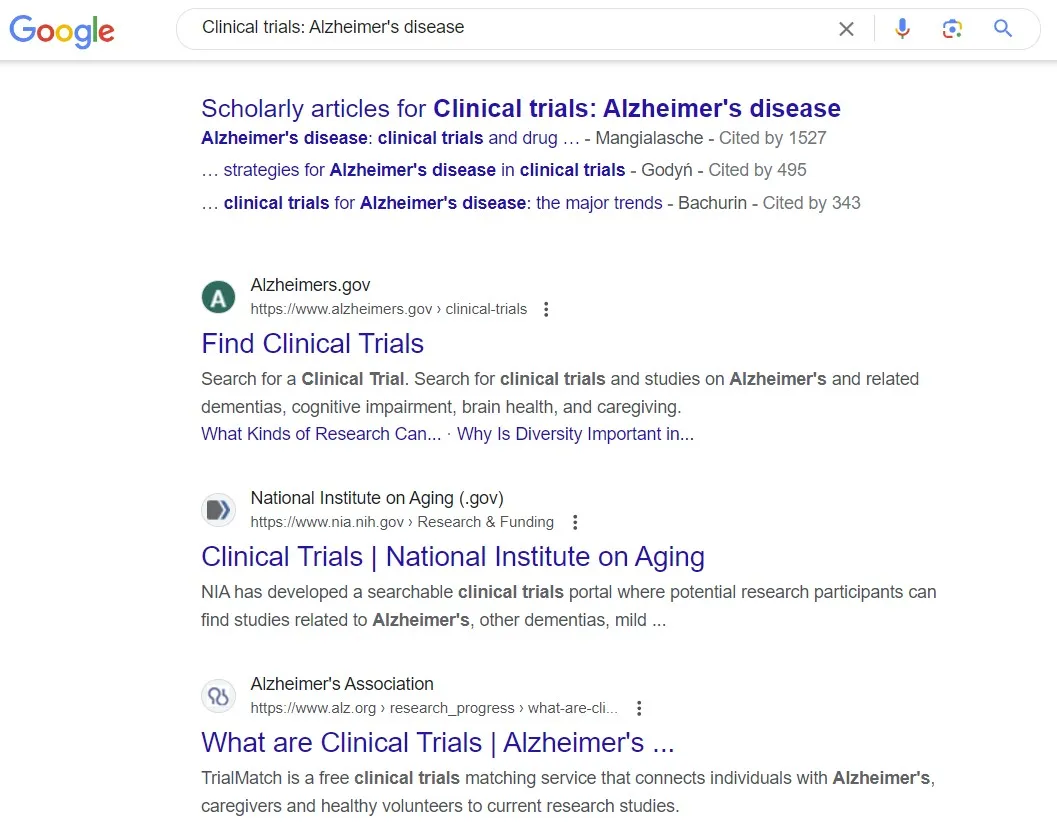 Ordinary web results in our test, not a trials panel.
Define: Use this to look up the definition of a word. Example: define:marketing will give you the definition of marketing. No dictionary panel fired for us.
Book: Search for books relevant to a particular title, topic, or author. Example: book:content strategy
Music: If you're a music lover, you can also use the music: operator to find information about your favorite bands, singers, or albums. Example: music: Beatles will return information about The Beatles.
Area code: Find what area a specific code is tied to. Example: area code:347 — this came back 71% identical to just searching 347.
City1 City2: Input two city names into Google, and the search engine directly offers flight-related data. Example: New York Los Angeles will give real-time flight information between these cities. No panel fired, and 67% of results matched a plain search. This was never an operator, just a onebox.
Safesearch: Filters out explicit content from search results. Example: safesearch:breast cancer will filter out any adult sites that might pop up (due to the inclusion of the word "breast"). Except it won't: SafeSearch is an account and browser setting, not something you type into a query.
Six sit in an honest grey zone. Google documents them as supported, and we're not calling them dead — but our control method couldn't isolate them, so we won't call them confirmed either.
Asterisk (*): This operator works as a wildcard and will be replaced by any word or phrase.
Example: most important SEO * can return “most important SEO techniques”, “most important SEO strategies”, “most important SEO tip”, etc.
Caveat: 70% control overlap. A wildcard inside a natural phrase returns near-identical results to the phrase without it, so the overlap proves nothing either way.
OR: Matches either term, and the vertical-bar shorthand does the same job. Caveat: 67% control overlap — expected, since Google's default matching is already fuzzy.
Inurl: This operator searches for a specific text within the URL.
Example: inurl:blog ecommerce trends will return blogs that mention 'ecommerce trends' in their URL.
Caveat: 5 of 9 URLs contained the term, against 0% in the control. It's clearly doing something — but Google relaxes it rather than filtering strictly.
Allinurl: Searches for all terms in the URL of web pages
Example: allinurl:SEO trends will return only web pages that contain the words “seo” and “trends” in the URL.
Caveat: 6 of 9 URLs contained all terms — the same loose behaviour we saw from allintitle:.
Allintitle: Searches for all terms in the title of web pages.
Example: allintitle:backlink tracking sheet will return only pages that contain the words “backlink” and “tracking” in the webpage title.
Caveat: only 1 of 9 returned titles contained both terms. Google appears to relax this heavily, so treat its output with suspicion.
Ext: The documented alias for filetype:. Caveat: 6 of 9 results were PDFs, against 0 in the control. It works, just less strictly. If precision matters, use filetype:.
The pattern is consistent: the all* operators promise "every term must match" and don't deliver. If you need a hard filter, chain the strict ones instead — intitle:backlink intitle:tracking beats allintitle:backlink tracking.
These are the combinations I actually run in an audit, not party tricks. The indexation-bloat query in the first row is usually the first thing I check on a site I've never seen — one search tells me whether Google has picked up sections that should never have been indexed. Every recipe below uses only operators from the ✅ column, so they'll survive contact with live Google.
| Task | Query | What it surfaces |
|---|---|---|
| Audit indexation bloat | site:example.com -site:example.com/blog/ | Everything indexed outside the section you expected |
| Find indexed parameter or search URLs | site:example.com inurl:? | Faceted and internal-search pages Google shouldn't have |
| Find a competitor's gated assets | site:competitor.com filetype:pdf | Whitepapers, one-pagers, sales decks |
| Find guest-post targets | intitle:"write for us" intext:"SEO" | Sites openly soliciting contributors in your niche |
| Check for scraped or duplicate content | "a full sentence from your page" -site:yourdomain.com | Anyone republishing your copy |
| Find a competitor's newest pages | site:competitor.com intitle:pricing after:2026-01-01 | What they've shipped this year |
| See how the web anchors a topic | inanchor:"seo audit" -site:yourdomain.com | The pages earning links for your phrase |
Three rules from running these. No space after the colon — site: example.com is not site:example.com, and it's the most common syntax error there is. Add operators one at a time, because a four-operator query that returns nothing won't tell you which constraint broke it. And operators query the index; they don't audit your site — when a site: search says something is wrong, hand the question to a crawler and our free SEO audit tool. (Chasing subdomains? We covered whether Google indexes subdomains separately.)
Yes — more than they did a year ago, in my experience. Operators query the classic index, which is exactly the layer AI is pushing out of view. In a Pew Research Center study of 900 U.S. adults, people clicked a traditional result on just 8% of visits that showed an AI summary, against 15% of visits without one — and most of the people studied hit at least one AI Overview that month. When the summary eats the top of the page, a precise site: or intitle: query is how you get back to the pages themselves.
Operator-heavy queries also tend to suppress AI Overviews: strings like site:, filetype: and quoted phrases read as a research intent Google rarely answers with a generated summary. If one still fires, append &udm=14 to the results URL to drop into Google's "Web" view — the plain ten-blue-links mode with no AI panel, available since May 2024. It isn't a hard switch (personalisation can still trigger a summary), but paired with a strict operator it's the most reliable way to see the raw index. If AI Overviews are reshaping the queries you care about, our AI Overview keyword checker flags the terms where Google answers before anyone clicks.
The run. On 13 July 2026, our SERP scraper ran all 41 operators against live Google — US/English, desktop, top 10 results per query. We used the same example queries this cheat sheet has always taught, so we were testing the actual advice.
The control. Every operator query was paired with a control query: the same words, operator stripped. This is the part that matters. Because Google silently drops unrecognised operators, "results came back" proves nothing. If the operator query and the control return substantially the same pages, Google is running a plain text search. We treated 60%+ overlap as strong evidence the prefix was being dropped.
The constraint check. Where an operator makes a checkable promise, we verified it on the returned results: are all 10 results actually on that domain (site:)? Actually PDFs (filetype:pdf)? Does the phrase appear in each title (intitle:)? Does the excluded word appear in zero results (-term)? Do the results exclude the target site, as a working related: must?
The limits. This is one dated snapshot. Results vary by region and language — we tested US/English, so for another market see how to see Google search results for other locations. They vary by personalisation: a logged-in browser is not a scraper. And they vary over time, because Google changes operator support without announcements. That's why every claim here carries a date, and why the six unclear operators stay unclear.
Some do. Of the 41 we ran against live Google in July 2026, 12 verifiably applied the filter they promise: site:, filetype:, intitle:, intext:, allintext:, inanchor:, quotation marks, the minus sign, .., AROUND(X), before: and after:. Ten were dead, 13 were instant-answer triggers, and six our control method couldn't settle.
No. cache:google.com returned zero organic results in our July 2026 test. Google retired it in September 2024 and removed the cached-page link from the SERP too. Use the Wayback Machine for a historical copy, or crawl the page for a current rendered one.
You need a backlink index — Google no longer exposes one through search. link:seomator.com returns seomator.com's own pages, because Google drops the prefix and searches the domain as plain text. Run the domain through a backlink checker instead, for referring domains, anchors and the follow/nofollow split.
before: and after:, both of which take a YYYY-MM-DD date and both of which we confirmed still filter. site:example.com after:2026-01-01 is the pattern you actually want.
They're documented as aliases, but they didn't behave identically for us. filetype:pdf returned 9 of 9 PDFs; ext:pdf returned 6 of 9 on the same query. Both beat the control, which returned zero PDFs — so ext: works, just less strictly.
Because that number is an estimate, not a count. Google generates it from a sample rather than by counting the index, and it swings between refreshes. Treat it as an order-of-magnitude signal, and get the real number from a crawl plus Search Console.
Same syntax, different intent. "Google dorking" is the security-research practice of chaining operators — usually site:, inurl: and filetype: — to surface exposed files, admin panels and misconfigured directories. Only the target changes, so every status above applies to both uses.
Six: site:, filetype:, intitle:, intext:, quotation marks and the minus sign. Add before:/after: when you need a date window, and inanchor: when you care how the web links to a topic. Quote multi-word phrases (intitle:"seo techniques") and skip allintitle: — only 1 of 9 titles contained every term in our test.
After running all 41, the takeaway I keep coming back to is this: Google is still a precise tool if you know how to ask it. Some of these operators seem niche, but they're the ones I'm glad to have when a job needs them — and a third of the commands you've been told about will quietly do nothing at all.
The objective here is not about memorizing all these operators, but about understanding their functionality, and knowing how to apply them when required. With the help of these useful commands, you can uncover valuable insights about the competition for your chosen keywords, boost your link building, get new content ideas, understand user behavior and optimize your SEO performance.
Google is continuously evolving its search operators, adding new features and finessing existing ones, and remaining updated is a part of our learning curve. That's why this page now carries a test date instead of a promise. Bookmark the table, check the date on every other operator list you read, and remember where the operators stop: they show you what Google has indexed, never what Google couldn't reach. Your pages are more visible to your target audience only if a crawler can get to them in the first place.
💡_You might want to read:_
- How to Search Keywords on a Website
Who wrote it, what changed and how to tell us about a mistake.

Isabella Edwards
Technical SEO Content Manager, SEOmator
Leads technical SEO content at SEOmator: audits, Core Web Vitals and on-page fixes
Isabella Edwards leads technical SEO content at SEOmator, turning crawl data, Core Web Vitals, and on-page signals into guidance teams can actually act on. She focuses on the practical side of search — auditing sites, fixing what holds rankings back, and explaining the reasoning behind each recommendation so non-specialists can follow along.
Published · Updated
Spot a mistake or a number that has gone stale? Tell us. We correct it and log the change in the History above. Report an error →
SEOmator plans and pricing
Most of this cluster ends in the same question: what does the tooling cost? Here is every plan, side by side.
SEOmator plans and pricing· 16 min read
We ran a 251-rule audit on 20 well-known homepages: none scored 100 and the median site failed 13 rules. Learn what SEO is, how it works, and audit yours.

· 11 min read
Learn 9 proven methods to detect what CMS any website uses in 2026. Compare top tools like SEOmator, TechnologyChecker.io, Wappalyzer & BuiltWith with accuracy data and sales intelligence features.


